Why Use VBMT160404/08 CM UP2115 Inserts for Cast Iron Turning?
Author : Surya makeyoueasy | Published On : 24 Sep 2026
Introduction
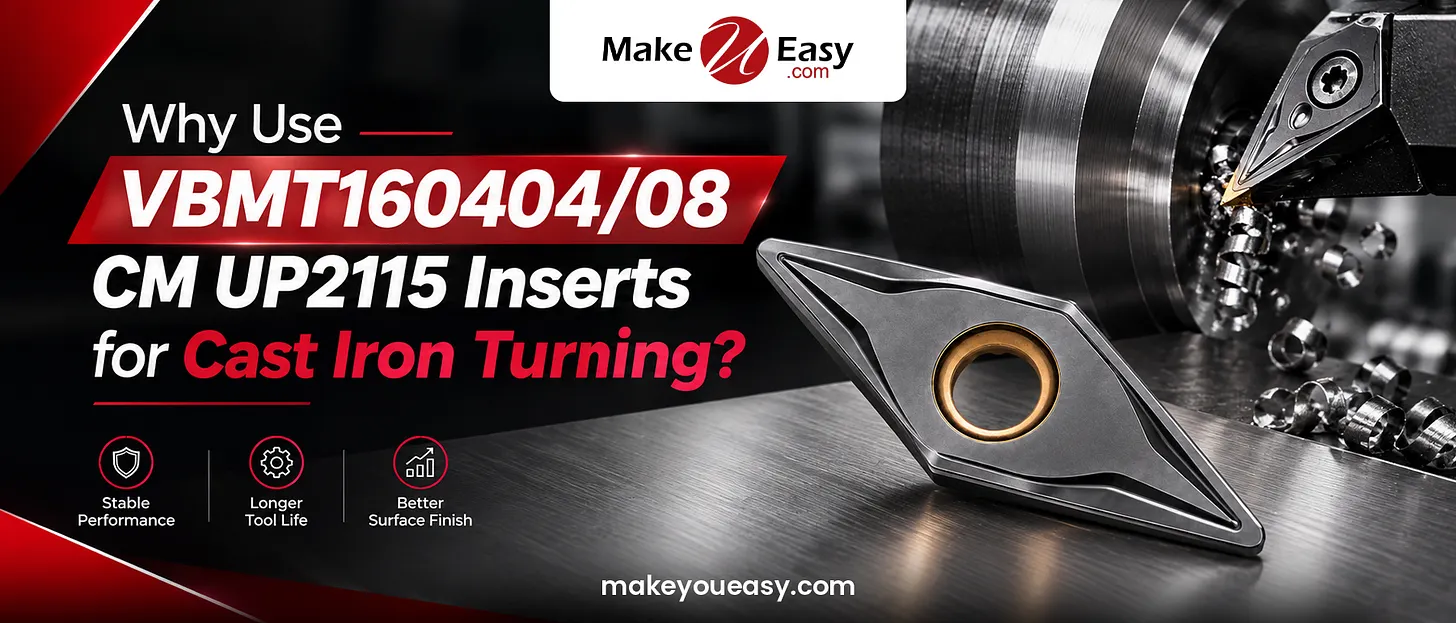
Turning cast iron requires an insert that can handle abrasive wear while maintaining a stable cutting edge and predictable chip control. VBMT160404/08-CM UP2115 inserts combine a 35° positive rhombic geometry with a cast-iron-focused CM chipbreaker and carbide grade. Similar VBMT-CM designs are specifically listed for grey and ductile cast iron, making this insert family suitable for general cast iron turning, facing, profiling, and finishing operations.
What Is VBMT160404/08-CM?
VBMT is a 35° positive rhombic turning insert with a 5° clearance angle. The 1604/08 size family has a 9.525 mm inscribed circle, 4.76 mm thickness, and either a 0.4 mm or 0.8 mm corner radius.
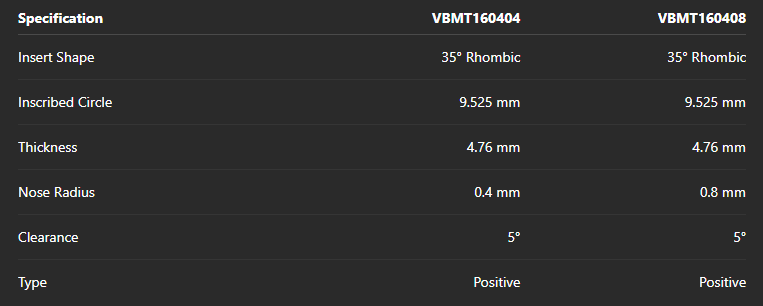
The 0.4 mm radius generally suits lighter finishing and profiling, while the 0.8 mm radius provides a stronger edge for more demanding cuts when the setup permits.
Why Is the CM Chipbreaker Important?
The CM geometry is designed specifically around cast-iron machining requirements.
Tungaloy’s VBMT-CM family describes the geometry as a positive 5° relief, M-class, 35° rhombic insert for multi-purpose cutting of grey and ductile cast iron. Its published example uses a TiCN + Al₂O₃ coating and carbide substrate.
A suitable cast-iron chipbreaker helps:
-
Control the chips produced during turning
-
Maintain a stable cutting edge
-
Reduce uncontrolled chip flow
-
Support consistent machining
-
Improve surface quality
The exact performance of UP2115 should still be confirmed against its manufacturer’s current grade data.
1. Suitable Geometry for Cast Iron Turning
The 35° VBMT shape provides a relatively sharp positive cutting geometry.
This makes the insert useful for:
-
External turning
-
Facing
-
Profiling
-
Shoulder transitions
-
Finishing
-
General-purpose cast iron machining
Positive geometry can also help reduce cutting forces compared with heavier negative geometries, which can be useful on smaller or less rigid machines.
2. Choose Between 0.4 mm and 0.8 mm Radius
The final two digits in VBMT160404 and VBMT160408 indicate different nose-radius options.
VBMT160404
The 0.4 mm nose radius is useful when:
-
Finishing is important
-
Smaller profiles are required
-
Lower cutting loads are preferred
-
The component contains tighter contours
VBMT160408
The 0.8 mm nose radius offers a larger cutting edge radius and can provide greater edge strength.
It is useful when:
-
The cut is more demanding
-
A stronger edge is required
-
Higher feed is appropriate
-
Surface geometry allows the larger radius
A larger radius is not automatically better. Match it to the component profile, feed, depth of cut, and machine rigidity.
3. Why Use UP2115 Grade?
The grade is as important as the insert geometry.
For cast iron, the grade needs to balance wear resistance, edge stability, toughness, and cutting temperature resistance.
Before purchasing UP2115, verify that the grade’s current manufacturer data specifically covers your cast iron type and cutting conditions.
This is important because grey cast iron and ductile cast iron do not necessarily produce identical cutting behaviour. Current cast-iron-specific VBMT-CM products are explicitly categorized for both grey and ductile cast iron, illustrating the importance of application-specific grade selection.
4. Benefits for Grey Cast Iron
Grey cast iron contains graphite flakes and is generally abrasive during machining.
A suitable carbide insert can provide:
-
Good wear resistance
-
Consistent edge performance
-
Predictable tool life
-
Stable dimensional control
-
Efficient turning at suitable cutting conditions
The CM geometry is specifically positioned for multi-purpose grey and ductile cast iron turning.
5. Benefits for Ductile Cast Iron
Ductile cast iron behaves differently because its graphite is present in nodular form.
It can produce different cutting forces and wear patterns compared with grey iron.
When machining ductile cast iron, verify that the selected UP2115 grade and CM geometry are approved for the material and intended operation rather than assuming all cast-iron inserts will perform identically.
VBMT160404 vs VBMT160408
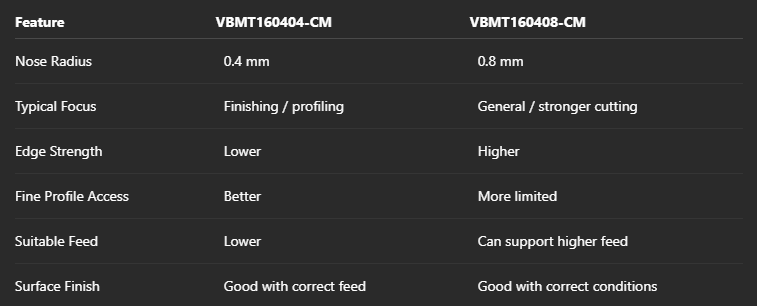
These are general geometry considerations. Actual cutting limits should come from the insert manufacturer’s recommendations.
6. Check Toolholder Compatibility
Before ordering, verify the complete insert and holder combination.
Check:
-
VBMT1604 pocket compatibility
-
Positive 5° clearance requirement
-
Insert orientation
-
Clamping screw
-
Holder hand
-
Nose-radius clearance
-
Toolholder size
VBMT160404 is a standard 35° positive insert format with a 4.4 mm fixing hole in commonly specified designs.
Do not assume that every VBMT holder is automatically suitable for every CM variant.
7. Set the Cutting Conditions Correctly
Cutting speed, feed, and depth of cut should be selected according to:
-
Cast iron type
-
Insert grade
-
Nose radius
-
Machine rigidity
-
Workpiece diameter
-
Roughing or finishing
-
Coolant strategy
For example, one current VBMT-CM cast-iron product lists a 0.05 mm/rev minimum feed, 0.2 mm/rev maximum feed, and 2 mm maximum depth of cut for its specific grade and geometry. These figures are product-specific and should not be transferred directly to UP2115 without confirmation.
Common Applications
VBMT160404/08-CM UP2115 inserts can be considered for applications such as:
-
Grey cast iron turning
-
Ductile cast iron turning
-
External diameter turning
-
Facing
-
Profiling
-
Finishing
-
General-purpose CNC lathe operations
Always confirm the exact UP2115 manufacturer’s application range before machining.
Common Selection Mistakes
Avoid these mistakes when choosing VBMT160404/08-CM inserts:
-
Selecting only by insert size
-
Ignoring the cast iron grade
-
Choosing the wrong nose radius
-
Using an incompatible holder
-
Applying steel cutting parameters to cast iron
-
Using excessive feed with a 0.4 mm radius
-
Ignoring vibration and tool overhang
-
Continuing to run a chipped cutting edge
Why Choose MakeYouEasy?
At MakeYouEasy, you can explore CNC cutting tools and machining accessories for turning, milling, boring, threading, and other industrial applications.
Before purchasing VBMT160404/08-CM UP2115 inserts, verify the complete insert designation, grade, nose radius, chipbreaker, holder compatibility, cast iron type, and recommended cutting parameters.
Conclusion
VBMT160404/08-CM UP2115 inserts are designed around the requirements of cast iron turning, where abrasive wear, chip control, and edge stability are important. The VBMT 35° positive geometry provides a useful combination of accessibility and cutting efficiency, while the 0.4 mm and 0.8 mm nose-radius options allow the insert to be matched to different machining requirements.
For reliable results, select the correct grade, CM geometry, nose radius, holder, cutting speed, feed, and depth of cut for the actual cast iron application. A correctly matched insert system can improve tool life, surface finish, dimensional consistency, and machining productivity.
Frequently Asked Questions
1. What are VBMT160404/08-CM inserts used for?
They are positive turning inserts intended for suitable cast iron turning applications.
2. What is the difference between VBMT160404 and VBMT160408?
VBMT160404 has a 0.4 mm nose radius, while VBMT160408 has a 0.8 mm nose radius.
3. Can CM geometry be used for ductile cast iron?
Yes, cast-iron-specific VBMT-CM families are available for both grey and ductile cast iron.
4. What does the CM chip breaker do?
It is designed to support chip control and cutting performance during cast iron machining.
5. How do I choose between 0.4 mm and 0.8 mm nose radius?
Choose 0.4 mm for finer profiling and finishing requirements and 0.8 mm when greater edge strength is appropriate.
Popular Search Keywords
VBMT160404 CM UP2115 Inserts, VBMT160408 CM UP2115 Inserts, VBMT CM Cast Iron Inserts, UP2115 Turning Inserts, VBMT160404 Cast Iron Insert, VBMT160408 Cast Iron Insert, Cast Iron CNC Turning Inserts, 35 Degree Positive Turning Inserts, Cast Iron Carbide Inserts, Buy VBMT CM Inserts
