Why Use an NPT Thread Mill Holder for Precision Thread Milling?
Author : Surya makeyoueasy | Published On : 14 Sep 2026
Introduction
Producing accurate NPT tapered pipe threads requires precise control of thread geometry, pitch, taper, and cutting position. An NPT thread mill holder provides a rigid and repeatable platform for compatible indexable thread milling inserts, helping CNC machines produce controlled internal or external pipe threads through helical interpolation. When correctly matched with the insert, cutter, CNC program, and workpiece material, an NPT thread milling system can provide excellent flexibility, thread quality, and process control.
What Is an NPT Thread Mill Holder?
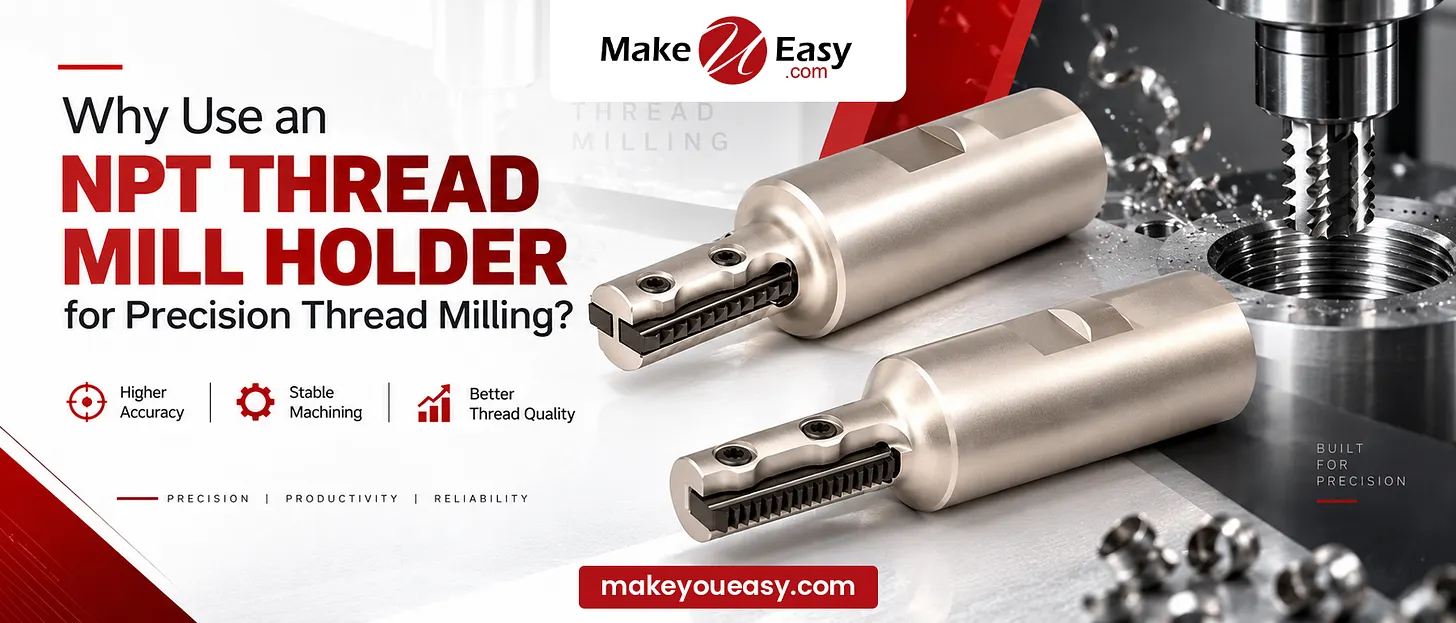
An NPT thread mill holder is a cutting-tool holder or indexable cutter body designed to carry compatible inserts for machining National Pipe Taper (NPT) threads.
NPT threads use a 60° thread form and a nominal 1:16 taper, meaning the diameter changes by 1 unit for every 16 units of axial length.
Unlike conventional tapping, thread milling creates the thread by coordinating:
-
Cutter rotation
-
Circular interpolation
-
Axial movement
This allows a CNC machining center to generate the required helical thread path.
Why Use Thread Milling for NPT Threads?
NPT threads require controlled taper and thread geometry to achieve proper assembly and sealing behavior.
Thread milling provides several advantages for these applications:
-
Controlled CNC toolpath
-
Good thread accuracy
-
Adjustable thread size through programming
-
Lower cutting engagement than tapping
-
Easier machining of larger thread diameters
-
Good chip control
-
Ability to correct thread dimensions through tool offsets
-
Reduced risk associated with a broken tap inside an expensive component
The actual benefits depend on the cutter design, thread size, workpiece material, and machining conditions.
1. Better Control of NPT Thread Accuracy
One major advantage of an NPT thread milling system is CNC-controlled thread generation.
Instead of forcing a full-profile tap through the workpiece, the cutter follows a programmed helical path.
This gives the machinist control over:
Thread Diameter: Tool offsets can be adjusted to influence the finished thread size.
Thread Position: CNC interpolation controls where the thread is generated.
Thread Depth: Axial tool movement controls the threaded length.
Tapered Geometry: The tool and programmed path must correspond to the required NPT specification.
This adjustability is particularly useful when producing precision pipe-thread features.
2. Rigid Insert Support
The holder plays a major role in cutting stability.
A properly designed thread mill holder should locate and support the insert securely during machining.
Rigid insert support can help reduce:
-
Insert movement
-
Vibration
-
Chatter
-
Thread-profile variation
-
Premature insert damage
The insert pocket, screw, and seating surfaces should always be kept clean.
Even a tiny chip underneath the insert can turn a precision thread into a very expensive spiral-shaped headache. ⚙️
3. Replaceable Indexable Inserts
Indexable NPT thread milling systems use replaceable inserts rather than requiring the entire cutter to be replaced when the cutting edge reaches the end of its useful life.
Depending on the tooling system, this can provide:
-
Convenient cutting-edge replacement
-
Reduced tooling replacement cost
-
Multiple insert grades or geometries
-
Easier inventory management
-
Consistent cutter-body reuse
However, insert compatibility must be verified carefully.
An insert that physically fits the holder is not automatically correct for the required NPT thread.
4. Good Choice for CNC Machining Centers
Thread milling is particularly suited to machines capable of synchronized helical interpolation.
NPT thread mill holders may therefore be used in:
-
VMC machines
-
HMC machines
-
CNC milling machines
-
Multi-axis machining centers
-
CNC machines with suitable interpolation capability
Before selecting a holder, confirm that the machine and control support the required thread milling toolpath.
5. Easier Thread Size Adjustment
Thread milling provides a useful advantage when a finished thread requires dimensional correction.
With suitable tooling, small changes can often be made through the CNC cutter compensation or programmed toolpath rather than physically changing the cutter.
This can help compensate for factors such as:
-
Insert wear
-
Tool deflection
-
Material variation
-
Required thread fit
-
Measured thread condition
Adjustments should be made based on proper thread inspection rather than guesswork.
NPT Thread Milling vs NPT Tapping
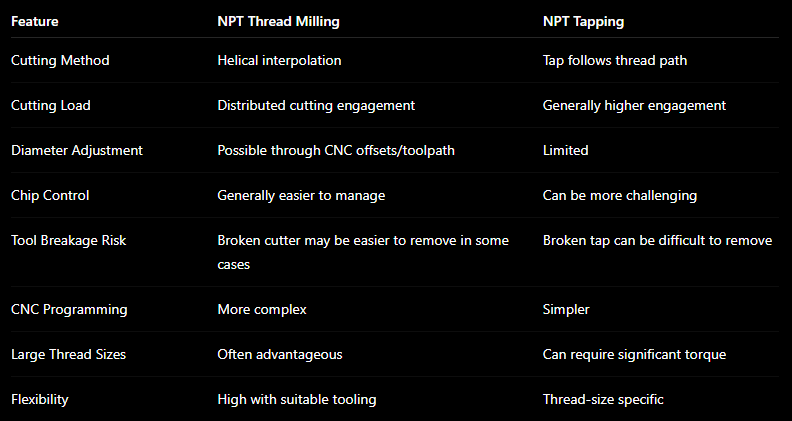
Neither method is universally better. The correct choice depends on production volume, thread size, machine capability, material, and tooling cost.
6. Improved Chip Control
Chip evacuation is especially important when machining internal pipe threads.
Because thread milling does not engage the complete thread circumference in the same way as a tap, chips can be shorter and easier to evacuate in many applications.
Effective chip control helps reduce:
-
Chip recutting
-
Insert damage
-
Surface defects
-
Heat accumulation
-
Thread-profile damage
Coolant or air delivery should be selected according to the workpiece material and the insert manufacturer’s recommendations.
7. Suitable for Different Materials
An NPT thread milling system can be used across different workpiece materials when the correct insert grade and cutting conditions are selected.
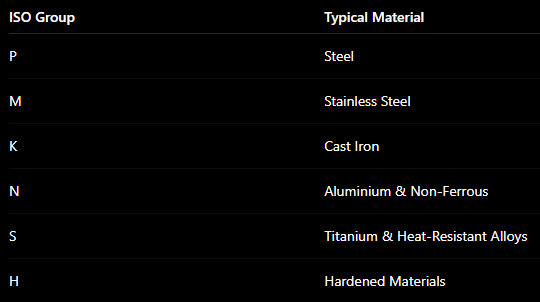
For steel, balance toughness and wear resistance.
For stainless steel, prioritize suitable edge geometry, toughness, and controlled cutting conditions.
For cast iron, wear resistance is especially important.
For aluminium, sharp cutting geometry and good chip evacuation help reduce material adhesion.
Always follow the insert manufacturer’s application recommendations.
8. Internal and External NPT Threading
Thread milling technology can be used for both internal and external threads when the tooling system and CNC toolpath are designed for the required operation.
Before selecting an NPT thread mill holder, confirm:
-
Internal or external thread
-
Nominal NPT size
-
Threads per inch
-
Thread length
-
Minimum bore diameter
-
Cutter clearance
-
Insert designation
-
Right-hand or left-hand requirement
Do not assume that every NPT holder or insert supports both internal and external machining.
9. Choose the Correct NPT Size and Pitch
NPT threads use different pitches depending on the nominal pipe size.
For example, common NPT thread pitches include 27, 18, 14, and 11.5 TPI across different nominal sizes.
Therefore, the insert and holder must be selected according to the required thread specification.
Check the component drawing for:
-
Nominal pipe size
-
NPT designation
-
TPI
-
Thread length
-
Required gauge condition
Never select an insert based only on visual similarity.
10. Check Holder and Insert Compatibility
Before purchasing an NPT thread mill holder, verify the complete tooling system.
Check:
-
Holder designation
-
Insert designation
-
NPT thread range
-
Pitch or TPI
-
Cutter diameter
-
Shank diameter
-
Overall length
-
Number of inserts
-
Insert pocket
-
Clamping screw
-
Machine interface
Using the correct insert-holder combination ensures that the cutting edge is positioned as intended by the tooling manufacturer.
Optimize Cutting Parameters
Correct cutting parameters are essential for reliable NPT thread milling.
Cutting Speed
Select cutting speed according to the workpiece material, insert grade, and coating.
Feed
Program the appropriate feed for the cutter and thread milling strategy.
Radial Engagement
Avoid excessive cutting engagement that can overload the insert.
Toolpath
The programmed helical movement must correspond to the required pitch and thread geometry.
Manufacturer-recommended cutting data should be used as the starting point.
How to Improve NPT Thread Quality
For accurate and repeatable NPT thread milling:
-
Use the correct NPT insert and holder.
-
Verify thread size and TPI.
-
Minimize tool runout.
-
Keep the insert pocket clean.
-
Use rigid toolholding.
-
Minimize unnecessary overhang.
-
Apply suitable cutting parameters.
-
Maintain effective chip evacuation.
-
Use CNC compensation carefully.
-
Inspect the finished thread with the correct gauge.
Precision thread milling is a system. The holder, insert, CNC program, machine, and inspection process all need to speak the same mechanical language.
Inspect the Finished NPT Thread
Because NPT is a tapered pipe-thread system, inspection is essential.
Depending on the application and specification, suitable NPT thread gauges are commonly used to verify the finished thread.
Inspection helps identify:
-
Incorrect thread size
-
Excessive or insufficient thread depth
-
Profile errors
-
Taper problems
-
Tool wear effects
Do not rely only on the CNC program or tool setting to confirm that the finished thread meets specification.
Common NPT Thread Milling Problems
Incorrect Thread Size
Check cutter compensation, insert wear, cutter runout, and programmed toolpath.
Poor Thread Finish
Inspect the insert edge, cutting parameters, rigidity, and chip evacuation.
Insert Chipping
Check cutting load, insert grade, toolpath, vibration, and workpiece material.
Chatter
Reduce unnecessary overhang and verify holder rigidity, spindle condition, and cutting parameters.
Incorrect Thread Fit
Confirm the NPT specification, TPI, toolpath, insert geometry, and gauge inspection procedure.
NPT Thread Mill Holder Selection Checklist
Before purchasing, verify:
-
NPT thread size
-
Required TPI
-
Internal or external application
-
Cutter diameter
-
Shank size
-
Insert compatibility
-
Carbide grade
-
Workpiece material
-
Thread depth
-
Machine capability
-
Tool overhang
-
Coolant requirements
-
Replacement insert availability
Selecting the complete holder-insert-thread combination is more important than choosing the holder by size alone.
Why Choose MakeYouEasy?
At MakeYouEasy, you can explore CNC threading, milling, turning, boring, and machining accessories for industrial applications.
Relevant tooling categories include:
-
NPT Thread Mill Holders
-
Indexable Thread Mill Cutters
-
Thread Milling Inserts
-
Solid Carbide Thread Mills
-
Milling Cutters
-
Turning Inserts
-
Threading Inserts
-
Boring Tools
-
BT Tool Holders
-
CNC Tooling Accessories
Always verify the exact NPT size, pitch, insert compatibility, cutter dimensions, and machine requirements before ordering.
Conclusion
Using an NPT thread mill holder for precision thread milling provides a rigid platform for producing tapered pipe threads through controlled CNC interpolation. Compared with conventional tapping, thread milling can offer greater diameter adjustment, manageable cutting loads, improved chip control, and useful flexibility for precision machining.
For reliable results, select the holder according to the NPT size, TPI, cutter diameter, insert compatibility, workpiece material, and machine capability. Combine it with a rigid setup, suitable cutting parameters, accurate CNC programming, and proper thread inspection to achieve consistent NPT thread quality.
Frequently Asked Questions
1. What is an NPT thread mill holder used for?
It holds compatible thread milling inserts or tooling for producing NPT tapered pipe threads on CNC machines.
2. What is the taper of an NPT thread?
NPT threads use a nominal 1:16 taper along with a 60° thread form.
3. Is thread milling better than tapping for NPT threads?
Thread milling offers CNC diameter adjustment and good chip control, while the best method depends on the application and production requirements.
4. Can an NPT thread mill be used on a VMC?
Yes, when the VMC and CNC control support the required helical interpolation and the tooling is compatible.
5. How do I improve NPT thread milling accuracy?
Use the correct insert and holder, minimize runout, apply suitable cutting parameters, program the toolpath accurately, and inspect the finished thread with the appropriate gauge.
