Why Third Party Veterinary Medicine Manufacturing Is a Smart Way to Launch Your Animal Health Brand
Author : Oxi Pharma | Published On : 20 Oct 2026
Starting a veterinary pharma business used to mean heavy investment in land, machinery, licences and skilled staff. Today, many successful animal health brands begin differently: they partner with a third party veterinary medicine manufacturer and build their business around marketing, distribution and customer relationships. If you have been wondering whether this model is right for you, this article explains the benefits, the challenges and the practical steps to get started.
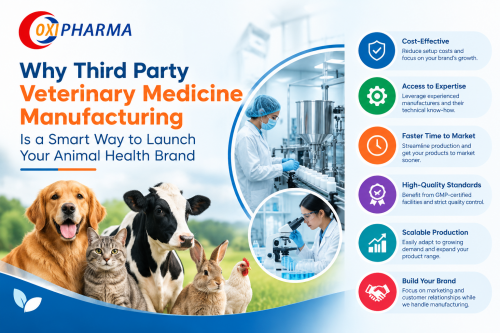
The Business Case: Lower Investment, Faster Launch
Setting up a compliant manufacturing plant takes significant capital and time. You need approved premises, validated equipment, trained personnel, quality systems and ongoing regulatory upkeep. Third party manufacturing removes most of that burden. You pay for production per batch instead of funding a facility, which keeps your risk low and frees cash for the activities that actually generate sales: building relationships with veterinarians, dealers and farmers.
Key Benefits of Working with a Third Party Veterinary Medicine Manufacturer
Lower capital requirement. Without a plant to build and maintain, your startup costs are limited mainly to branding, packaging design, registrations and initial inventory.
Faster time to market. An established manufacturer already has licences, equipment and processes in place. Once formulations and artwork are approved, production can begin in a matter of weeks rather than the years needed to build a facility.
Access to technical expertise. Experienced manufacturers have formulation scientists, quality teams and regulatory know-how. They can suggest improvements to dosage forms, stability and palatability, which is especially useful for products given to livestock in feed or water.
Scalability. As demand grows, you can increase batch sizes or add new products without reinvesting in infrastructure. If a product underperforms, you can discontinue it without stranded assets.
Focus on your strengths. Your time goes into market research, field promotion, veterinarian education and distribution networks, the areas that decide whether a brand succeeds.
Consistent quality and compliance. A good manufacturer follows GMP, tests raw materials and finished products, and keeps batch records. This gives you a dependable quality base to build your reputation on.
Products You Can Launch
The range of veterinary products suitable for contract manufacturing is broad. Common categories include bolus tablets and oral powders for cattle and buffalo, oral liquids and tonics, injectables, antiparasitic products, liver and mineral supplements, poultry premixes and water-soluble products, and pet care formulations for dogs and cats. When choosing your range, consider the species you plan to serve, regional disease patterns, seasonal demand and the competition in your territory. Starting with a focused portfolio of five to ten products is often wiser than launching dozens at once.
Third Party Manufacturing vs. Owning a Plant
Owning a plant gives you full control over production, but it also brings fixed costs, compliance obligations and capacity risks. If volumes are low, the plant sits underused; if demand spikes, you may not have enough capacity. Third party manufacturing converts those fixed costs into variable costs. You gain flexibility, and you can switch or add manufacturing partners as your needs change. For most new and mid-sized brands, outsourcing is the more practical and less risky route. Large companies often combine both approaches, using contract partners for specialised dosage forms or surge capacity.
Common Challenges and How to Manage Them
No model is free of risk. Dependence on a single manufacturer can create supply problems if that partner faces delays, so consider qualifying a backup source for your best-selling products. Quality can vary if oversight is weak, so schedule periodic audits and review batch documents regularly. Intellectual property needs protection; use written agreements that cover formula ownership, confidentiality and brand rights. Finally, poor communication causes avoidable delays, so agree on timelines, points of contact and approval steps at the start.
Steps to Get Started
- Define your target market, species and product list.
- Shortlist manufacturers and verify their licences and certifications.
- Request quotations, MOQs and sample batches.
- Finalise formulations, artwork and a written agreement.
- Complete any registrations or label approvals required in your market.
- Place your first commercial order and prepare your distribution network.
- Review performance after each batch and refine your range.
Conclusion
Third party veterinary medicine manufacturing offers a practical route into the animal health industry: lower investment, faster launches and access to specialist expertise. Manufacturers such as Oxi Pharma, based in Dehradun and focused on veterinary medicines with stringent quality control, show the kind of partner profile worth looking for. Choose carefully, document everything and keep quality at the centre of every decision. With the right third party veterinary medicine manufacturer behind your brand, you can concentrate on what matters most: delivering effective products that support animal health and earn lasting trust in the market.
FAQs
Q1. What are the main advantages of third party veterinary medicine manufacturing? The main advantages are lower investment, quicker launch, access to technical and regulatory expertise, flexible production volumes and the ability to focus on sales and marketing.
Q2. Which veterinary products can be made through contract manufacturing? Common options include boluses, tablets, oral liquids, powders, injectables, antiparasitics, tonics, supplements, poultry premixes and pet care products. Availability depends on the manufacturer’s licences and facilities.
Q3. How long does it take to launch a product? Timelines vary with the product, formulation and approvals required. Established formulations with ready artwork can move faster, while custom formulations or new packaging take longer. Ask your manufacturer for a written timeline.
Q4. How do I protect my formulas and brand in a contract manufacturing agreement? Use a written agreement that states ownership of formulations and brand names, includes confidentiality terms and defines quality responsibilities. A legal professional can review the contract before you sign.
Q5. How much investment do I need to start a veterinary brand through third party manufacturing? The amount depends on your product range, batch sizes, packaging and registrations. Because you do not build a plant, costs are mostly branding, artwork, initial stock and marketing. Ask manufacturers for itemised quotations to plan your budget.
Q6. Can I change my manufacturer later? Yes, but plan for it. Keep formulation records, artwork files and quality documents in your control, and state transfer terms in the agreement, so a move to a new partner does not interrupt your supply.
Q7. Does outsourcing affect product quality? Not when you choose a verified partner. Quality depends on the manufacturer’s GMP compliance, testing and your oversight. Review batch certificates, run periodic audits and keep clear specifications to maintain consistent quality.
