Why Stainless Steel Fasteners Get Stuck During Assembly and How Dry Lubrication Can Help
Author : Jade Chemicals | Published On : 20 Nov 2026
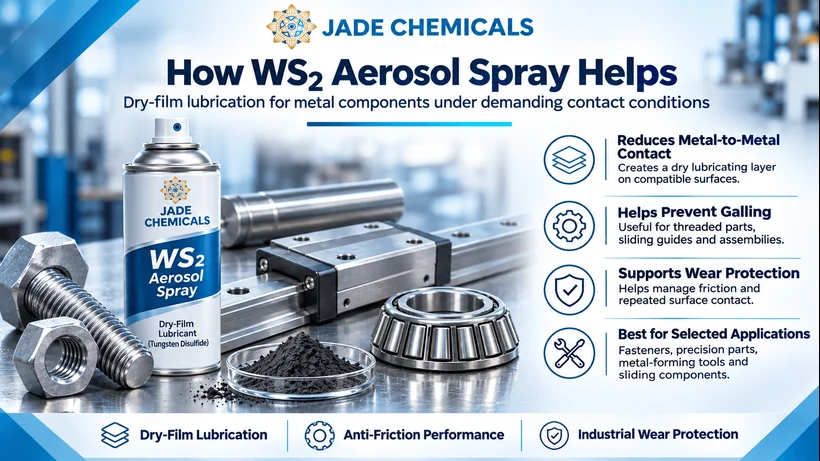
A stainless steel bolt can turn smoothly for the first few rotations and suddenly become difficult to tighten. Applying more force may not help. In some cases, the threads become permanently damaged and the fastener cannot be removed without cutting or drilling.
This is a familiar problem in metal assembly work, especially when stainless steel components are tightened under high contact pressure.
The problem is often associated with galling, a form of adhesive wear that develops when metal surfaces slide against each other.
Understanding why this happens can help manufacturing and maintenance teams choose better assembly practices.
Why Stainless Steel Fasteners Experience Galling
Stainless steel offers useful corrosion resistance, making it suitable for many industrial applications. However, certain stainless steel combinations can be susceptible to galling.
As a bolt turns inside a nut, the contacting threads experience pressure and sliding movement.
At a microscopic level, metal surfaces contain small peaks and irregularities. Under sufficient pressure, some of these points can develop strong adhesive contact.
Continued movement may cause material to transfer between the mating surfaces.
This can damage the thread profile and increase resistance during tightening.
In severe cases, the fastener may seize before the required assembly condition is reached.
Common Situations Where Fasteners Get Damaged
Galling can occur during installation, repeated adjustment and disassembly.
Some of the situations that increase the risk include using unsuitable mating materials, tightening components too quickly and working with damaged or poorly finished threads.
Incorrect clearances and excessive contact pressure can also contribute.
Fasteners used in industrial machinery may undergo repeated maintenance. If the same parts are assembled and removed regularly, surface condition becomes particularly important.
A damaged thread should not simply be forced back into service.
The underlying cause needs attention before another assembly attempt.
Can Lubrication Reduce Thread Damage?
Lubrication can help reduce friction between contacting threads and may lower the risk of adhesive wear.
Different assembly applications use oils, anti-seize compounds, greases or dry-film lubricants.
The correct choice depends on the materials involved, assembly specifications and operating environment.
Tungsten Disulfide, commonly known as WS₂, is a solid lubricant with a layered structure that allows low-friction sliding under suitable conditions.
In an aerosol formulation, WS₂ can be applied to compatible surfaces as a thin dry lubricating film.
This makes it an option worth evaluating where conventional lubricant application is inconvenient or a relatively thin coating is preferred.
However, the finished aerosol formulation must be suitable for the application.
Why Torque Specifications Must Be Checked
Lubrication changes the friction between fastener threads and contacting surfaces.
As a result, the same tightening torque can produce a different bolt preload when the lubrication condition changes.
This matters particularly for critical mechanical assemblies.
Applying a new lubricant without reviewing the specified tightening procedure may lead to an incorrect assembly load.
Maintenance teams should therefore follow the fastener or equipment manufacturer's approved lubrication and torque requirements.
A lubricant should never be treated as a substitute for correct assembly design.
Surface Preparation Before Applying a Dry Film
Before applying a dry lubricant, the component should be inspected.
Threads should be free from obvious damage, loose particles and contamination.
Existing oil or grease may need to be removed according to the coating manufacturer's instructions.
A coating applied over dirt or unsuitable residues may not perform as expected.
The aerosol should be used according to its recommended application method, and the film should be allowed to dry as specified.
For critical components, a controlled assembly trial can help establish whether the product is suitable.
WS₂ Aerosol Spray for Industrial Metal Assemblies
Manufacturers looking for a Tungsten Disulfide (WS2) Aerosol Spray supplier in India can explore Jade Chemicals' information on reducing galling and surface wear in metal components.
Based in Bengaluru, Jade Chemicals supplies specialty industrial lubrication materials, including WS₂ aerosol spray, powders and other products for demanding engineering applications.
Its WS₂ aerosol spray is intended for selected applications where a dry lubricating film may help manage friction and metal-to-metal contact.
The suitability of the product should be confirmed against the component material, loading conditions and assembly requirements.
Fastener galling is not simply a matter of using stronger tools or applying more tightening force. Better thread condition, appropriate materials, controlled assembly and suitable lubrication all contribute to reducing avoidable damage.
When fasteners repeatedly seize during assembly, reviewing these factors can save maintenance time and prevent unnecessary component replacement.
