Why Is Female Hair Transplant Becoming More Popular Among Women?
Author : Dr. Haror's Wellness | Published On : 01 Aug 2026
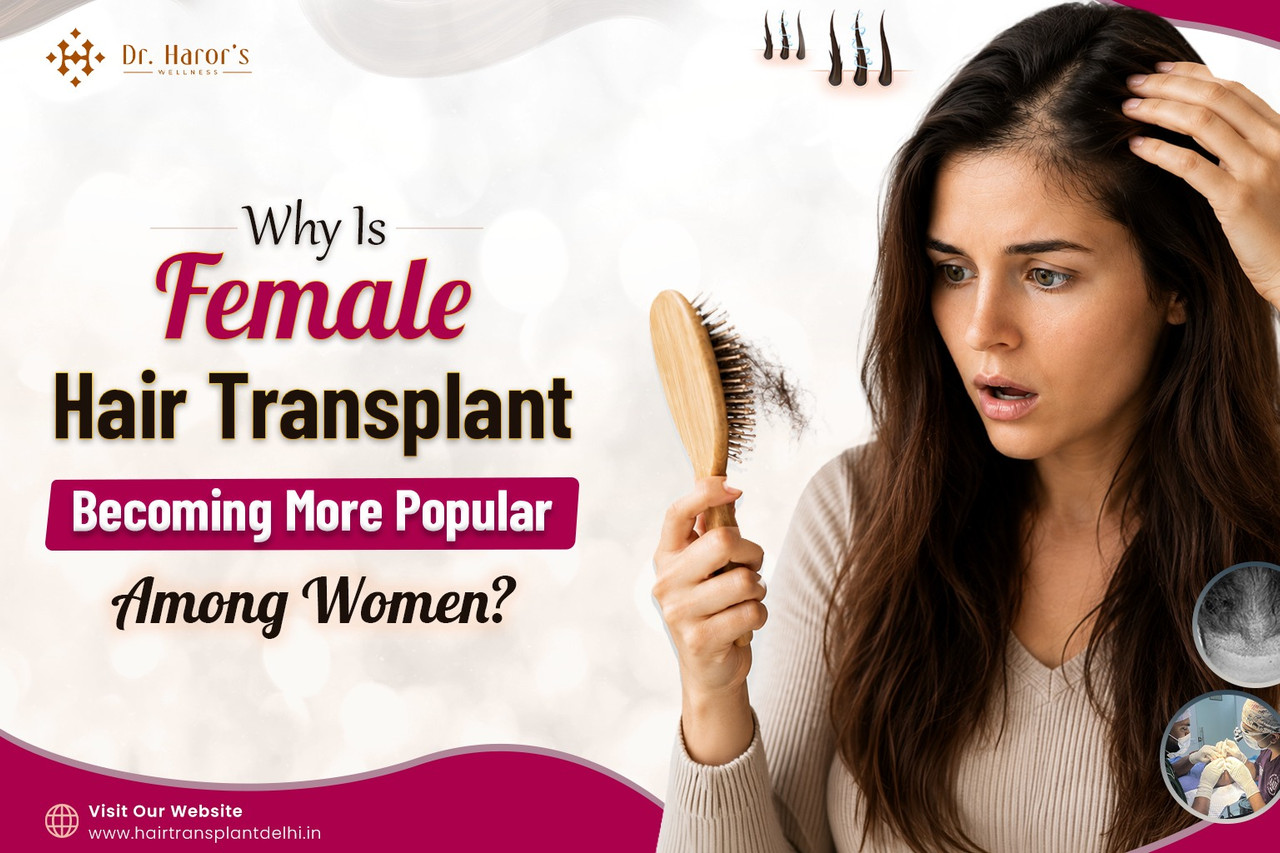
For a long time, hair loss was treated as something that happened to men. Women dealing with it were largely left to figure things out quietly — patting down thinning patches, changing their parting, switching to volumizing shampoos that didn't really do much. The conversation has shifted significantly in recent years, partly because the numbers are hard to ignore. Close to 40% of women experience meaningful hair loss at some point — and that's not a fringe statistic. That's nearly half.
What's also changed is what women are doing about it. A female hair transplant has moved from something whispered about to something openly researched, discussed, and seriously considered. The techniques have improved enough that results look genuinely natural, and more women are deciding that hiding the problem isn't the only option available to them.
Why It's Happening More — and Earlier
Twenty years ago, significant hair loss in a woman in her late twenties would have been considered unusual. Now it's not. Stress levels that most people have just accepted as baseline normal, diets that don't cover nutritional gaps, sleep that's consistently not enough — all of it adds up and shows up in hair health faster than most people expect.
Layer on top of that the biological factors that are specific to women — hormonal fluctuations, postpartum shedding that sometimes doesn't fully reverse, the long-term effects of conditions like PCOS or thyroid imbalances — and you have a situation where a lot of women are dealing with noticeable thinning much earlier in life than their mothers or grandmothers did.
Demand for a female hair transplant has grown steadily because awareness has grown. Women who might have spent years assuming nothing could be done are finding out that something actually can.
What's Behind the Hair Loss
It's rarely just one thing. The more common drivers:
Hormonal shifts. PCOS, thyroid problems, menopause — all of these can disrupt the hair growth cycle in ways that lead to sustained thinning rather than temporary shedding. When the hormonal environment changes, hair is often one of the first places it shows.
Pregnancy and what comes after. Shedding during and after pregnancy is common and usually temporary — but for some women, the thinning doesn't fully reverse. What starts as postpartum hair loss becomes something more persistent that eventually needs proper attention.
Lifestyle factors. Chronic stress is probably the most underestimated one. Combined with irregular sleep and nutritional gaps, it can accelerate thinning in women who might otherwise not have experienced significant hair loss for years.
What a Female Hair Transplant Actually Involves
The basic principle is the same as a male hair transplant — healthy follicles from a donor area get moved to wherever the thinning is happening. But female hair loss is different in character, and that changes how the procedure gets planned and executed.
Men typically lose hair in defined patterns — a receding hairline, a thinning crown. Women usually experience diffuse thinning spread across the scalp rather than concentrated in one area. That means the surgeon has to map both donor and recipient zones much more carefully, and the implantation work requires a level of precision that goes beyond standard hairline transplants.
The techniques used most commonly:
FUE — Follicular Unit Extraction- Individual follicles are pulled out one at a time, kept in a preservation solution, and implanted into the thinning areas. It's slow, meticulous work — but the scarring is minimal and the results look natural when it's done properly.
FUT — Follicular Unit Transplantation- A strip of scalp gets removed and broken down into individual grafts. Still used when a larger number of grafts is needed in a single session — it's more efficient for high-volume cases even though it does leave a linear scar.
What Actually Changes After One
The practical benefits are fairly clear — high success rates, visible regrowth that typically becomes noticeable somewhere between seven and twelve months post-procedure, results that blend with existing hair rather than sitting alongside it awkwardly.
But the less quantifiable part is probably what matters most to the women who've been through it. Hair loss does something to confidence that's hard to fully describe from the outside. It changes how you feel walking into a room, how you feel in photographs, how much mental energy goes into managing and concealing something you'd rather not think about. A female hair transplant doesn't just change how hair looks — it changes how much headspace the whole thing takes up.
One-on-one consultations with surgeons who actually understand female hair loss patterns — not just transplants generally — make a real difference in how the procedure gets planned and how the result turns out. The same goes for proper aftercare. What happens in the weeks and months after the procedure shapes the final outcome as much as the surgery itself.
Conclusion
A female hair transplant isn't about vanity. It's about feeling like yourself — showing up without the constant awareness of what your hair is or isn't doing. For women who've spent years working around the problem rather than addressing it, it's often the first time they feel like they have a real option rather than a workaround. Dr. Haror's Wellness approaches female hair transplant procedures with the specific expertise this hair loss pattern demands — careful planning, precise execution, and post-operative support that doesn't end when you leave the clinic. If you've been thinking about this seriously, book a consultation and find out what's actually possible for your specific situation.
