Why Decision-Making Velocity is New Competitive Advantage
Author : Ayesha Diaz | Published On : 21 Aug 2026
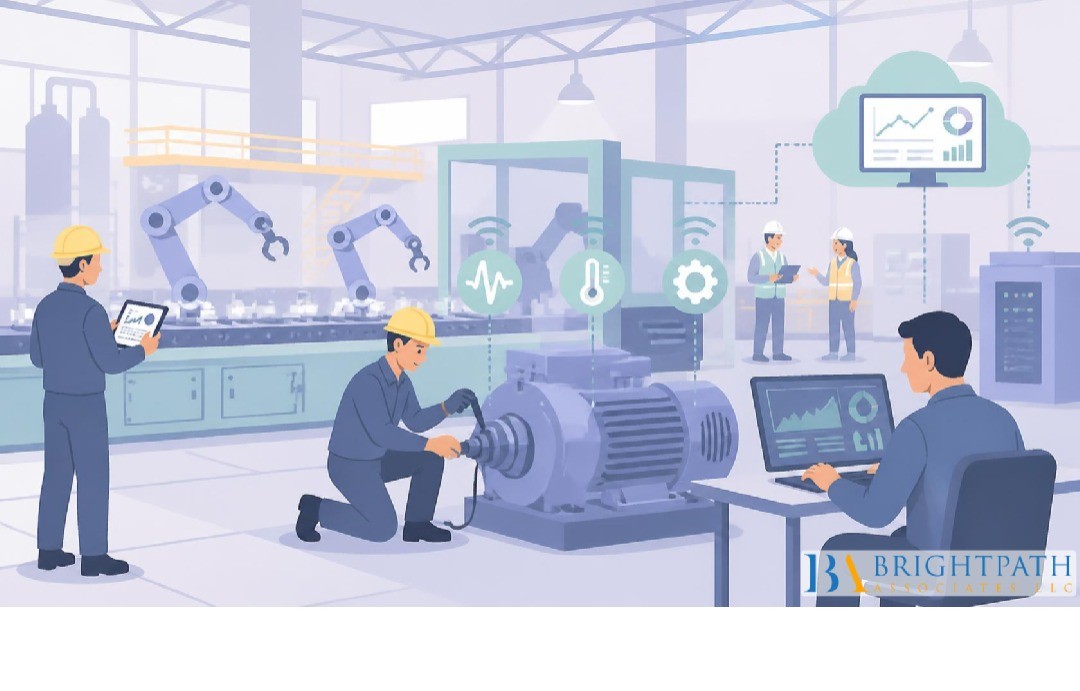
For manufacturers, an unexpected equipment failure can create consequences far beyond the cost of repairing a machine. A single breakdown can interrupt an entire production line, delay customer orders, create overtime expenses, increase scrap, and put pressure on already stretched maintenance teams. For small and mid-sized machinery companies, where resources are often more limited, these disruptions can be particularly difficult to absorb.
This is why predictive maintenance is becoming an increasingly important strategy for modern manufacturing operations. Instead of waiting for machinery to fail or servicing equipment strictly according to a fixed calendar, manufacturers can use sensors, machine data, analytics, and artificial intelligence to identify signs of deterioration before they become major failures. BrightPath Associates has similarly highlighted predictive maintenance as a data-driven approach that can help manufacturers anticipate equipment problems, reduce downtime, and improve asset performance.
Moving From Reactive Maintenance to Predictive Thinking
Traditional reactive maintenance follows a simple pattern: equipment breaks, production stops, technicians investigate the problem, and repairs begin. Although this approach may appear economical when equipment is operating normally, the real cost can become substantial when a critical machine fails unexpectedly.
Preventive maintenance improves the situation by scheduling inspections, component replacements, lubrication, calibration, and other activities at predetermined intervals. Yet scheduled maintenance has its own limitation. A component may be replaced even when it still has significant useful life, while another component could deteriorate earlier than expected.
Predictive maintenance introduces a different philosophy. The objective is to understand the actual condition of equipment and intervene when the available evidence indicates that maintenance is necessary. This can help companies move from a calendar-driven maintenance program toward a condition-driven strategy.
The Data Behind Predictive Maintenance
The effectiveness of predictive maintenance depends heavily on the quality and relevance of machine data. Modern production equipment can generate information about vibration, temperature, pressure, energy consumption, motor current, operating speed, acoustic signals, and other performance characteristics.
Individually, these measurements may not reveal much. When analyzed over time, however, they can establish a baseline for normal equipment behavior. Deviations from that baseline can provide an early indication that something has changed.
For example, an increase in vibration could indicate developing bearing problems. An unusual temperature pattern might suggest excessive friction or cooling-system issues. Changes in energy consumption could signal declining equipment efficiency or mechanical resistance.
IoT Sensors Are Changing Equipment Visibility
Internet of Things technology has made it easier for manufacturers to monitor equipment continuously. Sensors can capture operating conditions and transmit information to centralized systems where engineers and maintenance professionals can analyze it.
This creates greater visibility than periodic manual inspections alone can provide. Instead of checking a machine once during a scheduled inspection, manufacturers can potentially monitor its condition throughout the production cycle.
For smaller manufacturers, the ability to begin with selected critical assets can make predictive maintenance more practical. A company does not necessarily need to instrument every machine on the first day. It can identify equipment where unexpected failure creates the greatest operational and financial risk and begin there.
Artificial Intelligence Can Help Identify Complex Patterns
As manufacturing systems generate more data, artificial intelligence and machine learning can help identify relationships that may be difficult to detect through manual analysis. A predictive model can compare current equipment behavior with historical operating patterns and identify anomalies that may indicate emerging problems. Over time, these models can become more useful as organizations accumulate more operational data and maintenance records.
However, AI should not be treated as a replacement for experienced maintenance and engineering professionals. The most effective systems combine machine-generated insights with human expertise.
An algorithm may identify an unusual vibration pattern, but an experienced engineer understands the production environment, equipment history, operating conditions, and possible causes behind that change. This combination of technology and expertise is particularly important for machinery manufacturers seeking to modernize without losing practical knowledge accumulated by experienced employees.
Predictive Maintenance Can Improve More Than Uptime
The obvious benefit of predictive maintenance is reducing unexpected downtime, but the potential value extends further. Better equipment monitoring can help maintenance teams prioritize work according to actual asset conditions. It can also support more efficient spare-parts planning because organizations have greater insight into which components may require attention.
Production planning can benefit as well. If a maintenance issue is identified early, repairs may be scheduled during planned downtime rather than during an urgent production interruption.
Equipment life can also potentially be extended when developing problems are addressed before they escalate into major failures. This can reduce the frequency of expensive emergency repairs and help organizations obtain greater value from capital equipment.
Integrating Predictive Maintenance With Automation
Predictive maintenance becomes even more powerful when connected to broader industrial automation systems. Modern production environments may include programmable logic controllers, supervisory control systems, manufacturing execution platforms, robotics, sensors, and other interconnected technologies. Bringing maintenance information into this broader digital environment can provide operations teams with a more complete view of production performance.
For companies operating across the Machinery Industry, this integration is increasingly relevant. Machinery manufacturers and users are under pressure to improve productivity, reliability, quality, and responsiveness while dealing with skilled-labor shortages and increasingly sophisticated equipment.
Building a More Resilient Production Operation
That change may appear subtle, but it can fundamentally alter how production teams manage assets. The goal is not to eliminate every equipment failure. No predictive system can guarantee that. The goal is to identify developing risks earlier, make better maintenance decisions, reduce avoidable disruptions, and create a more resilient production environment.
For a deeper discussion of implementing predictive maintenance across production lines, explore Implementing Predictive Maintenance on Production Lines. As machinery manufacturers continue adopting connected equipment, AI, industrial IoT, and advanced automation.
