Why Ball Nose End Mill Cutters Are Used for Curved Surface Machining
Author : Surya makeyoueasy | Published On : 18 Sep 2026
Introduction
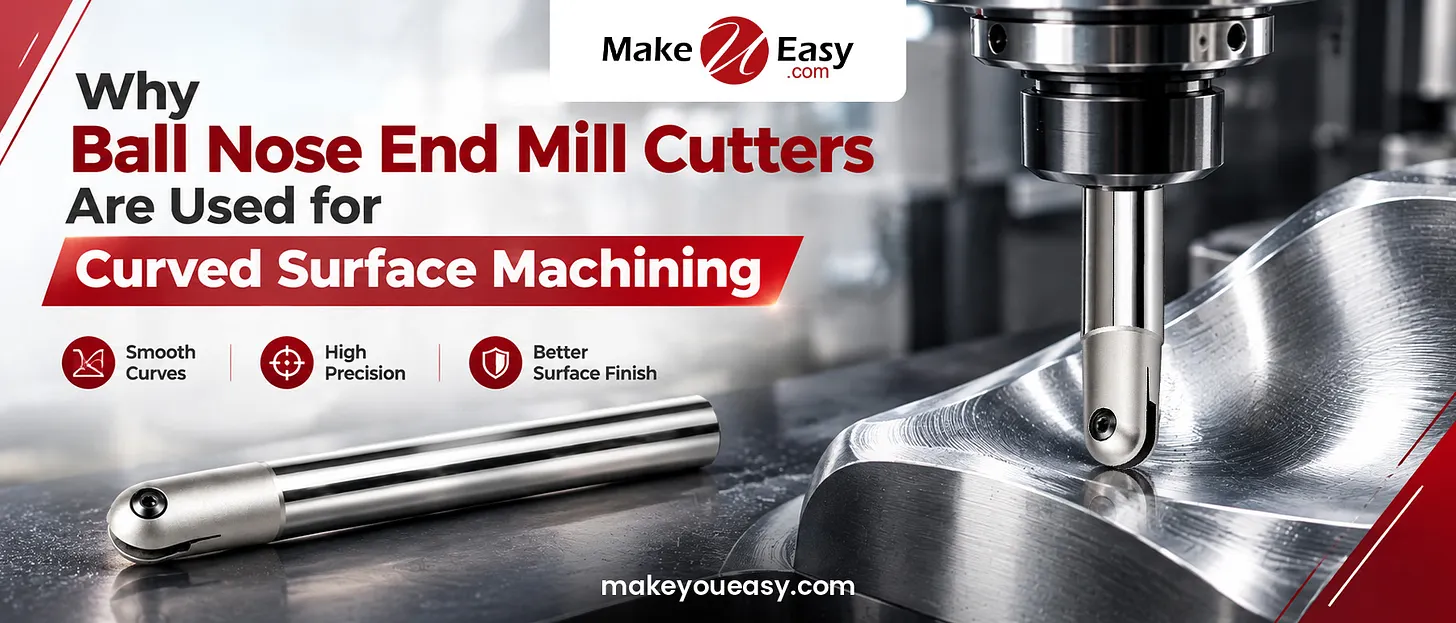
Machining curved and three-dimensional surfaces requires a cutter that can follow changing contours without leaving sharp steps or damaging the required profile. A ball nose end mill cutter has a rounded cutting end that makes it especially suitable for 3D contouring, curved surfaces, mold and die machining, profiling, and finishing complex CNC components. The spherical tip allows the cutting edge to maintain contact as the tool moves across slopes, pockets, radii, and free-form surfaces.
What Is a Ball Nose End Mill?
A ball nose end mill is a milling cutter with a hemispherical cutting end instead of the flat bottom found on a conventional square end mill.
The radius of the cutting end is generally half the cutter diameter. For example, a 10 mm ball nose cutter typically has a 5 mm ball radius.
Ball nose cutters are commonly available as:
-
Solid carbide end mills
-
Indexable ball nose cutters
-
2-flute designs
-
Multi-flute designs
-
Short and long-reach versions
-
Coated and uncoated tools
Kennametal identifies ball nose end mills specifically for 3D profiling and wall-to-floor finishing, demonstrating their importance for complex surface machining.
Why Are Ball Nose Cutters Ideal for Curved Surfaces?
The main advantage comes from the rounded cutting geometry.
When a square end mill moves over a curved surface, its flat cutting edge does not naturally match continuously changing slopes. A ball nose cutter can follow the changing contour more smoothly.
This makes it suitable for:
-
Concave surfaces
-
Convex profiles
-
Sculptured components
-
Mold cavities
-
Dies
-
Turbine blades
-
Impellers
-
Aerospace parts
-
Automotive components
-
Medical components
Sandvik specifically recommends ball nose and conical ball nose tools for semi-finishing and finishing double-curved blade surfaces.
1. Smooth 3D Contouring
Ball nose cutters are widely used in CNC programs involving simultaneous movement along multiple axes.
The rounded tip allows the cutter to move in the X, Y, and Z directions while following a programmed 3D profile.
This is particularly useful for:
-
Mold cavities
-
Complex pockets
-
Organic component shapes
-
Sculptured surfaces
-
3-axis and 5-axis machining
Modern ball nose cutters are specifically designed for 3D profiling applications.
2. Better Surface Finish on Curves
During finishing, the objective is to remove small amounts of material while producing a smooth and consistent surface.
Ball nose geometry creates overlapping curved tool paths rather than sharp flat steps.
The final surface quality depends on:
-
Cutter diameter
-
Ball radius
-
Step-over
-
Feed rate
-
Tool runout
-
Tool rigidity
-
Cutting speed
-
Toolpath strategy
Using a smaller step-over generally reduces the scallop height left between adjacent tool paths, improving surface smoothness.
3. Suitable for Mold and Die Machining
Molds and dies often contain:
-
Deep cavities
-
Rounded corners
-
Complex contours
-
Smooth transitions
-
Free-form surfaces
A ball nose end mill can follow these shapes more effectively than a flat end mill during semi-finishing and finishing.
Solid carbide ball nose cutters are particularly useful where dimensional accuracy and fine surface quality are required.
4. Useful for Multi-Axis Machining
Ball nose cutters are valuable in 3-axis, 4-axis, and 5-axis CNC machining.
In 5-axis machining, the machine can tilt the cutter relative to the component surface. This allows the cutting zone to move away from the very center of the ball tip, where cutting speed is lowest.
Kennametal lists ball nose designs for 3D profiling and 5-axis machining across steel, stainless steel, hardened materials, and high-temperature alloys.
5. Handles Wall-to-Floor Transitions
Components often contain curved transitions between a vertical wall and horizontal or angled floor.
A ball nose cutter can machine these blended radii smoothly because its rounded profile naturally follows the transition.
This makes it useful for:
-
Mold pockets
-
Die cavities
-
Aerospace components
-
Impellers
-
Precision housings
Ball nose tools are specifically used for wall-to-floor finishing applications.
Ball Nose vs Flat End Mill
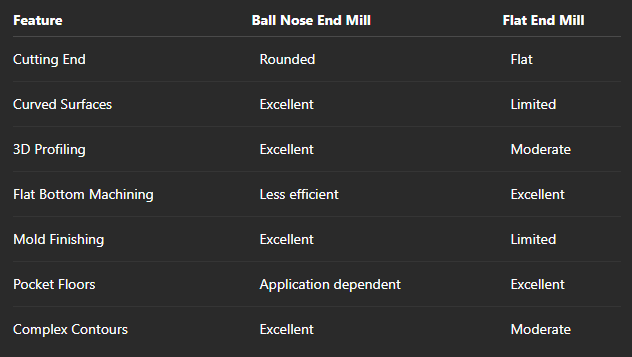
The correct cutter depends on the geometry being machined. Ball nose cutters are strongest where curves and 3D profiles dominate, while flat end mills are generally better for flat floors and square features.
Choose the Correct Cutter Diameter
Cutter diameter affects both productivity and accessibility.
Larger Diameter
A larger cutter can provide:
-
Greater rigidity
-
Faster surface coverage
-
Stronger cutting edges
However, it may not reach small radii or narrow areas.
Smaller Diameter
Smaller cutters provide better access to:
-
Tight curves
-
Small cavities
-
Fine component details
However, they are more sensitive to deflection and breakage.
Choose the largest cutter that can accurately follow the required component geometry.
Select the Right Flute Count
Ball nose end mills are available with different flute counts.
2-Flute Cutters: Provide larger flute spaces and can help chip evacuation.
4-Flute or Multi-Flute Cutters: Provide more cutting edges and can support productive finishing in suitable materials.
Kennametal offers both two-flute and six-flute ball nose designs for 3D profiling, showing how flute count can be optimized for different machining requirements.
Maintain Tool Rigidity
Long-reach ball nose cutters are sometimes required for deep cavities.
However, excessive tool overhang increases:
-
Deflection
-
Chatter
-
Vibration
-
Surface variation
-
Tool breakage risk
For better results, use the shortest practical cutter projection and rigid toolholding.
For deep features, choose a necked or long-reach cutter specifically designed for the application.
Optimize Step-Over
Step-over is especially important in curved-surface finishing.
A large step-over increases machining speed but can leave visible scallops.
A smaller step-over:
-
Improves surface finish
-
Reduces scallop height
-
Produces smoother transitions
The correct value should balance required surface quality and machining cycle time.
Common Ball Nose Milling Problems
Poor Surface Finish
Check tool wear, step-over, runout, feed, and vibration.
Chatter
Reduce excessive overhang and verify toolholder and workpiece rigidity.
Uneven Tool Wear
Check spindle runout, toolpath direction, cutting speed, and contact point.
Tool Breakage
Review cutter diameter, feed, depth of cut, tool projection, and material hardness.
Why Choose MakeYouEasy?
At MakeYouEasy, you can explore CNC milling cutters and machining accessories for different industrial applications.
Relevant tooling can include ball nose end mills, solid carbide end mills, milling inserts, face milling cutters, thread milling cutters, boring tools, and CNC tool holders.
Always verify cutter diameter, flute count, carbide grade, coating, cutting length, and workpiece-material compatibility before purchasing.
Conclusion
Ball nose end mill cutters are widely used for curved surface machining because their rounded cutting geometry can follow complex 3D contours smoothly. They are particularly useful for molds, dies, turbine components, cavities, blended surfaces, and precision 3D finishing.
For better results, choose the correct diameter, flute count, carbide grade, coating, tool length, step-over, and cutting parameters. Maintaining low runout and rigid toolholding can further improve surface quality, dimensional accuracy, and tool life.
Frequently Asked Questions
1. Why is a ball nose end mill used for curved surfaces?
Its rounded cutting end follows changing 3D contours more smoothly than a flat end mill.
2. Can a ball nose end mill be used for 3D profiling?
Yes, 3D profiling is one of the main applications of ball nose cutters.
3. Are ball nose cutters suitable for mold machining?
Yes, they are commonly used for semi-finishing and finishing mold cavities and complex surfaces.
4. How can I improve surface finish with a ball nose cutter?
Use suitable step-over, feed, speed, rigid toolholding, low runout, and a sharp cutting edge.
5. What is the difference between ball nose and flat end mills?
Ball nose cutters suit curved and 3D surfaces, while flat end mills are better suited to flat floors and square features.
Popular Search Keywords
Ball Nose End Mill Cutter, Ball Nose Cutter for Curved Surface, 3D Profiling End Mill, Solid Carbide Ball Nose End Mill, CNC Curved Surface Machining, Ball Nose Cutter for Mold Machining, 3D CNC Milling Cutter, Ball Nose End Mill for Finishing, Curved Surface Milling Tool, Buy Ball Nose End Mill
