Why Advertising Agencies Are Turning to Animation in 2026
Author : vann bells | Published On : 02 Jun 2026
The advertising landscape has changed dramatically over the past decade. Audiences are harder to reach, attention spans are shorter, and the competition for eyeballs across digital platforms is fiercer than ever. In this environment, animation has emerged as one of the most powerful and versatile tools in the advertising agency toolkit.
From explainer videos and motion graphics to full character-based brand storytelling, animation offers creative possibilities that live-action simply cannot match. It is no surprise that more advertising agencies are either building in-house animation capabilities or partnering with specialist studios to deliver animated content for their clients.
The Rise of Animation in Modern Advertising
Animation is not new to advertising. Iconic animated characters and cartoon-style commercials have been a staple of TV advertising for generations. What has changed is the scale, accessibility, and variety of animation formats now available, as well as the platforms on which animated content thrives.
Social media, YouTube pre-rolls, connected TV, digital out-of-home screens, and interactive web experiences have all created fresh demand for animated content that is short, visually compelling, and shareable. Brands that once reserved animation for occasional TV spots are now commissioning animated content across their entire digital presence.
For advertising agencies, this shift represents both a creative opportunity and a commercial one.
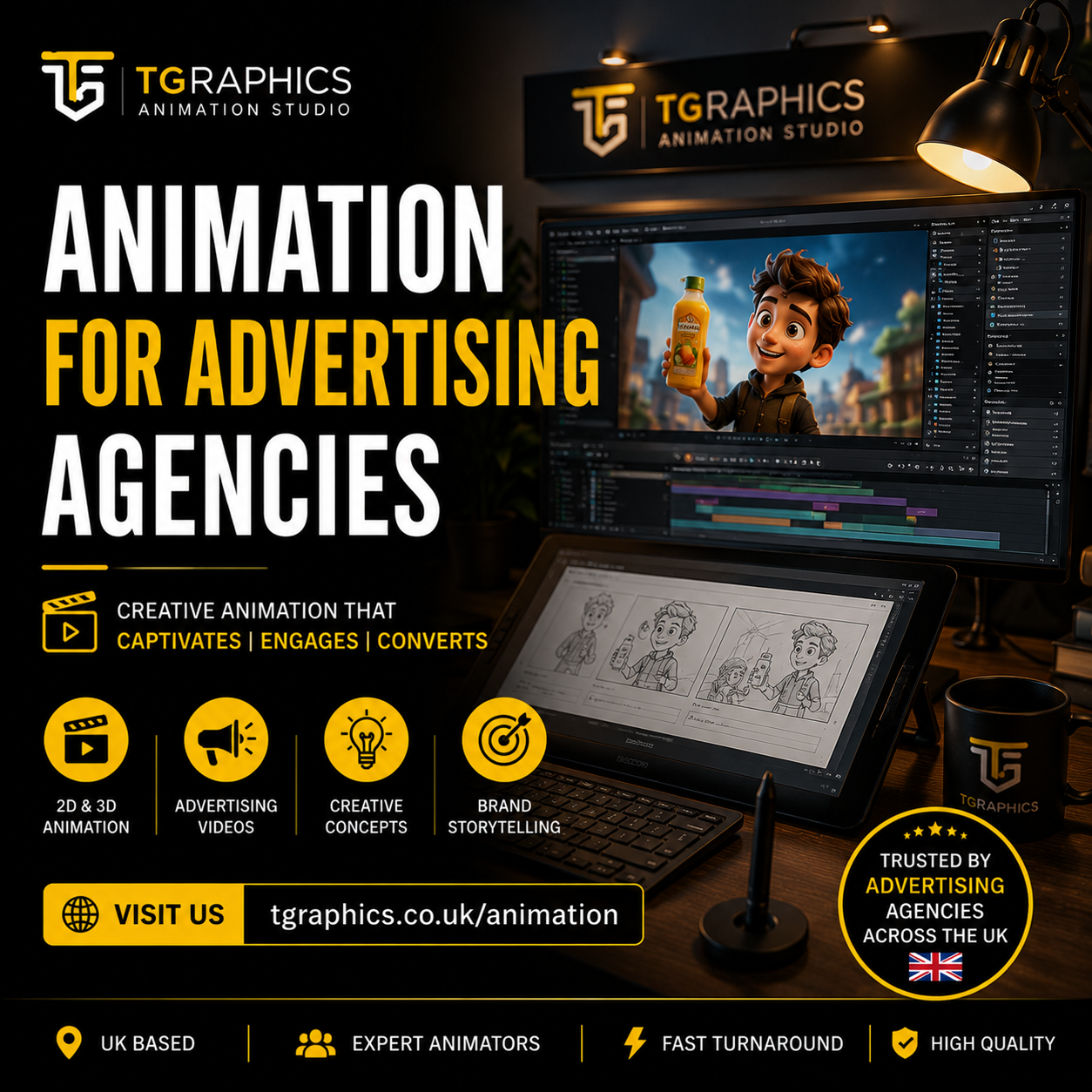
Why Animation Works So Well in Advertising
Animation has a unique set of qualities that make it particularly effective as an advertising medium.
It Simplifies the Complex
One of animation's greatest strengths is its ability to take a complicated idea and make it instantly understandable. Financial products, software platforms, healthcare services, and technical B2B offerings all benefit enormously from animated explainer videos that break down how something works in a clear and engaging way. Where a live-action video might struggle to visualise an abstract concept, animation can do so with ease.
It Creates Emotional Connection
Well-crafted animation has an extraordinary ability to create emotional resonance with audiences. Character-based animation in particular allows brands to develop mascots and personas that audiences genuinely connect with and remember over time. This emotional stickiness translates into stronger brand recall and greater campaign effectiveness.
It Is Platform-Agnostic
An animated asset can be adapted, resized, and reformatted for virtually any platform or screen size. A 30-second animated brand video can be cut into a 6-second social bumper, expanded into a 90-second brand story, looped as a silent social video, or adapted into a series. This versatility gives Animation for Advertising Agencies and their clients exceptional value from a single creative investment.
It Is Not Bound by Physical Limitations
Animation can depict anything: impossible landscapes, microscopic worlds, futuristic cities, fantastical characters, or abstract data visualisations. There are no location logistics, no weather problems, no casting challenges, and no expensive sets to build. This creative freedom allows agencies to develop genuinely original campaigns without being constrained by real-world production limitations.
It Travels Well Across Cultures
Animated content is often easier to localise for international markets than live-action. Voiceovers can be re-recorded in different languages, on-screen text can be swapped, and character designs can be adapted for cultural relevance. For agencies working with global brands, this makes animation a highly efficient choice for international campaigns.
Types of Animation Used in Advertising
Advertising agencies draw on a wide range of animation styles depending on the brief, the brand, and the audience.
2D Animation
The most established and widely used form of animation in advertising. 2D animation ranges from simple flat design and motion graphics through to richly detailed character animation. It is cost-effective, highly customisable, and works exceptionally well for explainer videos, social content, and brand storytelling.
3D Animation
Three-dimensional animation adds depth, realism, and visual impact. It is widely used in product advertising, particularly in the automotive, consumer electronics, and FMCG sectors, where photorealistic product renders and dynamic 3D environments can showcase a product more compellingly than traditional photography or live-action video.
Motion Graphics
Motion graphics combine graphic design elements with animation to create visually dynamic content. This style is particularly effective for data visualisation, corporate communications, infographics, and any content where information needs to be presented clearly and attractively.
Stop Motion
A tactile and distinctive animation technique that involves photographing physical objects or characters frame by frame to create the illusion of movement. Stop motion has a handcrafted, artisanal quality that works particularly well for brands seeking an authentic, creative, or unconventional visual identity.
Mixed Media
Many modern advertising campaigns combine animation with live-action footage, creating hybrid formats that are visually arresting and unexpected. Mixing real-world footage with animated elements, overlays, or characters gives agencies the ability to create content that feels fresh and original.
Whiteboard Animation
A clean and simple format in which content appears to be drawn in real time on a white background. Widely used for educational and explainer content, whiteboard animation is particularly popular in the B2B space.
The Business Case for Animation in Advertising Campaigns
Beyond the creative arguments, there is a compelling business case for advertising agencies to recommend animation to their clients.
Animated content consistently outperforms static content across key engagement metrics. Studies have shown that video content in general drives higher click-through rates, longer dwell times, and greater social sharing. Within video, animation often performs particularly well because it is inherently attention-grabbing and visually distinctive in a feed full of real-world footage.
Animation also has a longer shelf life than live-action. A well-produced animated brand asset does not date in the same way that live-action footage does. There are no outdated hairstyles, no obsolete technology visible in the background, and no talent agreements to renew. An animated brand character or campaign can remain in use for years with only minor updates, delivering exceptional return on the original creative investment.
For agencies, offering animation as part of a broader creative service not only increases the value delivered to clients but also opens up retainer and ongoing project opportunities as clients commission animated content across different channels and formats.
Choosing the Right Animation Partner
Not every advertising agency has the in-house capability to produce high-quality animation. For many agencies, the most effective approach is to partner with a specialist animation studio or creative production company that can deliver the quality and variety of animated content their clients require.
When evaluating an animation partner, agencies should consider the breadth of styles and formats the studio can deliver, the quality and originality of its portfolio, its experience working with advertising briefs and brand guidelines, its ability to meet deadlines and manage revisions professionally, and its understanding of the technical requirements for different platforms and formats.
A strong animation partner becomes an extension of the agency's creative team, able to respond quickly to briefs and deliver work that meets the highest creative and technical standards.
For advertising agencies looking to expand their animation offering, working with an experienced creative partner such as TGraphics can provide the specialist skills and production capability needed to bring ambitious animated campaigns to life.
Animation and the Future of Advertising
Looking ahead, animation's role in advertising is set to grow further. The expansion of connected TV and streaming platforms creates new opportunities for longer-form animated brand content. The growth of augmented and virtual reality opens up entirely new animated experiences. Advances in AI-assisted animation tools are making certain types of animated content faster and more cost-effective to produce, although the creative vision and craft of skilled animators remains irreplaceable.
For advertising agencies, building a genuine expertise in animation, whether in-house or through strong creative partnerships, is increasingly becoming a competitive differentiator. Clients who discover the creative and commercial power of animation rarely want to go back to a world without it.
Conclusion
Animation has moved from being a niche or occasional choice in advertising to a central pillar of effective modern campaign strategy. Its ability to simplify complex ideas, create emotional connection, work across every platform, and deliver lasting value makes it an indispensable tool for advertising agencies and their clients.
Agencies that embrace animation, invest in the right partnerships, and develop a confident fluency in its many styles and formats will be best placed to deliver standout creative work in an increasingly competitive market.
For specialist animation and creative services tailored to the needs of advertising agencies, visit TGraphics.
