White and Blue hBN Coatings: Improving Coating Application in High-Temperature Industries
Author : Jade Chemicals | Published On : 23 Nov 2026
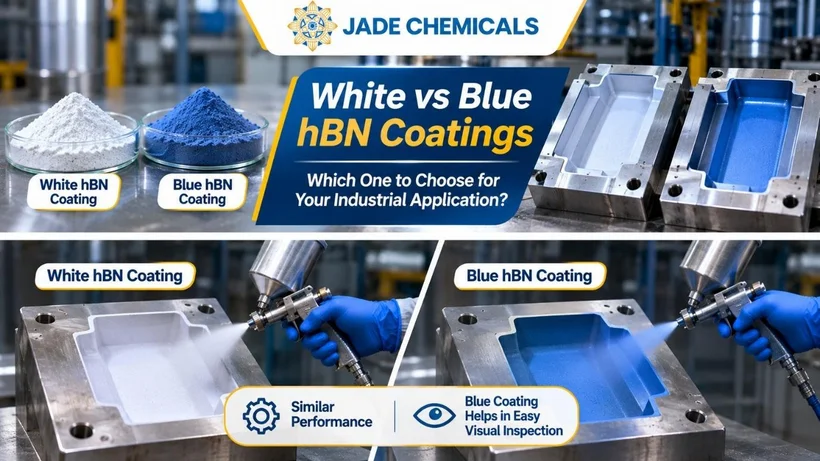
In high-temperature manufacturing, a protective coating needs to do more than simply cover a surface. It must be suitable for the equipment, withstand the intended operating conditions and provide consistent coverage across the required areas. Manufacturers working with moulds, dies and metal-processing equipment understand how important this can be, especially when production runs involve repeated heating and cooling.
Hexagonal Boron Nitride (hBN) coatings are used in industrial processes where dry lubrication, heat resistance and protection against material sticking are important. These ceramic-based coatings help create a protective layer on compatible surfaces, making them useful in applications such as aluminium extrusion, die casting, glass manufacturing and metal forming.
White and blue hBN coatings are two options available for these applications. Although both are designed to provide similar functional benefits, their appearance can make a practical difference during coating application.
Consider an aluminium extrusion facility where operators need to prepare tooling before production. The surface must be cleaned, the coating applied and the equipment inspected before use. If an area receives insufficient coating, it may behave differently during operation. This is why coating consistency matters as much as selecting a suitable material.
White hBN coatings are commonly considered where clean dry lubrication and anti-stick properties are required. Their natural white appearance can be suitable for processes where the coating is easy to inspect or where colour contrast is not a major requirement.
Blue hBN coatings provide an additional visual advantage. The blue pigment helps operators identify coated areas more easily. This can be useful on tooling with several working surfaces, especially when the production team needs to check whether certain sections have been missed.
However, colour alone cannot confirm whether the correct coating thickness has been achieved. A surface may appear fully coated while still requiring further inspection. Manufacturers should continue following the recommended application procedure, including surface preparation, drying and checking suitability for the actual operating conditions.
Another important factor is the working environment. In a foundry or metal-processing facility, tooling may be exposed to high temperatures and repeated contact with processed materials. Suitable hBN coatings can help reduce unwanted adhesion, but their performance also depends on the surface material, coating formulation and application method.
Manufacturers should not assume that blue hBN coating provides greater temperature resistance than white coating. The colour difference is mainly relevant to visual identification rather than an automatic improvement in lubrication performance.
Jade Chemicals supplies JD Nano-BNC80 White Coating and JD Nano-BNC80 Blue Coating for selected industrial applications. According to the company's product information, both variants offer equivalent intended lubrication, thermal protection and anti-stick properties. The blue formulation contains a pigment intended to make coating coverage easier to inspect.
For manufacturers evaluating these options, Jade Chemicals provides a detailed explanation in its article White vs Blue hBN Coatings: How to Choose the Right Coating for Industrial Applications. The article explains how both variants are used and why coating visibility may be useful during production.
Additional product details are available on the company's Hexagonal Boron Nitride Coatings supplier in India page.
When selecting an industrial coating, the first step should always be understanding the manufacturing process. Operators need to consider the tooling material, operating temperature, application method and inspection requirements. A coating that works well in one application may need further evaluation before being used in another.
White and blue hBN coatings offer manufacturers flexibility in how they approach coating application. Where visual inspection is important, the blue variant may be more convenient. Where additional colour identification is unnecessary, white coating may be an equally suitable option. In either case, careful application and regular process checks remain essential for consistent results.
