What You Need to Know About BJJ Skin Infections and How to Reduce Your Risk
Author : Kimura Soap Co | Published On : 21 Aug 2026
Mats and gear that see dozens of bodies a week create the exact conditions ringworm, staph, and MRSA need to spread. If you train regularly, you will eventually run into one of them. The question isn’t whether you can avoid every risk in a contact sport. It’s whether you can recognize what you’re looking at and know what actually lowers your exposure.
This article covers how to identify the BJJ skin infections that show up most often on the mat, how these infections actually spread in a BJJ gym, and the specific, unglamorous routine that lowers your risk- the habits that matter more than any product on the shelf.
Treating the shower as a finish line is how avoidable BJJ skin infections keep circulating through academies that otherwise run clean. None of what follows requires you to train less carefully or worry more. It requires a routine run every session, not a reaction after the fact.

The Four Most Common BJJ Skin Infections
Most BJJ skin infections fall into four categories, and they show up in almost every academy sooner or later. Knowing the difference between them matters more than most athletes realize because they don’t look alike, don’t spread the same way, and don’t get handled the same way. Treating all four as one generic mat rash is how people either overreact to something minor or undertreat something that needed a doctor two days ago.
Ringworm
Ringworm is a fungal infection, not a parasite, and it’s the most common skin issue grapplers run into. It shows up as a round, scaly patch, often with a clearer center, and it spreads through direct contact and shared surfaces like mats, gis, and towels.
Staph
Staph is a bacterial infection, usually caused by bacteria many people already carry harmlessly on their skin. It becomes a problem when it enters the body through a cut, a mat burn, or a friction spot, turning into a red, swollen, sometimes pus-filled lesion.
MRSA
MRSA is the antibiotic-resistant strain of staph, and it’s the one that gets taken most seriously in a grappling gym. It looks similar to a standard staph infection at first, but it doesn’t respond to the usual antibiotics, which makes early recognition and prompt medical care far more important.
Impetigo and Herpes Gladiatorum
Impetigo is a bacterial infection that spreads fast in close-contact environments and often shows up around the face or hands. Herpes gladiatorum is a viral infection associated with contact sports, and it can flare up more than once. Both are less common than ringworm or staph, but both spread quickly through a training group when they go unreported.
Each of these behaves differently, spreads differently, and calls for a different response, which is exactly why the next sections break them down individually rather than lumping them into one catch-all warning about mat hygiene.
How to Identify the Fungal Infection Called Ringworm
BJJ ringworm is a common part of BJJ skin infections that shows up in almost every academy at some point. It’s a fungal infection called tinea. On the body, it is known as tinea corporis. In the groin, it is called tinea cruris.
What Ringworm Looks Like
Ringworm starts as a small patch. It is usually red and slightly scaly. As it grows, the center often clears out. The outer edge stays raised. This is what gives the infection its ring shape.
Shape and border
The patch is round with a defined border. The edge stays raised even as the center starts to clear.
Center coloring
The center is often lighter than the surrounding skin. This is what creates the visible ring pattern people recognize.
Skin texture
The affected skin feels rough or scaly to the touch. It can also look slightly flaky along the edges.
Itching
Itching is common with ringworm. It can range from mild irritation to a persistent, noticeable itch that gets worse with sweat.
How Ringworm Spreads
Ringworm spreads through direct contact. Rolling and drilling put skin against skin for long stretches. That contact is enough to pass the fungus from one person to another. Mats, gis, and towels can also carry it. The fungus can survive on these surfaces long enough to reach the next person who touches them.
Spread during class
A single case at a drop-in class can spread within the same session. Close contact during rolling gives the fungus a direct path from one person’s skin to another’s.
Spread through shared gear
Shared gis and towels carry the fungus after training ends. Anyone who uses that gear afterward is exposed to it, even if they never rolled with the infected person.
Spread through mats
Mats hold the fungus if they are not cleaned properly. Athletes who roll on a contaminated mat can pick up the infection without any direct contact with an infected partner.
Spread across an academy
One untreated case at an academy often becomes several within two weeks. This happens when someone keeps training instead of stepping off the mat to get treated.
What To Do If You Suspect Ringworm
The response here is simple. Stay off the mat. Get the patch looked at by a doctor. Training through a suspected case is how one infection turns into an outbreak across a training group.
BJJ ringworm does not need to end your training for long. Most cases clear up with proper treatment in a few weeks. The cost of stepping off the mat for a short evaluation is small. The cost of spreading it to your teammates is not.
Understanding the Bacterial Risk of Staph and MRSA
BJJ skin infections are not all fungal. Staph and MRSA are bacterial, and they behave differently from ringworm in how they start and how fast they can turn serious.
Both come from bacteria that live on the skin already. The risk starts when that bacteria gets past the skin barrier through a cut or a mat burn.
What Staph Looks Like
Staph infections usually begin at a small break in the skin. A cut, a mat burn, a friction spot from gripping or scrambling. The bacteria gets in, and the area turns red and swollen. Many athletes mistake the early stage for a spider bite or a pimple.
Redness and swelling
The skin around the entry point turns red and puffy. It often feels warm when you touch it.
Pus or drainage
As the infection develops, it can fill with pus or begin draining fluid. This is a clear sign the infection has progressed past a minor irritation.
Pain at the site
The area is usually tender or painful, especially with pressure. This pain tends to increase as the infection grows rather than fade.
What Makes MRSA Different
MRSA is a strain of staph that does not respond to common antibiotics. It looks similar to regular staph at first. The difference shows up during treatment, when standard antibiotics fail to clear it, and a doctor has to switch to a different course of medication.
Resistance to treatment
MRSA does not respond to the antibiotics that clear typical staph. This is why doctors treat any lesion that fails to improve as a possible MRSA case.
Faster spread if untreated
Left alone, MRSA can spread deeper into tissue and cause more damage than standard staph. Early diagnosis matters more here than with most other MAT infections.
Higher stakes for delay
Waiting too long to see a doctor gives MRSA more time to establish itself. This is the infection coaches worry about most, and for good reason.
Kimura’s founder has talked openly about catching staph, MRSA, and ringworm over the course of his training career. That kind of exposure is common for anyone who has spent years on the mat, and it is part of why the brand treats hygiene as a routine rather than an afterthought.
When To See a Doctor
Not every red bump needs a medical visit. But certain signs mean you should stop guessing and get it checked. A lesion that is hot to the touch, growing in size, or draining fluid should go to a doctor, not get taped over and trained through.
Bjj skin infections involving staph or MRSA are not something to manage on your own. A same-day visit to a doctor is a small inconvenience compared to what an untreated bacterial infection can turn into. Toughing it out is how a short-term problem becomes a long one.
When the Routine Breaks Down: Training on the Road
Your routine works because you built it around your own gym. You know the mats, you know the shower, and you know where your gear lives between sessions. That routine gets tested the moment you step outside your home academy.
Drop-ins, open mats, seminars, and tournaments put you in rooms full of unfamiliar training partners and unfamiliar surfaces, often on the busiest, sweatiest days of a weekend. These are exactly the situations where exposure to BJJ skin infections goes up, because you are rolling with more people you do not know in spaces you cannot vouch for.
The problem is the gap between exposure and preparation. At your home gym, you likely have your own soap, your own towel, and a shower you trust. On the road, you are far more likely to be standing in an unfamiliar shower with nothing but the bar of soap the venue supplied. That is the exact moment your routine tends to fall apart, not because you forgot the plan, but because you did not pack for it.
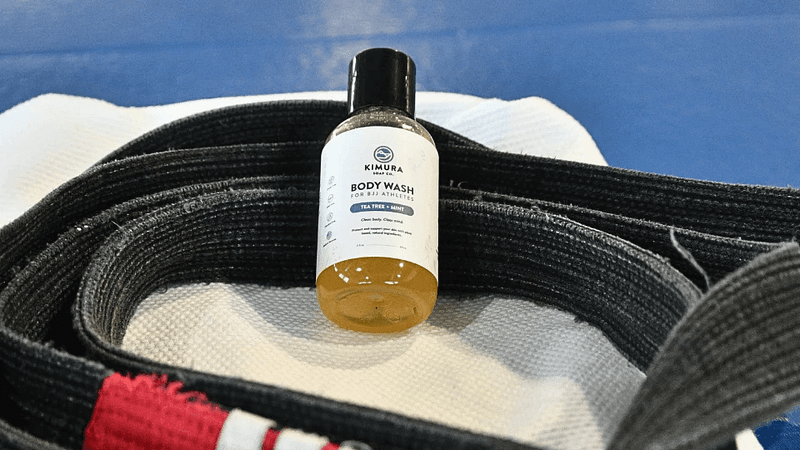
This is the gap the 3 oz travel bottle is built to close. It is not a stronger formula or a heavier-duty version of anything. It is the same Kimura wash in a size built for a gym bag, a suitcase, or a gi bag pocket. The point is making sure your own soap is actually with you when a seminar, a tournament, or a drop-in class puts you furthest from your usual routine.
Clean Body. Clear Mind.
BJJ skin infections are not a cost you have to accept for training hard.
Ringworm, staph, and MRSA all spread the same basic way, through close contact and shared surfaces, and all three respond to the same basic defense. Shower soon after class. Wash your gear every session.
Watch for anything in Kimura Soap Co. that looks off, and get it checked instead of training through it. Carry your own soap so the choice of what goes on your skin is yours.
Put the 3 oz travel bottle in your gym bag tonight, or start with the 16 oz and 3 oz combo and cover your home shower and your gym bag at the same time.
Frequently Asked Questions
Can you train BJJ with ringworm?
No. Ringworm spreads through direct skin contact and through shared mats, gis, and towels. Training with a visible patch puts every partner you roll with at risk. Stay off the mat until a doctor confirms it is clearing up.
How long is ringworm contagious?
Ringworm stays contagious as long as the fungus is active on your skin, which is usually until treatment has run its course. Most cases clear within two to four weeks with proper antifungal treatment. A doctor can confirm when it is safe to return to the mat.
What does a staph infection look like on a BJJ athlete?
Staph usually starts at a cut, a mat burn, or a friction spot. The area turns red, swollen, and often warm to the touch. Many athletes mistake early staph for a spider bite or a pimple, which is why any suspicious bump deserves a closer look.
How do you prevent skin infections in Jiu Jitsu?
Shower soon after training, wash your gi and rashguard every session, and never share towels, soap, or razors. Cover any cuts or mat burns and keep your nails short. Report anything suspicious instead of training through it, since that is how one case spreads to the rest of the team.
What’s the difference between staph and MRSA?
Staph and MRSA come from the same bacteria and look similar at first. The difference shows up in treatment. Regular staph responds to standard antibiotics, while MRSA does not, which is why lesions that fail to improve are treated as a possible MRSA case and referred to a doctor right away.
