What Makes the Pico Laser Tattoo Removal (1064/532/755nm) the Best Choice for Professional Skin Trea
Author : Globalzhitui lyy | Published On : 21 May 2026
Introduction
In the rapidly developing field of aesthetic medicine, laser technology has become the cornerstone of non-invasive skin treatments; among them, picosecond laser tattoo removal technology has brought revolutionary changes to practitioners and patients. As more and more clinics and aesthetic medicine centers seek advanced, safe, and efficient solutions to address stubborn tattoos and other problems, a key question arises: what qualities make the “1064/532/755nm picosecond laser system” stand out among numerous picosecond laser devices? This guide will delve into the core of this picosecond laser device, highlighting its key advantages, technical parameters, and clinical applications, aiming to assist professionals in making informed decisions. Whether you are an experienced aesthetic medicine practitioner or a clinic manager seeking equipment upgrades, this article will provide a detailed interpretation, precisely explaining why this “1064/532/755nm picosecond laser device” has won such widespread favor.
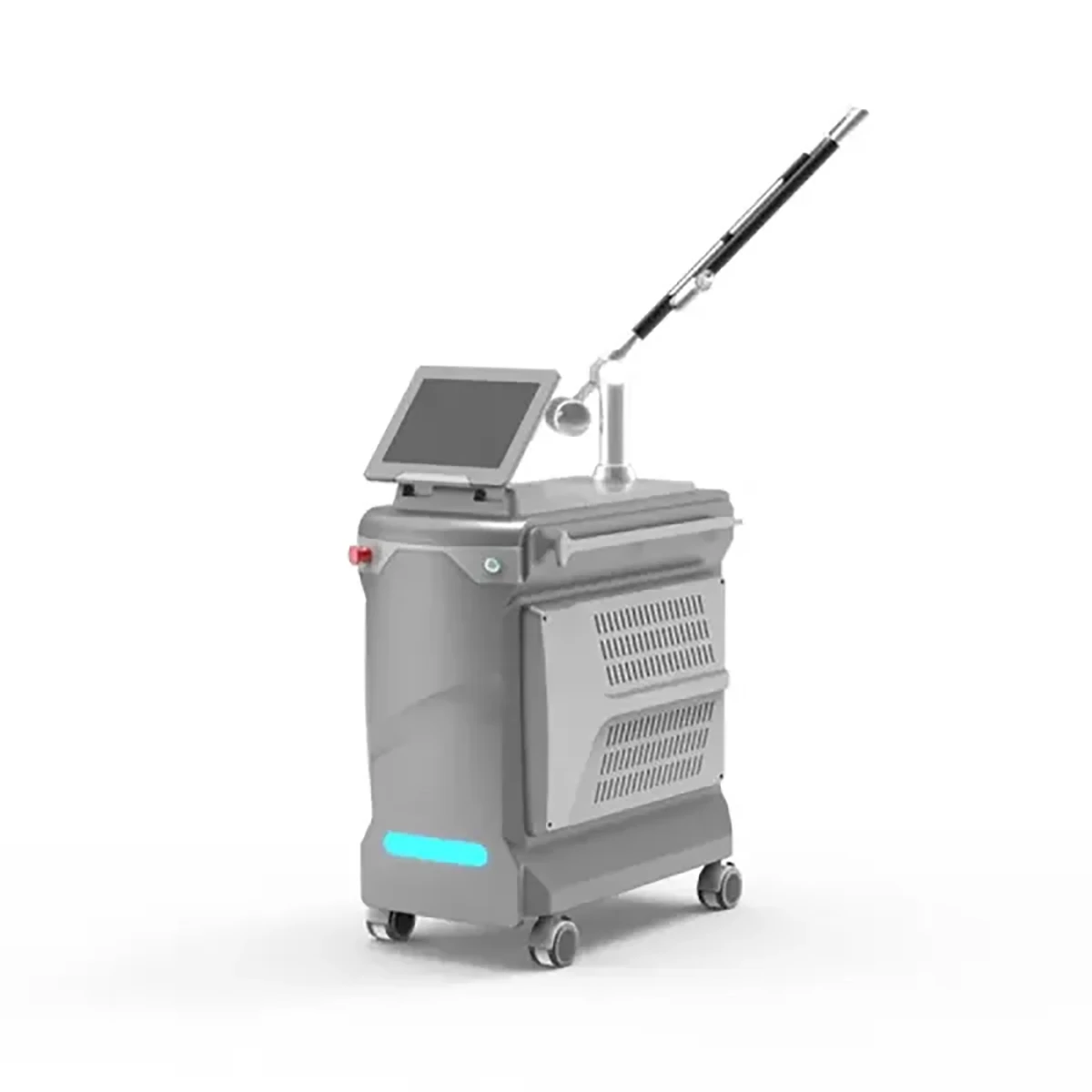
1. What is a Picosecond Laser?
Before delving into the specific details of 1064/532/755nm systems, it is essential to first understand the core technology underpinning picosecond laser tattoo removal. A picosecond is a unit of time equivalent to one-trillionth of a second (i.e., 10⁻¹² seconds)—a speed 10,000 times faster than the nanosecond pulses utilized by traditional Q-switched lasers (Source: https://www.ncbi.nlm.nih.gov/pmc/articles/PMC5034826/). So, how does it work? Picosecond laser devices emit laser pulses of extremely short duration.The picosecond laser emits ultra-short pulses of laser energy, targeting pigment cells within the skin with unprecedented precision to break down ink particles and pigment deposits into minute fragments. Subsequently, the body’s own immune system can more effectively recognize and clear away these fragments—transporting them away through metabolic processes—thereby achieving the gradual fading or even complete removal of tattoos.
2. Technical Specifications
The following core specifications reflect the system’s capabilities, verified by manufacturer data:
| Parameter | Specification |
| Laser Type | Picosecond Nd:YAG Laser (Canada BEAMTECH) |
| Wavelengths | 1064nm, 532nm, 755nm (switchable) |
| Pulse Width | ≤10ps |
| Spot Size | 2-10mm (adjustable) |
3. The Unique Advantages and Clinical Applications
While tattoo removal is a flagship application, the pico laser tattoo removal Machine (1064/532/755nm) is a true multi-application workstation. Its advantages extend far beyond ink clearance.
3.1 Multi-Wavelength Versatility for Comprehensive Treatment:
The effectiveness of a laser on a target depends heavily on the wavelength’s absorption characteristics. This machine’s three wavelengths allow for precise targeting:
- 1064nm: This longer wavelength penetrates deepest into the dermis. It is primarily absorbed by dark colors like black, dark blue, and green tattoo ink. It is also highly effective for treating dermal pigmentation like nevus of Ota and for skin rejuvenation by stimulating collagen deep within the skin.
- 532nm: This shorter wavelength is absorbed more strongly by red, orange, yellow, and brown pigments. It is ideal for removing red and orange tattoo inks, treating superficial pigmentation like sun spots, freckles, and cafe-au-lait spots located in the epidermis.
- 755nm: This wavelength offers an excellent balance, effectively targeting blue and green tattoo inks, as well as brown pigmented lesions. It is often considered the gold standard wavelength for treating benign pigmented lesions and certain tattoo colors with high precision.
- Advantage: A single device replaces the need for multiple machines, making it a cost-effective and space-efficient solution for clinics while offering a complete treatment palette for diverse patient needs.
3.2 Enhanced Efficacy with Reduced Sessions:
The photomechanical effect of the picosecond pulse shatters ink and pigment particles into much smaller fragments than nanosecond lasers. These microscopic particles are more easily recognized and removed by the body’s lymphatic system. Clinical studies have demonstrated that picosecond laser machines can clear tattoos, especially stubborn multicolored ones, in fewer treatment sessions.
3.3 Minimal Discomfort and Downtime:
The near-absence of significant thermal spread translates to less pain during the procedure (though topical anesthesia is still commonly used) and a marked reduction in post-treatment side effects. Patients typically experience less erythema (redness), swelling, and blistering. The risk of textural changes or scarring is significantly lowered, and recovery time is faster, allowing patients to return to their daily activities more quickly.
4. Main Application Scenarios
- Dermis pigmentation: Birth mark, such as: Ota nevus, Ito nervus, black nevus.
- Pigment, such as sun-burn spots, age spots, speckle, freckle, senior fleck.
- Man made pigment: Blue, black, red, brown tattoo, lips lilne, eyebow line
- Epidermis pigmentation, Speckles: such as freckle, senior flecks, coffee spot.
- Skin rejuvenation with laser peeling
5. Frequently Asked Questions
Q1: Can it treat all skin types?
A: With proper parameter settings and cooling measures, a wavelength of 1064nm is generally safe for Fitzpatrick skin types I to VI.
Q2: What should I expect after the treatment?
A: Most people will immediately feel a mild sunburn-like sensation after treatment, sometimes accompanied by slight swelling. This feeling usually lasts for 2 to 24 hours.
Q3.What types of pigment can be treated?
A: Laser light treatment is appropriate for treating age spots, sun damage, and freckles on the face, neck, chest, arms, hands, legs, and feet.
Q4: How many treatments will it take to remove my tattoo?
A: This varies significantly. While the picosecond laser machine is more efficient, most tattoos require 2 to 6 sessions for significant fading or clearance. Factors include ink density, color, depth, age of the tattoo, and your body’s immune response. Professional, multi-colored tattoos often require more sessions than amateur ones.
6. Conclusion
Picosecond laser tattoo removal represents a significant leap forward in the field of aesthetic laser technology. By harnessing the powerful energy of ultra-short pulses—and simultaneously utilizing wavelengths of 1064nm, 532nm, and 755nm—this device offers a safer, faster, and more effective solution for removing unwanted ink. Furthermore, as a “picosecond aesthetic laser” system designed for treating pigmentation issues and facilitating skin rejuvenation, its versatility makes it an indispensable asset for any modern dermatology practice or aesthetic clinic.
When selecting a supplier for picosecond laser equipment, the core engineering design—including the laser source, cooling system, wavelength options, and manufacturing processes—is of paramount importance, as these factors directly determine both patient satisfaction and return on investment. If you are interested in this device, please do not hesitate to contact us!
