What Is the Meaning of RFID?
Author : Jaming Wong | Published On : 26 Oct 2026
What is the meaning of RFID? RFID stands for Radio Frequency Identification, a technology that uses radio waves to identify and exchange data with tagged objects. An RFID system typically combines tags, readers, antennas, and software, allowing businesses to identify products, track assets, and manage inventory without scanning each item individually.
RFID is widely used in logistics, manufacturing, retail, libraries, access control, and equipment management. Unlike a conventional barcode system, RFID can identify compatible tagged items without requiring a direct line of sight between the reader and each tag.
According to GS1’s official RFID guidance, the technology automatically captures an object’s identifier through radio communication. The practical value is straightforward: instead of manually locating and scanning every label, a properly configured RFID system can collect identification data from multiple tagged items within its reading zone.
What Does RFID Stand For?
RFID is the abbreviation for Radio Frequency Identification. Each part describes an essential aspect of the technology:
- Radio Frequency: Radio waves carry signals between an RFID reader and a compatible tag.
- Identification: The system captures identifying information associated with a tagged object.
- Technology: Hardware and software work together to collect, process, and use the information.
An RFID tag commonly contains a microchip connected to an antenna. The chip stores identification data, while the antenna enables communication with the reader. The reader converts the received signal into digital information that a computer or management system can process.
Not every RFID tag works in the same way. Some tags operate without batteries, while others have their own power source. Frequency, antenna design, tag construction, and the surrounding environment all influence performance.
How Does RFID Work in Real Applications?
A typical RFID workflow follows the movement of an item rather than requiring a person to scan every label individually.
- Attach or embed an RFID tag. The tag is applied to a product, carton, reusable container, tool, or other asset.
- Configure the RFID reader. The reader and antenna establish the required reading zone and communicate with compatible tags.
- Capture identification data. When a tag enters the effective radio-frequency field, the reader receives its response.
- Process the data. Software associates the captured identifier with a product record, asset record, or inventory transaction.
- Update the business system. Depending on the application, the event can support receiving, stock counting, item tracking, or access management.
For example, consider a warehouse receiving area. A worker may move a carton of tagged products through a reader-equipped station. The system can capture identifiers from multiple products without requiring the operator to locate every barcode. The resulting records can support receiving verification and inventory updates, provided the reader configuration and application are designed for that workflow.
GS1 explains that passive UHF RFID can read compatible tags at distances well beyond 10 metres under suitable conditions. That is a technical capability, not a guaranteed operating distance. Tag orientation, surrounding materials, antenna placement, and interference can change actual performance.
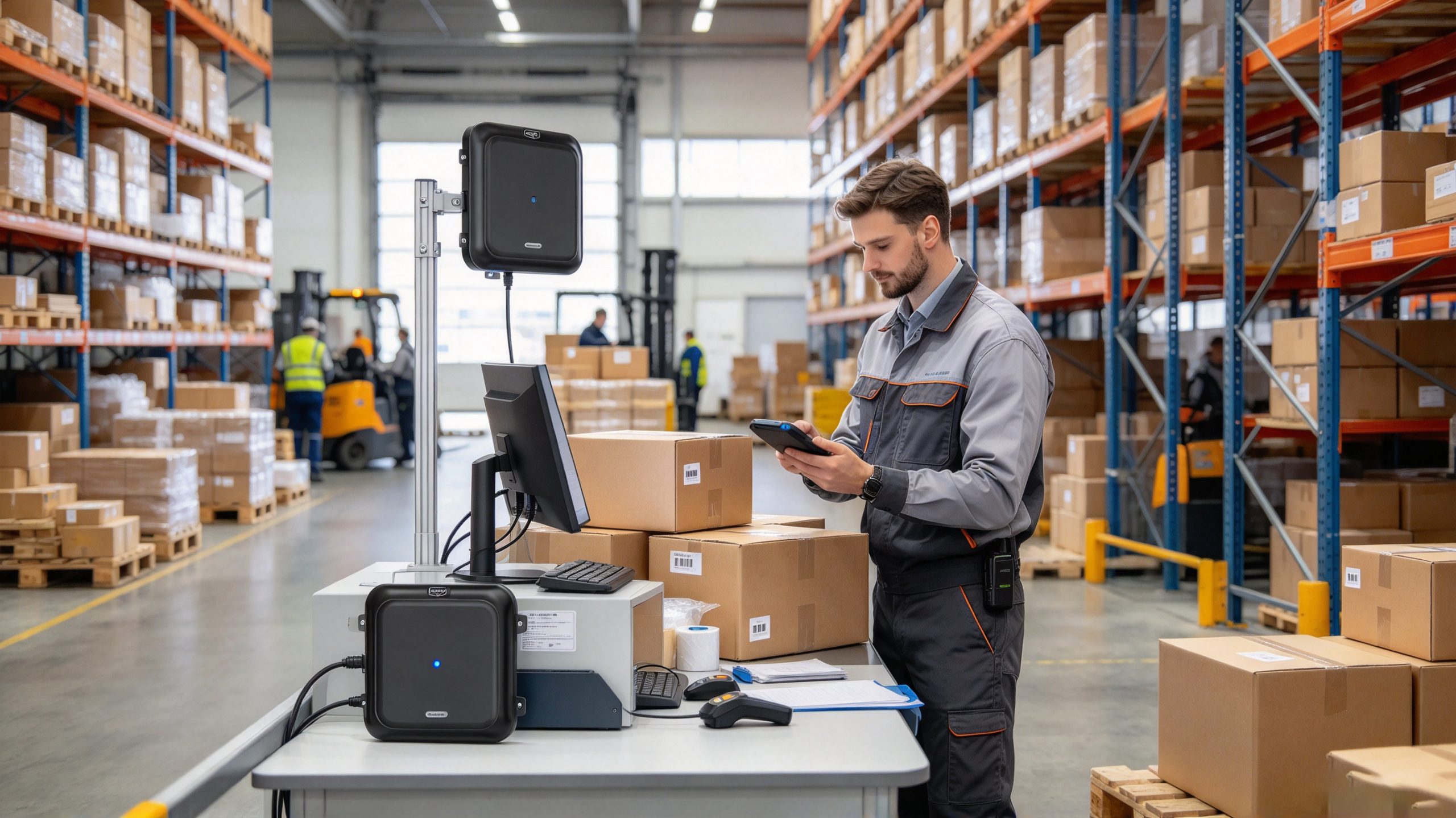
RFID readers capture product identification data to support warehouse receiving and inventory management.
What Are the Main Types of RFID?
RFID systems are commonly classified by their power source and operating frequency.
| RFID type | Typical characteristics | Common applications |
|---|---|---|
| Low-frequency (LF) RFID | Short-range identification; commonly operates around 125–134 kHz | Animal identification and specialized access systems |
| High-frequency (HF) RFID | Commonly operates at 13.56 MHz | Library systems, smart cards, and near-field applications |
| Ultra-high-frequency (UHF) RFID | Supports longer-range identification and rapid inventory reading | Warehouses, retail inventory, logistics, and industrial asset tracking |
| Active RFID | Tags have their own power source and can transmit signals | Selected asset-tracking and location systems |
| Passive RFID | Tags obtain operating energy from the reader’s radio field | Product identification, inventory, and many supply-chain applications |
These categories are not all mutually exclusive: LF, HF, and UHF describe frequency bands, whereas active and passive describe how tags are powered.
GS1’s RFID standards overview identifies UHF passive RFID, also known as RAIN RFID, as a widely implemented technology for industry. Its ability to identify multiple tagged items without direct line-of-sight scanning makes it particularly useful in high-volume operations.
Where Is RFID Used?
Businesses adopt RFID when they need reliable item identification across repeated transactions or large numbers of physical assets.
- Warehouse management: Identify cartons, verify incoming goods, and support cycle counting.
- Retail: Improve stock visibility and help locate individual products.
- Manufacturing: Associate components and work-in-progress items with production records.
- Libraries: Support book registration, borrowing, returns, and inventory checks.
- Asset management: Identify tools, reusable containers, and equipment.
- Access control and transportation: Use compatible RFID cards, credentials, or vehicle tags to support identification and automated transactions.
The right application depends on more than reading distance. A tag that performs well on a cardboard carton may behave differently when attached to a metal tool or placed near liquid. Before selecting hardware, businesses should test representative tagged items in their actual operating environment.
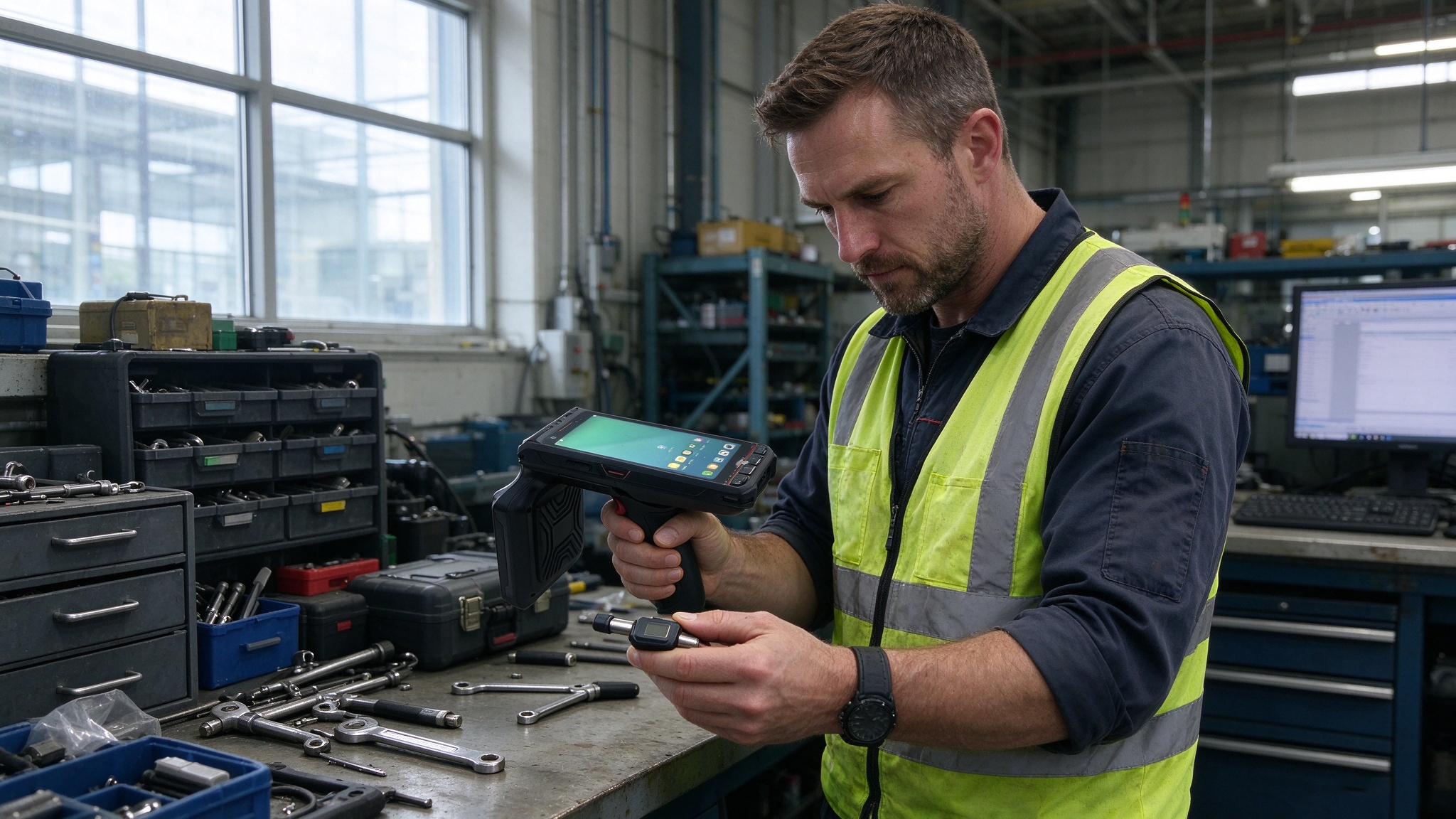
RFID helps industrial teams identify tools and connect physical assets with digital management records.
What Is the Difference Between RFID and a Barcode?
RFID and barcodes both identify objects, but they use different methods to capture information. A barcode reader typically needs to see the printed code, while an RFID reader communicates with a compatible tag through radio waves.
The difference becomes important when a business handles hundreds or thousands of items in a short period. A worker checking stock manually may need to locate each barcode and position the scanner correctly. With a properly configured RFID system, an operator can read multiple tagged items within the reader’s effective field without scanning each label separately.
| Feature | RFID | Barcode |
|---|---|---|
| Identification method | Radio-frequency communication | Optical scanning |
| Direct line of sight | Usually not required | Generally required |
| Multiple-item reading | Supported by suitable systems | Usually requires individual scanning |
| Data storage | Depends on tag type and chip capacity | Depends on barcode format and associated system |
| Environmental considerations | Metal, liquids, tag orientation, and interference can affect performance | Dirt, damage, glare, and poor print quality can affect scanning |
| Typical uses | Automated inventory, asset tracking, logistics | Retail checkout, shipping labels, product identification |
RFID is not automatically the better choice for every business. Barcodes remain a practical, economical option for many applications. RFID becomes attractive when faster bulk identification, reduced manual scanning, or automated movement records justify the cost of tags, readers, antennas, and integration.
What Information Does an RFID Tag Contain?
The information stored on an RFID tag depends on its chip, memory configuration, and application. Some tags carry only a unique identifier that software uses to retrieve a more detailed record. Others support additional user data or application-specific information.
For example, a warehouse RFID tag may contain an Electronic Product Code (EPC) associated with a product or logistics unit. When a reader captures the identifier, the warehouse management system can look up the corresponding stock record.
An RFID identifier does not automatically provide a product’s complete history, current location, price, or ownership information. Those details generally depend on the software and databases connected to the reader.
Three elements are worth distinguishing:
- Tag identifier: The code used to distinguish a tagged item or associate it with a record.
- Tag memory: The storage available on the chip, which varies by tag model.
- Business database: The external system that stores product descriptions, transactions, locations, and other operational details.
GS1’s Electronic Product Code (EPC) standards provide a structured approach to identifying physical objects. Its EPCIS standard supports the sharing of information about the status, location, movement, and chain of custody of objects across business processes. See the official GS1 EPCIS and CBV standards.
This distinction matters when planning an RFID project. Buying tags and readers establishes the identification capability; meaningful inventory visibility also requires accurate item records and a well-designed data workflow.
How Do You Choose the Right RFID System?
Selecting RFID equipment starts with the object being identified and the task the system must perform. Maximum read distance is only one consideration.
1. Identify the Object and Its Environment
A paper label on a cardboard carton presents a different technical challenge from a tag attached to a metal tool or a container holding liquid. Tag construction and placement should match the intended application.
2. Define the Required Reading Zone
Decide whether the reader needs to identify one item at a desk, several cartons at a receiving station, or tagged assets moving through a designated passage. A longer reading range can be useful, but it can also capture tags outside the intended area if the system is not configured carefully.
3. Match the Frequency to the Application
HF RFID is commonly used in smart cards and library applications, while passive UHF RFID is widely used for logistics, inventory, and industrial identification. The appropriate frequency depends on the required range, tag design, standards, and operating environment.
4. Check Integration Requirements
Confirm that the reader supports the necessary communication interfaces, protocols, and software integration. USB may suit a desktop registration station; Ethernet or serial communication may be appropriate for a fixed industrial installation. The exact interface depends on the reader model.
5. Test Before Deployment
Run a pilot with the actual products, tags, packaging, and reader positions. Measure missed reads, unintended reads, reading consistency, and processing time under realistic operating conditions. A successful demonstration with one tag does not establish that the same setup will perform reliably with a full pallet or densely packed group of products.
For companies evaluating RFID hardware, Cykeo provides RFID reader and module solutions for different identification and inventory workflows. Equipment selection should be based on the required application, compatible tag standards, installation conditions, and integration needs rather than a single headline specification.
Frequently Asked Questions About the Meaning of RFID
1. What is the meaning of RFID in simple words?
RFID means Radio Frequency Identification. It is a technology that uses radio waves to identify tagged objects and exchange data with a reader. Businesses use it to identify products, manage inventory, track assets, and automate selected identification tasks without needing to scan each item individually.
2. What does RFID stand for in technology?
RFID stands for Radio Frequency Identification. In a typical system, an RFID reader communicates with a tag containing a chip and antenna. The reader captures the tag’s response and passes the identification data to connected software for processing.
3. How does RFID work without a battery?
A passive RFID tag does not require its own battery. It harvests energy from the radio-frequency field generated by a compatible reader and uses that energy to respond. The achievable reading distance depends on the frequency, reader power, antenna design, tag sensitivity, and surrounding materials.
4. Does RFID need an internet connection?
No. The radio communication between an RFID reader and a tag does not inherently require an internet connection. A local reader can capture tag data without internet access, although cloud-based inventory dashboards, remote monitoring, and online database updates may require network connectivity.
5. Can RFID read multiple tags at once?
Yes. Suitable RFID readers use anti-collision protocols to communicate with multiple tags in a reading zone. The number of tags successfully identified within a given time depends on the protocol, reader configuration, tag population, interference, and physical arrangement of the items.
6. Is RFID the same as GPS tracking?
No. RFID identifies tagged objects through radio-frequency communication, typically when they are within a compatible reader’s effective range. GPS-based systems determine geographic position using satellite signals. RFID can support tracking workflows when readers record item movements, but an ordinary passive RFID tag does not independently provide continuous GPS location.
7. Is RFID safe to use?
RFID is a radio-frequency identification technology used in applications such as inventory management, access control, and transportation. Equipment should comply with the applicable radio-frequency exposure, electrical safety, and regional regulatory requirements. For a specific installation, follow the reader manufacturer’s instructions and the relevant local regulations.
Final Answer: What Is the Meaning of RFID?
What is the meaning of RFID? It means Radio Frequency Identification: a method of identifying tagged objects using radio waves. Its practical value lies in connecting physical items with digital records, helping organizations capture identification data during inventory checks, goods handling, asset management, and other operational processes.
For businesses considering RFID, the most important decision is not simply whether the technology can read a tag. It is whether the complete system—tags, readers, antennas, software, and operating procedures—can identify the right items reliably in the environment where the work actually happens.
Explore Cykeo RFID reader and module solutions to evaluate an appropriate setup for your identification and inventory requirements.
