What Is the Main Purpose of a Face Milling Cutter?
Author : Surya makeyoueasy | Published On : 19 Aug 2026
Introduction
A face milling cutter is primarily used to machine large, flat surfaces quickly and accurately on CNC milling machines and VMCs. By using multiple cutting edges or indexable inserts, it can remove material efficiently while producing a consistent surface finish. Face milling cutters are widely used in automotive, mold and die, general engineering, and precision manufacturing where productivity and surface quality are important.
What Is a Face Milling Cutter?
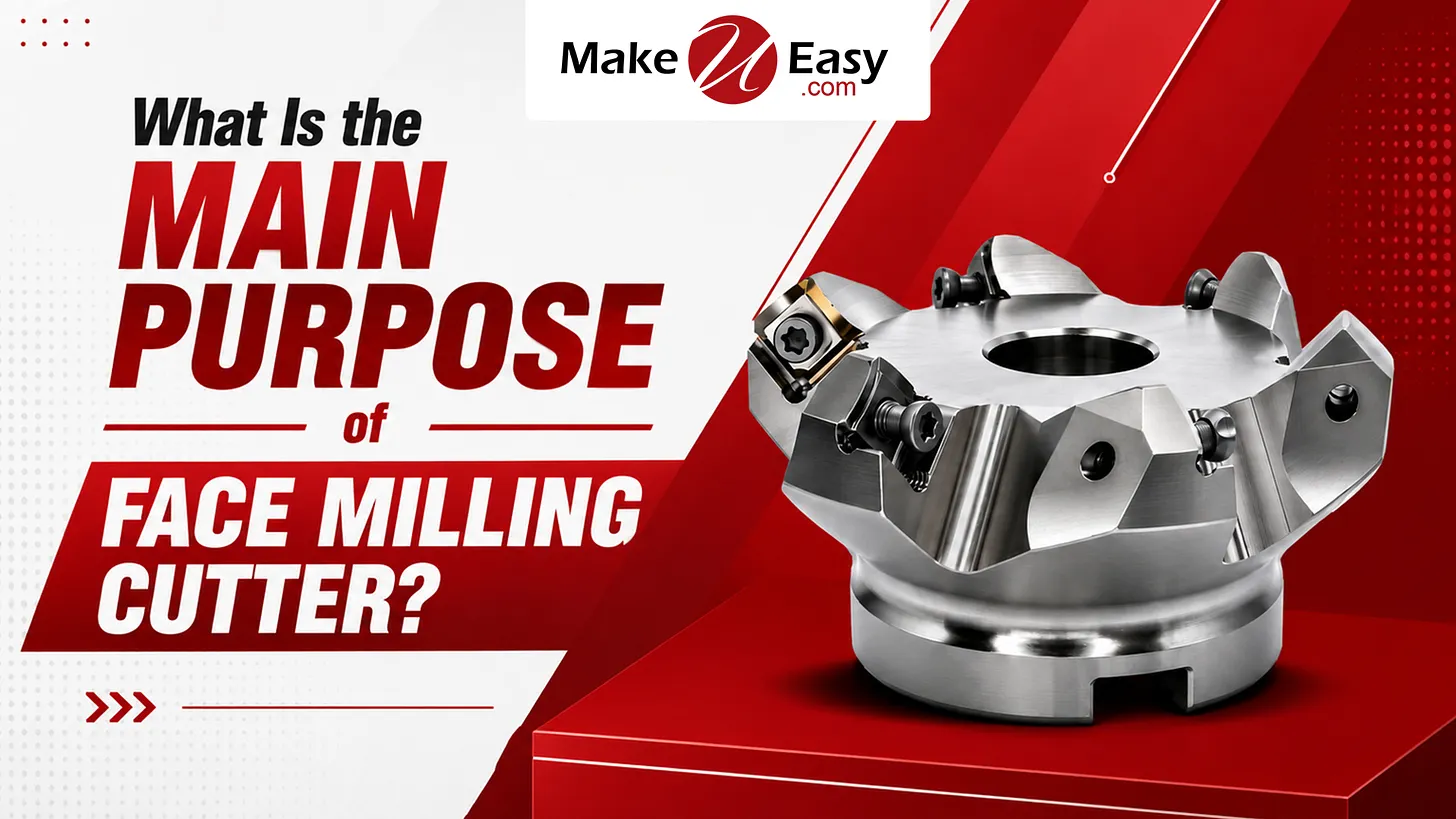
A face milling cutter is a rotary cutting tool designed mainly for machining the surface of a workpiece perpendicular to the cutter axis. Unlike end mills, which can perform a wider variety of operations, face mills are optimized for efficient machining across broad, flat areas.
Most modern CNC face milling cutters use replaceable carbide inserts, allowing worn cutting edges to be indexed or replaced without changing the entire cutter body.
Common face mill sizes include different cutter diameters and insert configurations depending on the machine, workpiece, and required material removal rate.
What Is the Main Purpose of a Face Milling Cutter?
The main purpose of a face milling cutter is to create a flat, accurately machined surface while ndtlslcckij removing material.
It is commonly used to:
-
Flatten rough workpiece surfaces
-
Remove excess material
-
Prepare surfaces for further machining
-
Improve surface finish
-
Machine large areas efficiently
-
Maintain consistent component dimensions
This makes face milling one of the most important operations in CNC machining and general manufacturing.
How Does Face Milling Work?
During face milling, the cutter rotates while the workpiece or cutting tool moves along the programmed feed direction.
The cutting inserts positioned around the cutter body progressively remove material from the workpiece surface.
Because several cutting edges can engage during the operation, face milling can provide a good balance of material removal rate, productivity, and surface finish when the correct cutter and cutting parameters are used.
Key Benefits of Face Milling Cutters
1. High Material Removal
Face milling cutters can cover relatively large surface areas, making them effective for removing material from large components.
2. Better Surface Finish
Proper cutter geometry, insert selection, and machining parameters can produce smooth and consistent surfaces.
3. High Productivity
Multiple cutting inserts allow manufacturers to use productive feed rates while distributing cutting loads across several edges.
4. Replaceable Inserts
Indexable face milling cutters use replaceable carbide inserts, reducing the need to replace the entire cutter when an edge becomes worn.
5. Versatile Machining
Depending on the cutter and insert grade, face mills can machine materials such as:
-
Steel
-
Stainless steel
-
Cast iron
-
Aluminum
-
Alloy steel
-
Other engineering materials
Types of Face Milling Operations
Rough Face Milling
Used for rapid material removal where productivity is the main priority.
Finish Face Milling
Used when surface quality, flatness, and dimensional accuracy are more important.
General-Purpose Face Milling
Balances material removal and surface finish for everyday CNC machining applications.
Face Milling Cutter vs End Mill
Although both are milling tools, they are designed for different primary purposes.
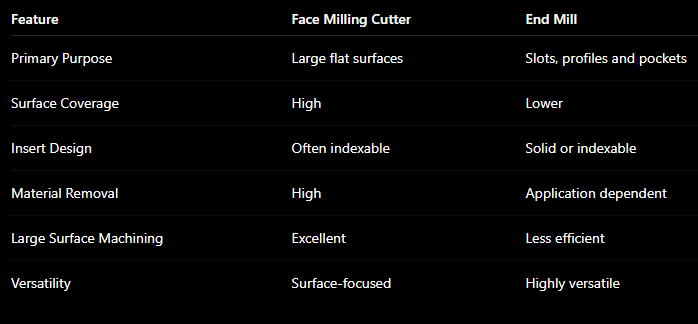
For machining broad, flat surfaces, a face milling cutter is generally the more productive choice.
How to Choose a Face Milling Cutter
Cutter Diameter
Select a diameter appropriate for the workpiece width and machine capacity.
Insert Grade
Match the carbide grade to the workpiece material and cutting conditions.
Insert Geometry
Positive geometries can reduce cutting forces, while stronger geometries may be preferred for demanding machining conditions.
Number of Inserts
The number and pitch of inserts affect feed capability, chip evacuation, and machine power requirements.
Approach Angle
Common face milling cutter designs use different entering angles, such as 45° or 90°, depending on the application.
For example, a 45° face milling cutter can provide smooth cutting action and is commonly used for productive face milling.
Applications of Face Milling Cutters
Face milling cutters are widely used for:
-
CNC machining
-
VMC machining
-
Automotive components
-
Machine bases
-
Mold and die manufacturing
-
Industrial equipment
-
General engineering
-
Precision components
-
Production machining
They are especially useful when large workpiece surfaces must be machined efficiently.
Tips for Better Face Milling Performance
For better machining results:
-
Choose the correct cutter diameter.
-
Match the insert grade to the material.
-
Use recommended cutting speeds and feeds.
-
Maintain proper cutter runout.
-
Keep tool overhang as short as practical.
-
Ensure rigid workpiece clamping.
-
Replace worn inserts at the appropriate time.
-
Use a suitable coolant or machining conditions for the material.
A stable setup helps reduce vibration and improves both tool life and surface quality.
Common Face Milling Problems
Poor Surface Finish
This may result from worn inserts, incorrect feed, excessive runout, or machine vibration.
Insert Chipping
Chipping can occur due to excessive cutting loads, unstable setups, or an unsuitable insert grade.
Vibration
Excessive tool overhang, weak workholding, or unsuitable cutting parameters can contribute to chatter.
Uneven Insert Wear
Check cutter runout, insert seating, and machine alignment when one insert wears significantly faster than others.
Why Choose MakeYouEasy?
At MakeYouEasy, we provide CNC cutting tools and industrial tooling solutions for precision manufacturing applications.
Our product range includes:
-
Face Milling Cutters
-
High Feed Milling Cutters
-
Milling Inserts
-
Turning Inserts
-
Grooving Inserts
-
Thread Milling Cutters
-
U Drills
-
Ball Nose End Mills
-
BT Tool Holders
-
Precision Measuring Instruments
🌐 Explore CNC cutting tools: MakeYouEasy
Conclusion
The main purpose of a face milling cutter is to machine large, flat surfaces efficiently while achieving the required dimensional accuracy and surface finish. Its ability to use multiple cutting edges makes it highly productive for roughing, semi-finishing, and finishing applications.
Choosing the correct cutter diameter, insert grade, geometry, and cutting parameters can improve material removal, tool life, surface quality, and overall CNC machining productivity.
Frequently Asked Questions
1. What is the main purpose of a face milling cutter?
A face milling cutter is mainly used to efficiently machine large, flat workpiece surfaces.
2. What materials can a face milling cutter machine?
With the correct insert grade, face milling cutters can machine steel, stainless steel, cast iron, aluminum, and other engineering materials.
3. Is a face milling cutter suitable for finishing?
Yes, the correct face mill, inserts, and cutting parameters can produce high-quality finished surfaces.
4. What is the difference between a face mill and an end mill?
A face mill is optimized for machining broad flat surfaces, while an end mill is more versatile for slots, pockets, profiles, and contours.
5. How do I choose the right face milling cutter?
Choose according to the workpiece material, cutter diameter, machine capacity, insert grade, approach angle, and required surface finish.
