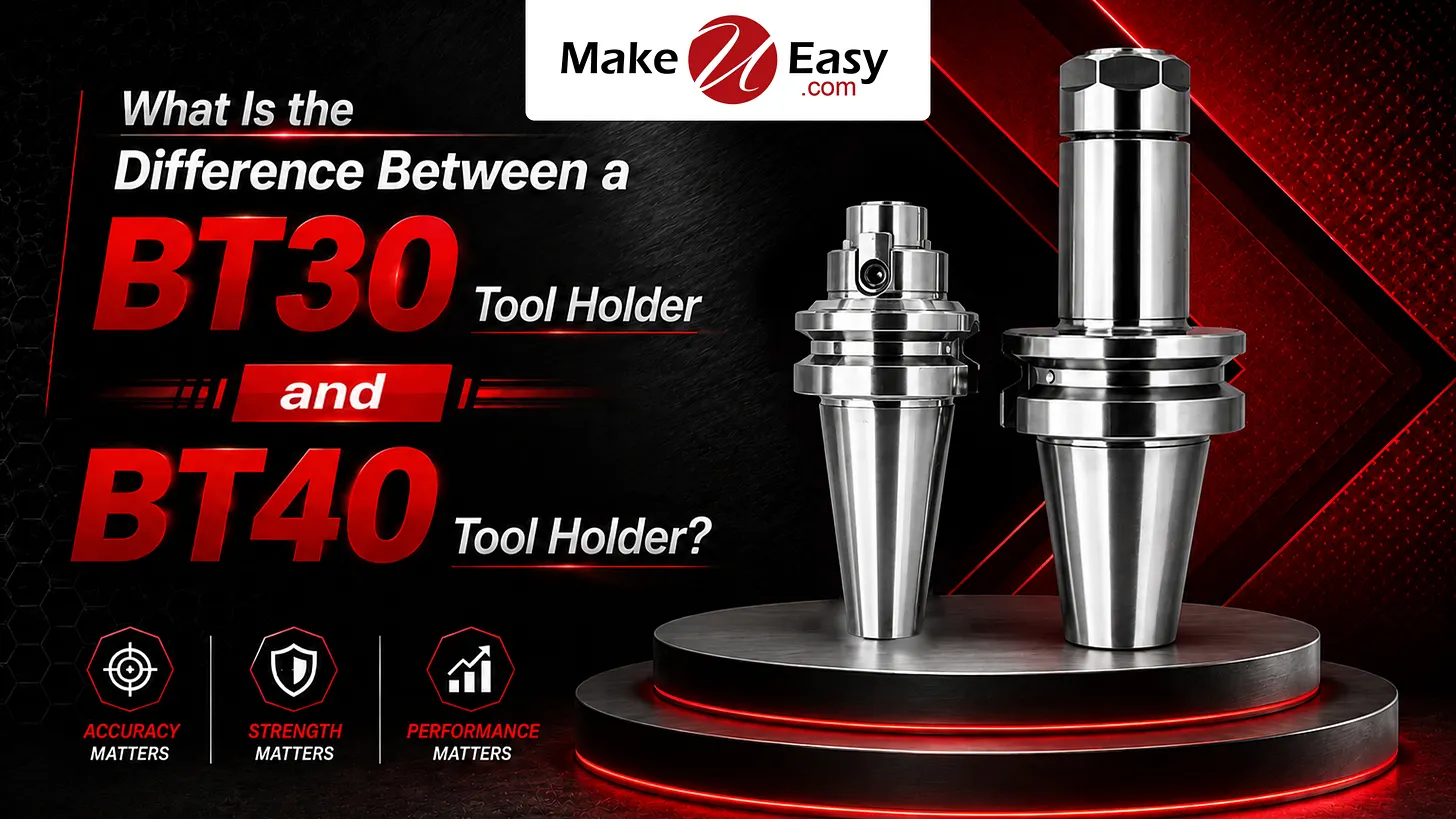
What Is the Difference Between a BT30 Tool Holder and a BT40 Tool Holder?
Author : Surya makeyoueasy | Published On : 19 Aug 2026
Introduction
Choosing the right BT tool holder is important for achieving machining accuracy, rigidity, and reliable tool performance on a CNC machine. BT30 and BT40 tool holders are widely used on vertical machining centers, but they differ in taper size, rigidity, tool capacity, and typical applications. Understanding these differences helps CNC machinists select the right tool holder for their machine and machining requirements.
What Is a BT Tool Holder?
A BT tool holder is a standardized CNC tooling system used to securely hold cutting tools in a machine spindle. The “BT” designation refers to the Japanese MAS 403-style 7/24 taper system, commonly used in CNC machining centers.
BT tool holders are available in different sizes, including
-
BT30
-
BT40
-
BT50
The number indicates the taper size and relates to the overall capacity and rigidity of the tooling system.
What Is a BT30 Tool Holder?
A BT30 tool holder is a compact CNC tool holder designed primarily for lighter machining applications and smaller machining centers.
It is commonly found on:
-
Compact VMCs
-
Small CNC machining centers
-
High-speed machining machines
-
Precision machining equipment
Advantages of BT30
-
Lightweight design
-
Lower spindle load
-
Suitable for smaller machines
-
Good for high-speed applications
-
Easy automatic tool changing
-
Suitable for small to medium cutting tools
BT30 is particularly useful when machine size, spindle speed, and tool weight are important considerations.
What Is a BT40 Tool Holder?
A BT40 tool holder is larger and more rigid than a BT30, making it suitable for a wider range of CNC machining operations.
It is commonly used on:
-
Standard VMC machines
-
General-purpose machining centers
-
Automotive machining
-
Production machining
-
Heavy-duty milling applications
Advantages of BT40
-
Greater rigidity
-
Higher cutting capacity
-
Better support for larger tools
-
Suitable for heavier machining
-
Improved resistance to tool deflection
-
Wide range of available tool holders
BT40 is one of the most common tooling standards for general-purpose CNC machining centers.
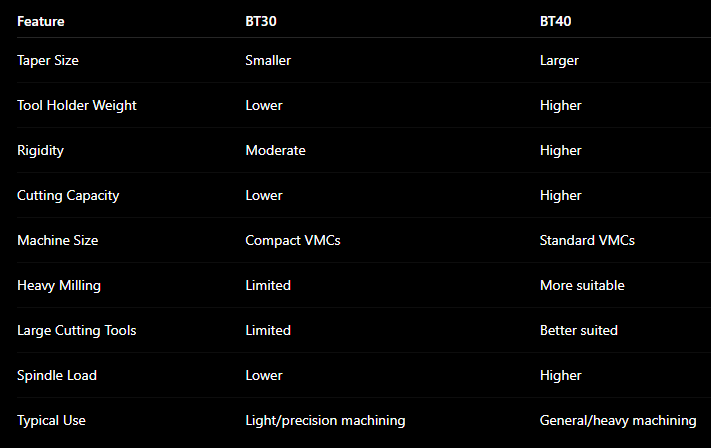
BT30 vs BT40: Key Differences
BT30 vs BT40: Which Is Better?
Neither tool holder is universally better. The correct choice depends on the CNC machine spindle and machining application.
Choose BT30 When:
-
You have a compact VMC.
-
High spindle speed is important.
-
Cutting tools are relatively small.
-
Machining loads are moderate.
-
Lower tool weight is preferred.
Choose BT40 When:
-
You need greater rigidity.
-
Larger milling cutters are required.
-
Heavy material removal is involved.
-
The machine is designed for BT40 tooling.
-
Production machining requires higher cutting capacity.
Rigidity and Machining Performance
One of the most important differences between BT30 and BT40 is rigidity.
BT40’s larger taper and greater tool-holder mass generally provide better support for demanding cutting operations. This can help reduce tool deflection and vibration when machining with larger cutters or deeper cuts.
BT30, on the other hand, can be advantageous for applications where high spindle speeds and lightweight tooling are more important than heavy cutting capacity.
Tool Compatibility
BT30 and BT40 tool holders are not interchangeable.
A BT30 spindle requires BT30-compatible tooling, while a BT40 spindle requires BT40-compatible tooling.
Common BT tool holder types include:
-
BT-ER Collet Chucks
-
BT-FMB Face Mill Holders
-
BT-MTA Morse Taper Adapters
-
BT-SLB Side Lock Holders
-
BT Hydraulic Holders
-
BT Shrink Fit Holders
Always match the tool holder taper and pull stud specifications with the CNC machine spindle.
How to Choose the Right BT Tool Holder
Before purchasing a BT30 or BT40 tool holder, consider:
1. CNC Machine Spindle
First, check the spindle specification. A BT30 machine requires BT30 tooling, while a BT40 machine requires BT40 tooling.
2. Cutting Tool Size
Small end mills may work well with BT30, while larger milling cutters generally benefit from the additional rigidity of BT40.
3. Machining Operation
Light finishing and high-speed machining may favor BT30, while roughing and heavier milling can favor BT40.
4. Spindle Speed
Consider the machine’s maximum spindle speed and select a properly balanced tool holder suitable for the intended RPM.
5. Tool Overhang
Long tool overhang increases the risk of vibration and deflection, so choose the shortest practical tool holder and tool assembly.
Common Applications
BT30 Applications
BT30 tool holders are commonly used for:
-
Small CNC milling
-
Precision machining
-
High-speed machining
-
Small component manufacturing
-
Prototype machining
BT40 Applications
BT40 tool holders are widely used for:
-
VMC machining
-
Automotive components
-
General engineering
-
Mold and die machining
-
Production manufacturing
-
Heavy milling
Why Choose MakeYouEasy?
At MakeYouEasy, you can find CNC tooling solutions designed for professional machining applications.
Our product range includes:
-
BT30 Tool Holders
-
BT40 Tool Holders
-
BT50 Tool Holders
-
ER Collet Chucks
-
Face Mill Holders
-
Morse Taper Holders
-
Side Lock Tool Holders
-
Pull Studs
-
CNC Cutting Tools
-
Precision Measuring Instruments
Explore CNC tooling solutions:
Conclusion
The main difference between BT30 and BT40 tool holders is their size, rigidity, and machining capacity. BT30 is well suited to compact machines, smaller tools, and high-speed or lighter machining, while BT40 provides greater rigidity and is better suited to general-purpose and heavier CNC milling operations.
The most important rule is simple: choose the BT tool holder that matches your CNC spindle and machining requirements. Using the correct holder, suitable cutting tool, and proper machining parameters can improve stability, accuracy, tool life, and overall productivity.
Frequently Asked Questions
1. What is the main difference between BT30 and BT40 tool holders?
BT40 is larger and generally more rigid than BT30, making it better suited for heavier machining applications.
2. Can a BT30 tool holder be used in a BT40 spindle?
No, BT30 and BT40 tool holders require their respective compatible spindle taper systems.
3. Is BT40 better than BT30 for heavy milling?
Yes, BT40 generally provides greater rigidity and cutting capacity for demanding milling operations.
4. Which BT tool holder is better for high-speed machining?
BT30 can be suitable for high-speed machining when its smaller, lighter tooling system matches the machine and application.
5. How do I choose between BT30 and BT40?
Choose based on your CNC spindle specification, cutting-tool size, machining load, spindle speed, and required rigidity.
