What Is Plate RFID System? UHF Intelligent Tracking System
Author : Jaming Wong | Published On : 08 Jun 2026
Plate RFID systems use ultra high frequency RFID technology to automatically identify and track tagged assets at long distances, improving warehouse efficiency, inventory visibility, and automated item management.
Several years ago, while testing a warehouse checkpoint system for reusable industrial trays, we learned something frustrating very quickly: manual scanning simply could not keep up with real traffic flow.
Forklifts moved faster than operators.
Boxes passed through loading zones without registration.
Inventory accuracy dropped little by little every week — not dramatically enough to trigger panic, but enough to quietly damage operations.
That project eventually switched to a ceiling-mounted Cykeo UHF RFID integrated reader system. The difference was immediate.
No handheld scanning.
No stop-and-scan workflow.
Assets moved naturally while RFID captured movement automatically overhead.
That is where plate RFID systems become genuinely useful — not in demonstrations, but in messy, fast-moving environments.
What Is a Plate RFID System?
A plate RFID system is typically an integrated ultra high frequency RFID reader installed overhead or in fixed positions for automatic item identification.
Unlike traditional barcode scanning systems, plate RFID solutions allow:
- Long-distance reading
- Multi-tag recognition
- Automatic warehouse logging
- Real-time inventory updates
- Alarm-based unauthorized movement detection
Cykeo ceiling-mounted RFID systems combine the antenna and reader into one compact device while supporting sound and light alarm functions.
The design matters more than many buyers realize.
Traditional separated antennas often create cable complexity and installation limitations. Integrated ceiling systems simplify deployment dramatically.
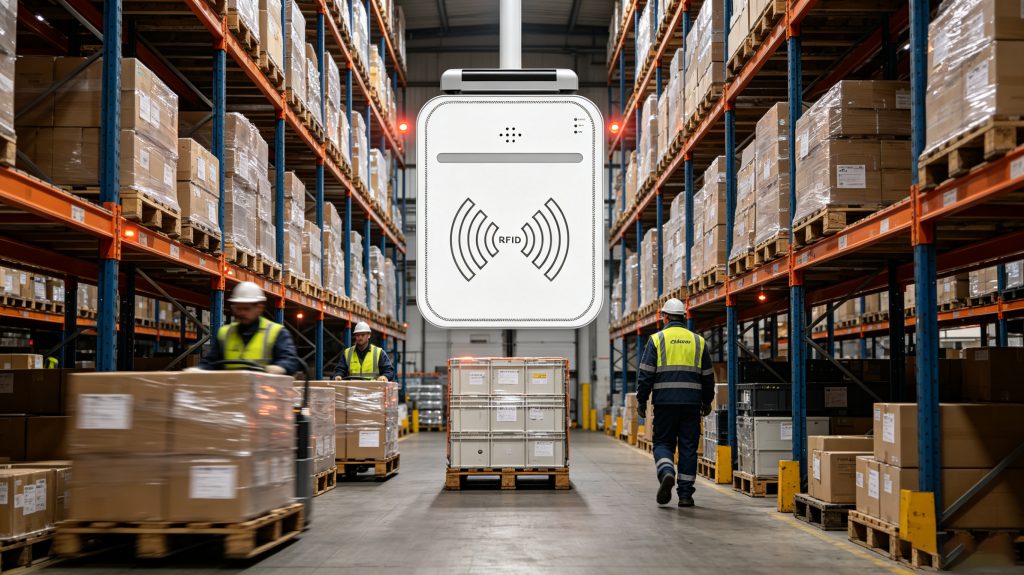
Cykeo plate RFID systems automate warehouse inventory movement tracking with long-range UHF identification.
Why Warehouses Are Moving Toward Automated RFID
Manual Inventory Is Still Expensive
According to research published by Deloitte Supply Chain Insights, inventory visibility remains one of the most critical operational challenges in modern logistics environments.
That sounds corporate.
On-site, the reality is simpler.
People forget to scan things.
They get interrupted.
They rush.
Night shifts miss procedures.
A fully automated RFID overhead system reduces dependence on manual discipline.
That changes operational reliability more than most software upgrades ever will.
Real Deployment Experience With Ceiling RFID
One deployment we participated in involved a medical storage warehouse handling high-volume consumables.
The customer originally relied on barcode tunnels.
The problem was congestion.
Boxes accumulated near scanning checkpoints because operators needed precise barcode alignment.
After installing Cykeo ceiling-mounted UHF RFID readers above entry and exit points, workflow changed almost overnight.
Goods moved continuously.
The RFID system identified multiple tagged assets simultaneously from distances approaching 10 meters.
Even better, unauthorized asset movement triggered immediate sound and light alarms.
The warehouse supervisor later mentioned something unexpected:
“The biggest improvement was not speed. It was finally trusting the movement records.”
That sentence stuck with me.
Because in industrial operations, trust in data changes behavior.
Key Features of Cykeo Plate RFID Systems
Long-Range UHF Reading
Cykeo integrated RFID ceiling readers support long-distance UHF identification, suitable for warehouse corridors and asset movement checkpoints.
Intelligent Alarm Function
Integrated sound and light alarms help detect unauthorized tagged assets or abnormal item movement.
Compact Ceiling Installation
The ceiling-mounted structure saves floor space while maintaining wide-area coverage.
Multi-Tag Recognition
Advanced anti-collision algorithms support dense tag reading and rapid asset movement environments.
Fully Automated Record Management
The system automatically records inbound and outbound item activity without manual scanning.
Typical Applications for Plate RFID
| Industry | RFID Usage |
|---|---|
| Warehousing | Automated inventory movement |
| Manufacturing | Production material tracking |
| Hospitals | Medical asset control |
| Libraries | Smart circulation management |
| Logistics | Pallet and container tracking |
| Retail Storage | Backroom inventory visibility |
The interesting part is how invisible the technology becomes after deployment.
Operators stop “using RFID.”
They simply move inventory normally while the system works quietly in the background.
That is usually the sign of a successful RFID project.
Why Ultra High Frequency RFID Matters
Ultra high frequency RFID enables longer reading distances and faster multi-tag recognition compared with lower-frequency systems.
According to RAIN Alliance RFID Technology Overview, UHF RFID is widely adopted in logistics and inventory automation because it supports simultaneous reading of large numbers of tags without line-of-sight scanning.
In practice, this means:
- Faster warehouse throughput
- Reduced labor dependency
- Better inventory accuracy
- Reduced operational bottlenecks
The gap becomes especially obvious during peak shipment periods.
Barcode systems slow down under pressure.
Automated RFID systems usually scale more smoothly.
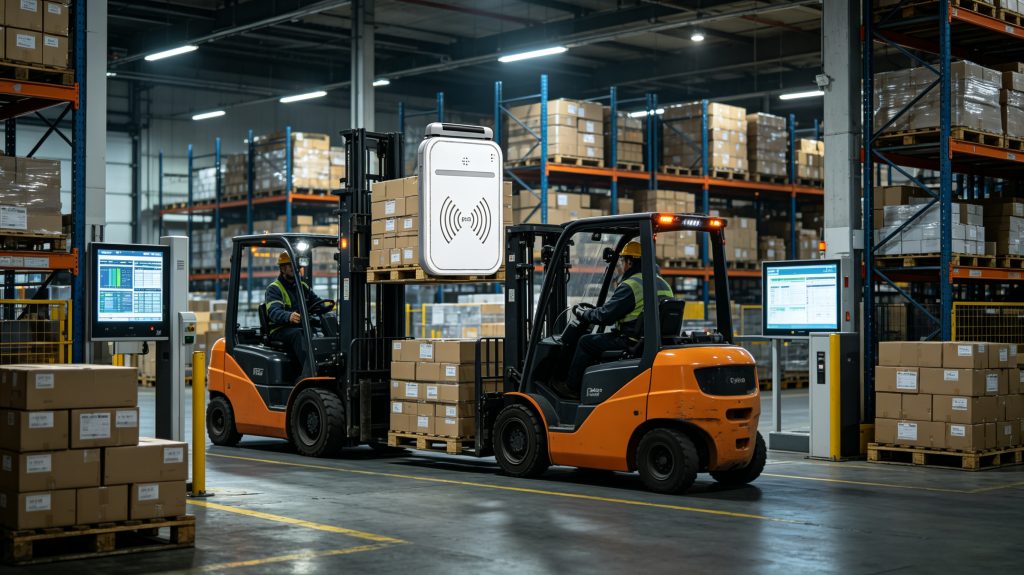
Integrated UHF RFID ceiling readers improve inventory visibility and reduce manual scanning workload.
FAQ
What is plate RFID used for?
Plate RFID systems are commonly used for automated warehouse tracking, logistics management, inventory visibility, and industrial asset control.
How far can UHF plate RFID readers detect tags?
Depending on antenna design and tag type, many ceiling-mounted UHF RFID systems can achieve reading distances close to 10 meters.
Can plate RFID systems read multiple tags at once?
Yes. Ultra high frequency RFID supports simultaneous multi-tag reading using anti-collision algorithms.
Why use ceiling-mounted RFID readers?
Ceiling-mounted RFID systems save floor space, provide wider reading coverage, and support automated inventory movement detection.
Final Thoughts
Plate RFID systems are becoming increasingly important in environments where manual scanning slows operations and introduces avoidable errors.
The technology itself is not new anymore.
What has changed is deployment maturity.
Modern ultra high frequency RFID systems now deliver stable long-range reading, dense tag recognition, and automated tracking reliability that industrial operators can actually trust day after day.
In busy warehouses, that reliability matters more than flashy specifications.
And once automated RFID visibility becomes part of daily operations, very few facilities want to return to manual scanning again.
