What Is a RFID Scanner? Understanding RFID Reading Technology and Industrial Applications
Author : Jaming Wong | Published On : 31 Jul 2026
What is a rfid scanner? An RFID scanner is a device that reads and captures information stored in RFID tags through radio frequency signals. It identifies multiple tagged items without direct contact, allowing businesses to automate inventory, asset tracking, and identification processes in industries such as manufacturing, healthcare, logistics, libraries, and government management.
Understanding What Is a RFID Scanner in Modern Identification Systems
After years working with RFID deployment projects, I have found that many companies initially misunderstand RFID scanners. They often compare them with barcode scanners, expecting only a faster way to capture numbers. In reality, an RFID scanner becomes the communication point between physical assets and digital management platforms.
During one industrial tool management project, I observed technicians spending nearly 20 minutes searching for equipment before maintenance tasks could begin. After implementing an RFID scanning system, every tagged tool could be identified through an RFID reader, and the software automatically recorded movement history.
That practical difference explains why enterprises ask what is a rfid scanner before investing in RFID solutions.
An RFID scanner is not simply a reading device. It is a key component that enables automatic identification, data collection, and real-time asset visibility.
How Does an RFID Scanner Work?
An RFID scanner works by sending radio frequency energy to communicate with RFID tags.
The basic process includes:
- The RFID scanner generates a radio signal.
- The RFID tag receives energy and responds with stored information.
- The scanner collects the tag data.
- The software platform processes and links the information with business records.
Unlike traditional barcode scanning, RFID scanners do not require a direct line of sight.
A warehouse employee does not need to manually position every item. A fixed RFID scanner installed at a doorway can automatically identify tagged products passing through the area.
Main Components of an RFID Scanner System
| Component | Function |
|---|---|
| RFID Scanner / Reader | Sends signals and receives tag responses |
| RFID Antenna | Controls communication range and coverage |
| RFID Tags | Store EPC codes and identification information |
| Software Platform | Manages, analyzes, and displays collected data |
A professional RFID system depends on the balance between these components. In real deployments, antenna positioning, tag material, and environment conditions often determine performance more than the scanner itself.
What Does an RFID Scanner Read?
An RFID scanner reads digital information stored inside RFID tags.
Common data includes:
- EPC (Electronic Product Code)
- Unique identification numbers
- Product information references
- Asset management codes
- Inventory status information
For enterprise applications, RFID tags usually do not store all business information directly. Instead, the EPC number acts as a unique key connected to a database.
For example, Cykeo RFID smart workstations can register RFID tags by writing EPC serial numbers and associating each tag with specific product or asset information.
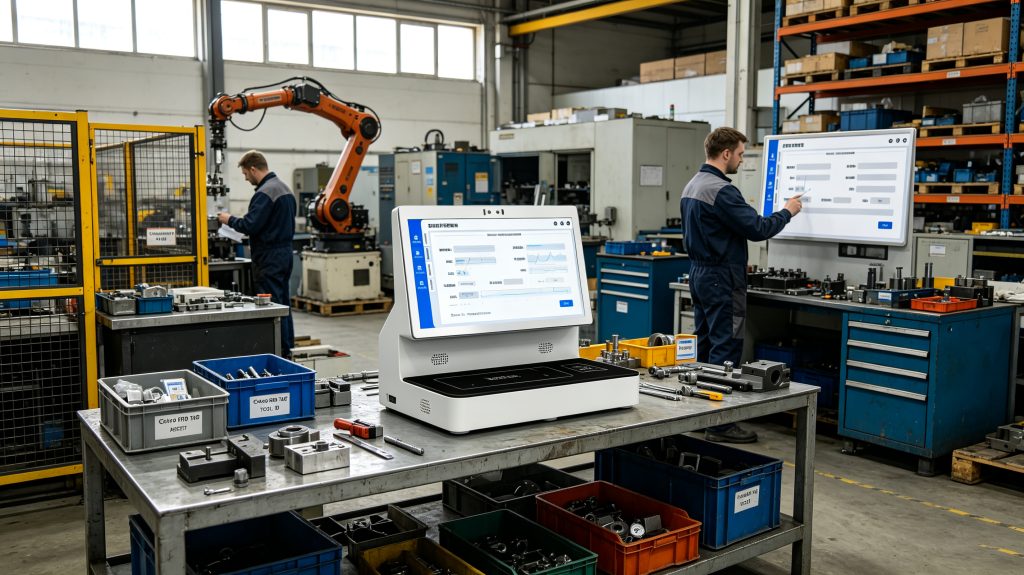
RFID scanners automatically identify equipment and assets, improving visibility and reducing manual tracking work.
RFID Scanner Types and Their Applications
Fixed RFID Scanner
Fixed RFID scanners are installed in permanent locations.
Typical applications:
- Warehouse entrances
- Production lines
- Smart cabinets
- Library management systems
- Access control areas
Advantages:
- Continuous automatic identification
- Hands-free operation
- Suitable for high-volume environments
Cykeo industrial RFID readers are designed for applications requiring stable reading performance, multi-tag recognition, and integration with enterprise software systems.
Handheld RFID Scanner
Handheld RFID scanners provide mobility.
They are commonly used for:
- Inventory counting
- Equipment inspection
- Field asset management
- Retail stock checking
Operators can walk through storage areas and collect hundreds of tag records quickly.
RFID Scanner Advantages Compared with Barcode Technology
| Feature | RFID Scanner | Barcode Scanner |
|---|---|---|
| Direct visibility required | No | Yes |
| Multiple item reading | Yes | Usually one at a time |
| Reading speed | High | Medium |
| Automation capability | Excellent | Limited |
| Environmental flexibility | Strong | Lower |
According to GS1 RFID Technology Overview, RFID technology is widely adopted across supply chains because it improves identification efficiency and data accuracy.
How RFID Scanners Improve Business Operations
Asset Management
Companies can monitor:
- Tool locations
- Equipment usage
- Maintenance history
- Borrowing records
This is especially valuable in industries where missing equipment creates delays.
Inventory Management
Traditional inventory counting requires employees to scan products manually.
RFID scanners allow:
- Faster stock checking
- Automatic item recognition
- Reduced counting errors
- Real-time inventory updates
In large warehouses, the difference is significant because thousands of items may need identification within a limited time window.
Healthcare and Laboratory Applications
Hospitals use RFID scanners for:
- Medical equipment tracking
- Surgical instrument management
- Pharmaceutical inventory control
A properly designed RFID system helps healthcare organizations understand where critical assets are located.
Cykeo RFID Scanner Solutions and Practical Experience
Cykeo develops RFID identification solutions for industrial and commercial environments.
Our RFID systems support:
- ISO18000-6C (EPC C1G2) protocol
- High-speed tag identification
- EPC data management
- Enterprise database integration
- Customized RFID applications
From practical deployment experience, the most successful RFID scanner projects are not simply about achieving maximum reading distance. They focus on stable identification where the business process actually happens.
A controlled reading area can sometimes be more valuable than a longer range because it prevents unwanted tag reads.

Libraries use RFID scanners to automate book identification, inventory checking, and circulation management.
Frequently Asked Questions About What Is a RFID Scanner
Is an RFID scanner the same as an RFID reader?
Yes, the terms are often used interchangeably. In industrial applications, “RFID scanner” usually emphasizes the identification process, while “RFID reader” refers to the hardware communication device.
How far can an RFID scanner read tags?
Reading distance depends on frequency, antenna design, tag type, and environment.
UHF RFID scanners can often achieve several meters of reading range when properly configured.
Can RFID scanners read multiple tags at once?
Yes. One major advantage of RFID scanners is multi-tag identification. Advanced systems can process many tags simultaneously, making them suitable for inventory and asset management.
Do RFID scanners require internet access?
Not always. RFID scanners can communicate locally through interfaces such as Ethernet, USB, or serial communication. Internet connectivity depends on the software architecture.
Conclusion: What Is a RFID Scanner and Why Does It Matter?
What is a rfid scanner is ultimately a question about how businesses connect physical objects with digital information.
An RFID scanner transforms ordinary assets into identifiable data sources. From manufacturing tools to library books, it helps organizations reduce manual work, improve accuracy, and create transparent management processes.
With practical experience in RFID system deployment, Cykeo continues developing reliable RFID scanner solutions that support smarter identification, tracking, and automation across global industries.
