what is a rfid label: A Practical Guide to RFID Labels
Author : Jaming Wong | Published On : 12 Oct 2026
RFID label is a printable identification label that combines an RFID chip and antenna with a paper or synthetic label material. It allows products, cartons, or assets to be identified wirelessly while retaining human-readable information such as product names, numbers, or barcodes.
That distinction matters in real deployments. An RFID label is not simply a barcode with radio communication added. Inside the label is an RFID inlay containing the chip and antenna; the outer material provides the surface for printing and attachment.
At Cykeo, when we evaluate RFID labels for an application, we look at the item being tagged first, not just the reader specification. A label that performs well on corrugated cartons may behave very differently when moved onto a metal tool, liquid-filled container, or densely packed product.
That is one of the details that tends to get missed during procurement.
How RFID Labels Work
What Is Inside an RFID Label?
A typical RFID label contains three functional layers:
| Component | Primary Function |
|---|---|
| RFID chip | Stores identification and other encoded data |
| RFID Antenna | Receives reader energy and communicates with the reader |
| Label substrate | Holds the inlay and provides a printable surface |
For a passive RFID label, the tag does not need a battery. The reader supplies the RF energy needed for communication.
GS1 describes RFID as a family of technologies in which information is stored in a microelectronic chip and communicated with dedicated readers using radio-frequency waves or fields. GS1’s current standards repository lists EPC Gen2 as the UHF RFID air-interface standard and the current version as 3.0.1, modified February 26, 2026.
That makes RFID labels particularly useful when a business needs to identify large numbers of physical objects without manually scanning every printed code.
What Data Can an RFID Label Carry?
The answer depends on the RFID chip and how the system is configured.
In an EPC-based deployment, an RFID label can carry an Electronic Product Code associated with a unique physical object. GS1 explains that EPC provides a way to encode GS1 identifiers on RAIN RFID tags and can add serialization to identifiers such as GTINs.
Typical information associated with an RFID label includes:
- Product identification
- Serialized item information
- Asset identification
- Inventory references
- Application-specific user memory
- Information associated with a GS1 identifier
The label does not necessarily need to contain every piece of product information. In many systems, the RFID tag provides the identifier while the business database holds the detailed record.
RFID Label Types for Different Applications
UHF RFID Labels
UHF RFID labels are common in logistics, warehousing, retail, and supply-chain applications because they can support identification of multiple tagged objects within a reading zone.
GS1’s EPC/RFID specifications identify UHF EPC/RFID as operating in the 860–960 MHz range, while the specific regulatory operating band depends on the region.
For a warehouse carton, a conventional UHF RFID label may be sufficient.
For metal assets, however, a standard paper label is often not the right choice. A specialized on-metal RFID label may be required because the mounting surface changes antenna behavior.
Paper RFID Labels vs Industrial RFID Tags
| Type | Typical Environment | Main Consideration |
|---|---|---|
| Paper RFID label | Cartons, products, packaging | Low-cost labeling |
| Synthetic RFID label | More demanding environments | Improved material durability |
| On-metal RFID label | Metal equipment and tools | Designed for metal surfaces |
| Hard RFID tag | Industrial assets | Mechanical protection |
The physical format should follow the application. It is tempting to standardize on one label across an entire operation, but that can create unnecessary read-performance problems later.
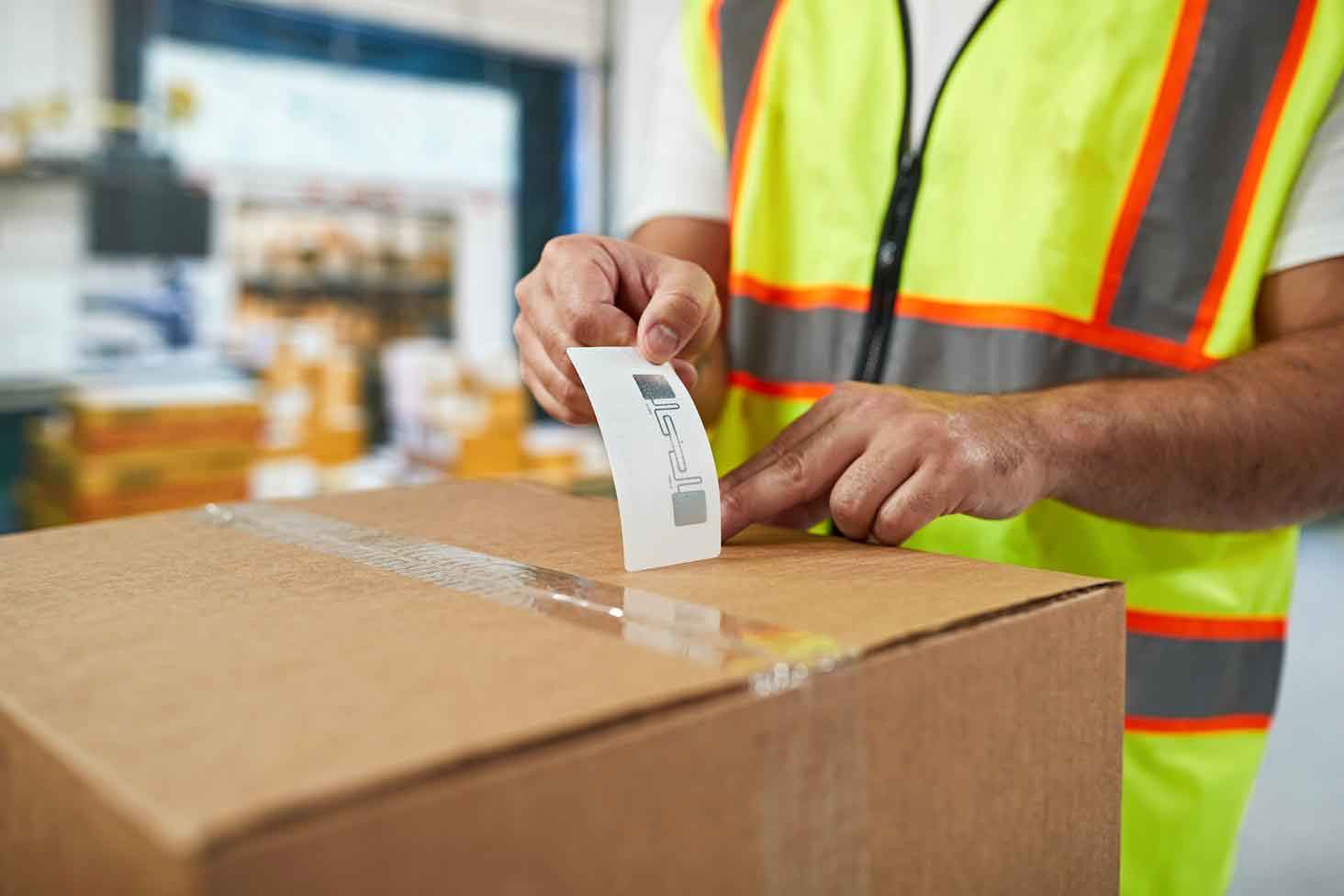
A printable UHF RFID label combines product identification with wireless RFID tracking.
What Are RFID Labels Used For?
RFID Label Applications in Supply Chains
RFID labels are useful wherever physical products need to be identified as they move through a process.
Common applications include:
- Warehouse inventory: identifying cartons, cases, and products
- Retail: supporting item-level inventory visibility
- Manufacturing: tracking components and work-in-progress
- Logistics: associating shipments with digital records
- Libraries: identifying books and other circulating assets
- Asset management: assigning unique identities to equipment
GS1’s traceability guidance specifically describes EPC/RFID tags being used for serialized identification and notes that fixed readers and handheld devices can be combined to capture important tracking events.
That combination is important. A label on its own does not create traceability. The reader, software, business identifier, and capture points all have to work together.
What Makes an RFID Label Useful?
The practical advantage becomes clearer when looking at a busy receiving area.
A barcode requires the operator or scanning equipment to optically capture the printed symbol. RFID can identify tagged objects through radio communication, potentially allowing several tags to be captured in one reading operation.
Research from Auburn University’s RFID Lab illustrates why that capability matters. A field experiment involving 13 retail stores over 23 weeks found that RFID-enabled automatic inventory-record adjustment reduced inventory record inaccuracy by about 26%. The researchers also conducted a larger second study involving 62 stores and five product categories.
That result should not be interpreted as a guaranteed 26% improvement for every RFID installation. Product category, process design, reader placement, tag performance, and operational discipline all matter.
The more useful lesson is that RFID labels can become part of a measurable inventory-control process rather than functioning merely as another identification sticker.
What Should You Check Before Buying RFID Labels?
Before ordering a large quantity, I recommend testing actual samples against the actual products.
Check:
- Tag frequency — confirm compatibility with the RFID reader.
- Chip type and memory — verify the required data can be stored.
- Mounting surface — test cardboard, plastic, metal, glass, or other materials.
- Label dimensions — make sure the label fits the available surface.
- Printing requirements — determine whether barcodes, text, or logos must also appear.
- Read performance — test at the real installation distance and orientation.
- Environmental conditions — consider moisture, temperature, abrasion, and handling.
The last three are frequently overlooked. In an actual warehouse, labels are bent, covered, stacked, exposed to dust, and sometimes placed at inconsistent orientations.
That is where a specification sheet stops being enough.
RFID Label vs Barcode: What Is the Difference?
Why Use an RFID Label Instead of a Barcode?
An RFID label and a barcode label can look similar on the outside, but they operate differently.
A barcode stores information visually and normally requires a scanner to see the printed code. An RFID label stores information electronically in its RFID chip and communicates wirelessly with an RFID reader.
| Feature | RFID Label | Barcode Label |
|---|---|---|
| Reading method | Radio frequency | Optical scanning |
| Line of sight | Not necessarily required | Generally required |
| Multiple-item reading | Possible | Usually one code at a time |
| Data storage | RFID chip memory | Printed symbol |
| Rewritable | Depending on chip | No |
| Human-readable printing | Yes | Yes |
| Typical application | Automated identification | Conventional identification |
This does not mean RFID labels automatically replace barcodes. In many deployments, the two are printed together.
That combination is useful. The RFID component supports automated machine reading, while the barcode gives employees a familiar visual reference during exception handling.
How to Choose the Right RFID Label
Match the RFID Label to the Tagged Object
The correct RFID label depends heavily on the object receiving it.
A few practical examples:
Cardboard carton:
A standard passive UHF RFID label is often suitable because cardboard has relatively little influence on UHF tag performance.
Plastic container:
Testing is still important because container geometry and contents can affect the RF environment.
Metal tool:
A conventional paper RFID label may perform poorly when directly attached to metal. An on-metal RFID label designed with an appropriate structure is usually a better starting point.
Liquid-filled container:
The liquid content can affect UHF RFID performance, so the tag should be tested on the actual container rather than evaluated separately.
At Cykeo, I prefer testing the complete combination—tag + product + reader + antenna + software workflow—before recommending a production quantity. It takes longer at the beginning, but it avoids the expensive situation where thousands of labels have already been printed and the reading process then needs to be redesigned.
What Is the Read Range of an RFID Label?
RFID Label Reading Distance Depends on the System
There is no single reading distance that applies to every RFID label.
Actual performance depends on:
- RFID frequency
- Reader output power
- Antenna gain and polarization
- RFID chip sensitivity
- Label orientation
- Distance between reader and tag
- Tagged material
- Nearby metal or liquids
- Regional radio regulations
For UHF systems, GS1 specifies the EPC Gen2 air interface within the 860–960 MHz frequency range, but a deployment does not simply operate at one universal frequency worldwide. Regional spectrum rules determine the permitted operating channels and power conditions.
This is why I would not select an RFID label based solely on a supplier’s advertised maximum distance.
A controlled three-meter reading zone can be much more useful than an uncontrolled ten-meter zone if the business needs to know exactly when a pallet enters a specific area.
How RFID Labels Fit Into a Complete RFID System
RFID Label, Reader, Antenna, and Software
An RFID label is only one part of an RFID system.
A typical deployment contains:
RFID label → RFID reader → antenna → communication interface → application software → business database
Each layer has a different job.
The label identifies the object.
The reader communicates with the label.
The antenna shapes the RF interaction.
The software interprets the captured information.
The business system turns the event into an inventory, shipment, asset, or production record.
That last step is where many projects become complicated.
A warehouse can capture thousands of EPC values every hour, but those readings have little operational value if the software cannot distinguish receiving, storage, picking, and shipping events.
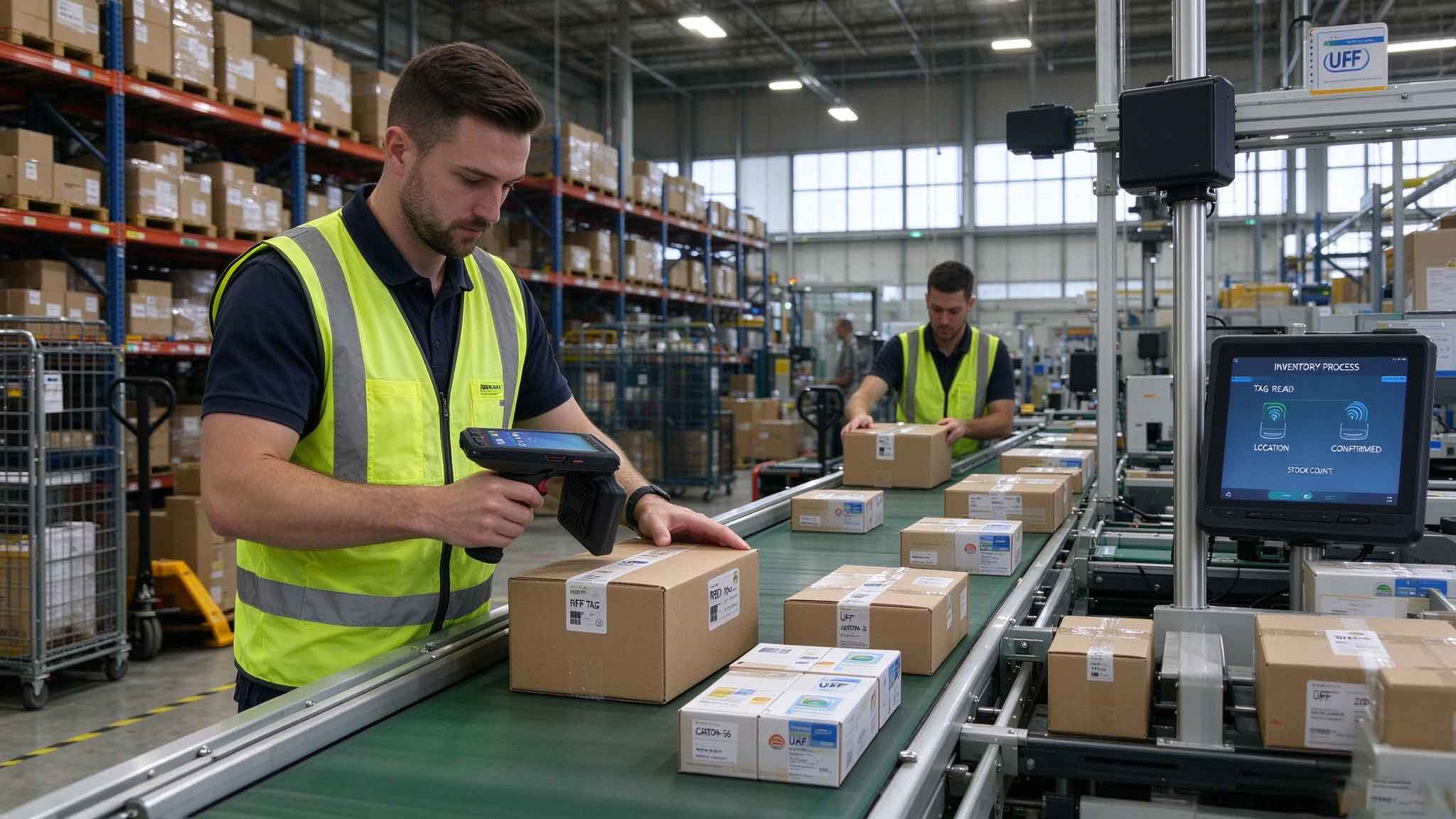
RFID labels allow tagged products and cartons to become identifiable data points within automated inventory processes.
What Are the Benefits of RFID Labels?
Practical Advantages for Businesses
RFID labels can provide several operational advantages when the application is properly designed:
- Automatic identification of tagged objects
- Reduced manual scanning for repetitive inventory operations
- Serialized identification at item level
- Potential multi-tag reading with compatible systems
- Printable information for human operators
- Integration with inventory and enterprise systems
- Flexible label formats for different products and environments
The important qualification is “when properly designed.”
RFID does not remove the need for process engineering. A poorly positioned antenna, unsuitable tag, excessive read zone, or badly configured software can create just as many operational problems as it solves.
That is why field testing matters.
Frequently Asked Questions About What Is a RFID Label
1. What is a RFID label used for?
A RFID label is used to identify and track products, cartons, assets, and other physical objects wirelessly. It is commonly used in inventory management, logistics, manufacturing, retail, libraries, and supply-chain operations.
2. How does a RFID label work?
A passive RFID label receives RF energy from a compatible reader and uses that energy to communicate information stored in its RFID chip. The reader captures the tag data and sends it to connected software.
3. Is a RFID label the same as a barcode?
No. A barcode stores information in a visual printed pattern, while an RFID label contains an electronic RFID inlay. RFID can support wireless and multi-tag identification, while barcode scanning normally requires optical access to the printed code.
4. Can RFID labels be printed?
Yes. Many RFID labels have a printable surface that can contain product names, serial numbers, barcodes, logos, or other human-readable information while the embedded RFID inlay provides wireless identification.
5. Can RFID labels be used on metal?
Some can, but a standard RFID label should not automatically be assumed to work well directly on metal. Specialized on-metal RFID labels are designed for these applications and should be tested on the actual asset.
6. Are RFID labels reusable?
It depends on the label construction and application. Some RFID chips can be rewritten, but adhesive labels are generally designed around the lifecycle of the item or packaging to which they are attached.
Practical RFID Label Testing at Cykeo
When testing a new RFID label, I would not begin with a theoretical maximum range.
I start with the actual object.
Place the label where it will really be attached. Put several tagged objects into the same carton or shelf configuration. Introduce the reader and antenna that will actually be installed. Then repeat the test while changing orientation, distance, tag density, and movement speed.
This reveals problems that a bench test can hide.
For example, a label may read perfectly when placed flat and centered. Turn the carton ninety degrees, add ten more cartons, move them through the reading zone, and the result can change. That is not necessarily a defective label. It is information about the RF environment.
This is also why Cykeo treats RFID labels as part of the complete identification system rather than as an isolated consumable.
Conclusion
What is a RFID label? It is a printable RFID identification medium that combines an RFID inlay with a label substrate, allowing physical objects to carry both visible information and electronically readable identity.
For straightforward cardboard packaging, a conventional UHF RFID label may be enough. Metal, liquids, harsh environments, or specialized asset tracking require more careful tag selection and testing.
The useful question is therefore not simply which RFID label has the longest advertised range. It is which label remains readable, writable when required, physically suitable, and operationally useful throughout the actual workflow.
That distinction is where successful RFID implementation begins.
