What Are the Key Differences Between CNMG and DNMG Inserts?
Author : Surya makeyoueasy | Published On : 17 Aug 2026
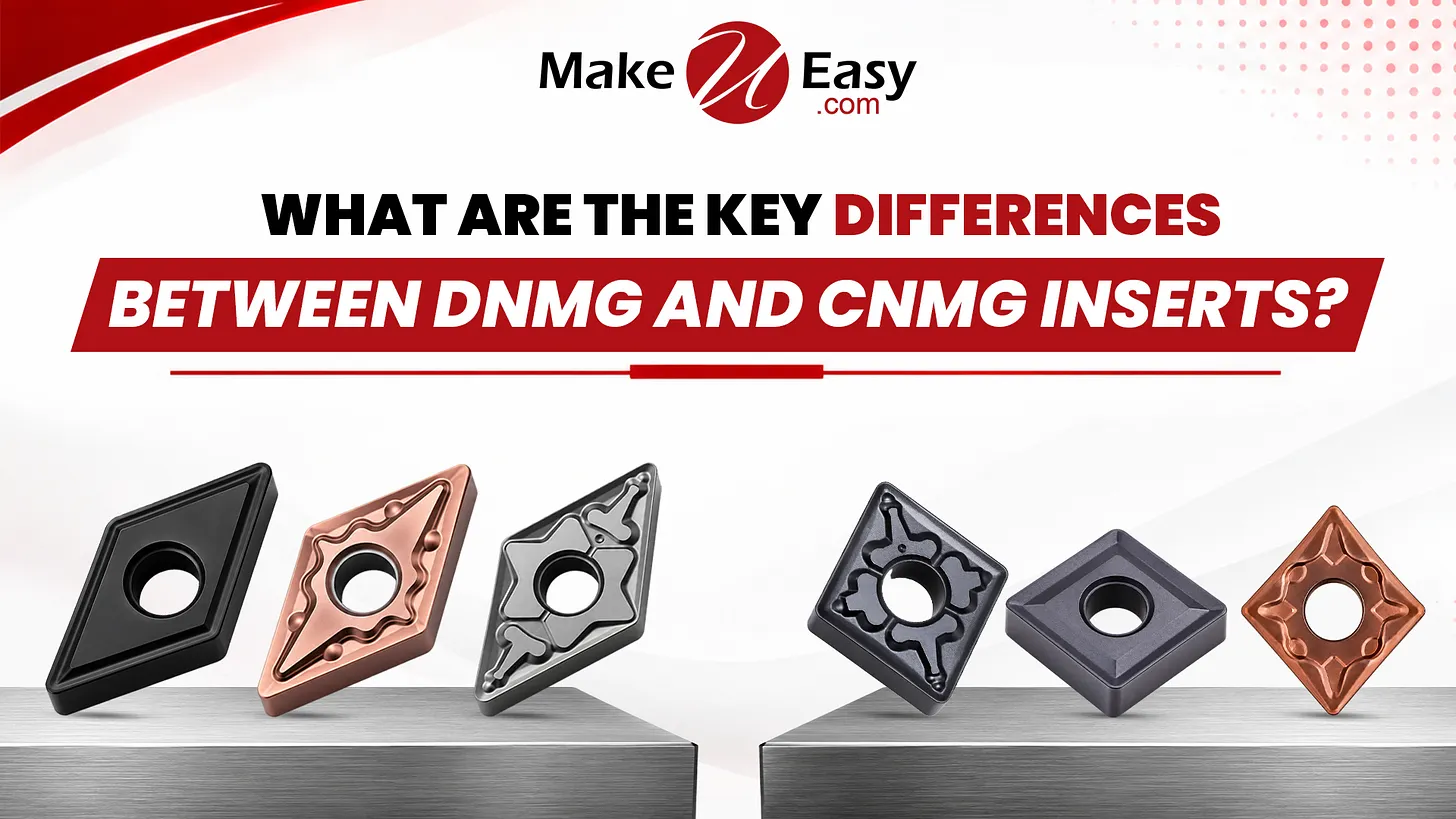
Introduction
CNMG and DNMG inserts are widely used carbide inserts for CNC turning, but their different geometries make them suitable for different machining requirements. CNMG inserts feature an 80° diamond-shaped geometry designed for strength and versatility, while DNMG inserts use a 55° diamond geometry that provides better access for profiling and finishing. Understanding the differences between CNMG vs DNMG inserts helps CNC machinists select the right insert for roughing, finishing, profiling, and general turning operations.
What Is a CNMG Insert?
CNMG inserts are negative-rake, double-sided carbide turning inserts with an 80° included angle.
Their strong cutting-edge geometry makes them suitable for demanding turning operations, particularly where stability and material removal are important.
Common CNMG Applications
-
Heavy roughing
-
General turning
-
Facing
-
Semi-finishing
-
External turning
-
Interrupted cutting
CNMG inserts are popular because their geometry provides multiple usable cutting edges, helping reduce tooling costs during production.
What Is a DNMG Insert?
DNMG inserts are also negative-rake, double-sided carbide turning inserts, but they have a 55° included angle.
The sharper diamond geometry provides greater accessibility around profiles, shoulders, and complex component shapes.
Common DNMG Applications
-
Finish turning
-
Profiling
-
Contouring
-
Shoulder machining
-
External turning
-
Internal turning
DNMG inserts are particularly useful when tool access and profile accuracy are more important than maximum cutting-edge strength.
CNMG vs DNMG: Key Differences
FeatureCNMGDNMGInsert Shape80° diamond55° diamondCutting EdgeStrongerSharperRoughingExcellentGoodFinishingGoodExcellentProfilingModerateExcellentAccessibilityLowerHigherEdge StrengthHigherLowerComplex ProfilesLimitedBetter suitedCommon UseRoughing & general turningFinishing & profiling
1. Insert Geometry
The biggest difference between CNMG and DNMG inserts is their shape.
CNMG
The 80° geometry provides a strong cutting edge that can withstand higher cutting forces.
DNMG
The 55° geometry provides better access to component profiles and allows the tool to machine contours that may be difficult to reach with a CNMG insert.
2. Cutting Edge Strength
CNMG generally has the advantage when cutting forces are high.
Its stronger included angle makes it suitable for:
-
Heavy material removal
-
Rough turning
-
Interrupted cuts
-
Less stable machining conditions
DNMG has a sharper geometry, but its smaller included angle makes the cutting edge comparatively more vulnerable to excessive cutting forces or impact.
3. Profiling Performance
This is where DNMG inserts have a significant advantage.
The 55° geometry allows better access to:
-
Contoured surfaces
-
Tapered sections
-
Shoulders
-
Complex profiles
-
Internal features
For precision profiling and finishing, DNMG is often the more suitable choice.
4. Roughing Performance
For heavy-duty roughing, CNMG is generally preferred because its geometry provides greater edge strength.
A suitable CNMG grade can handle substantial cutting loads while maintaining reliable performance.
DNMG can also perform roughing operations, but it is usually selected when profile accessibility or finishing requirements are more important.
5. Surface Finish
DNMG inserts can be advantageous for finishing and profiling because their geometry provides better access and cutting control.
However, surface finish depends on more than insert shape.
It is also influenced by:
-
Feed rate
-
Nose radius
-
Cutting speed
-
Insert grade
-
Workpiece material
-
Machine rigidity
-
Tool overhang
6. Tool Life
Neither insert is automatically better for tool life.
CNMG may provide longer life during heavy roughing because of its stronger cutting edge.
DNMG can provide excellent life during suitable finishing and profiling operations when the cutting conditions match the insert geometry.
The correct insert grade and cutting parameters are critical for maximizing tool life.
Which Is Better: CNMG or DNMG?
The answer depends on the machining application.
Choose CNMG When You Need:
-
Heavy roughing
-
Strong cutting edges
-
High material removal
-
General-purpose turning
-
Interrupted cutting capability
Choose DNMG When You Need:
-
Precision profiling
-
Finish turning
-
Better access to contours
-
Complex component profiles
-
Shoulder and contour machining
In many CNC workshops, CNMG and DNMG inserts complement each other rather than compete directly.
How to Choose the Right Insert Grade
Insert shape is only one part of tool selection.
Consider the workpiece material:
-
Steel: Select a grade optimized for wear resistance and continuous turning.
-
Stainless Steel: Choose a grade with suitable toughness and chip control.
-
Cast Iron: Wear-resistant grades are often preferred.
-
Aluminum: Sharp cutting geometries and suitable positive-rake options can improve performance.
Always follow the insert manufacturer’s recommended cutting parameters for the selected grade.
Tips for Better CNC Turning Performance
To get the best results from CNMG or DNMG inserts:
-
Select the correct insert grade for the workpiece.
-
Use recommended cutting speeds and feed rates.
-
Maintain a rigid tool setup.
-
Minimize tool overhang.
-
Use suitable coolant where required.
-
Monitor flank and crater wear.
-
Replace worn inserts before they affect dimensional accuracy.
-
Match the nose radius to the required surface finish and cutting conditions.
Why Choose MakeYouEasy?
At MakeYouEasy, we provide CNC cutting tools and industrial accessories for precision manufacturing applications.
Our product range includes:
-
CNMG Turning Inserts
-
DNMG Turning Inserts
-
Grooving Inserts
-
Threading Inserts
-
Milling Cutters
-
U Drills
-
Thread Milling Cutters
-
BT Tool Holders
-
Precision Measuring Instruments
Explore CNC tooling solutions:
Conclusion
The main difference between CNMG and DNMG inserts is their geometry and the machining applications they are designed to handle. CNMG inserts feature an 80° geometry that provides excellent cutting-edge strength and makes them well suited to roughing and general turning. DNMG inserts feature a 55° geometry that provides better profile accessibility and is often preferred for finishing and contouring.
For CNC manufacturers, the best choice depends on the workpiece, cutting conditions, required profile, and machining objective. Selecting the correct insert geometry and grade can improve tool life, surface finish, dimensional accuracy, and overall CNC productivity.
Frequently Asked Questions
1. What is the main difference between CNMG and DNMG inserts?
CNMG has an 80° geometry for robust turning, while DNMG has a 55° geometry suited to profiling and finishing.
2. Is CNMG better for roughing?
Yes, CNMG inserts are commonly preferred for roughing because of their strong cutting geometry.
3. Is DNMG suitable for finishing?
Yes, DNMG inserts are well suited to profiling and finishing applications.
4. Which insert provides better profile access?
DNMG generally provides better access to complex profiles and contours because of its 55° geometry.
5. Can CNMG and DNMG inserts use the same tool holder?
No, they generally require tool holders designed for their respective insert geometries and clamping arrangements.
