What Are RFID Label Printers Used For?
Author : Jaming Wong | Published On : 16 Jun 2026
RFID label printers combine RFID encoding and label printing into one process, enabling faster inventory tracking, automated asset identification, and higher data accuracy across warehouses, retail, healthcare, and manufacturing environments.
The first warehouse manager I met who switched fully to RFID labels did not talk about “digital transformation.”
He talked about missing pallets.
That was the real problem.
Boxes entered storage correctly, but somewhere between inbound scanning, shelf movement, and outbound shipping, inventory records slowly drifted away from physical reality. Staff spent entire afternoons searching for products that technically existed in the system.
After RFID label printers were introduced, the biggest change was not speed.
It was confidence.
People stopped arguing about inventory numbers.
What Are RFID Label Printers?
RFID Printing and Encoding in One Step
RFID label printers are devices that simultaneously:
- Print visual label information
- Encode RFID chip data
- Verify tag readability
- Prepare labels for automated tracking systems
Unlike standard barcode printers, RFID printers write electronic identity information directly into RFID tags during the printing process.
That difference matters once operations scale beyond manual verification.
Why RFID Label Printers Are Growing Fast
According to Grand View Research, the global RFID market continues expanding due to increasing demand for warehouse automation, retail inventory visibility, and supply chain digitization.
Traditional barcode systems still work well in smaller environments.
But large-scale logistics operations eventually hit practical limits:
- Workers forget scans
- Labels become damaged
- Line-of-sight scanning slows movement
- Inventory counts drift over time
RFID label printers reduce those friction points early in the process by creating trackable smart labels immediately at the source.
RFID Label Printers in Warehouse Operations
Faster Inventory Processing
In distribution centers, RFID labels allow multiple items to be identified simultaneously without direct visibility.
That changes workflow design completely.
At one apparel logistics site we observed, workers previously scanned cartons individually during outbound verification. After RFID labeling deployment, entire rolling cages passed through tunnel readers automatically.
The warehouse felt quieter afterward.
Less stopping. Less rescanning. Fewer frustrated supervisors near loading docks.
Common RFID Printer Applications
Retail Inventory Management
Retailers use RFID label printers for:
- Apparel tracking
- Footwear inventory
- Shelf replenishment
- Anti-loss management
Manufacturing Traceability
Manufacturers increasingly rely on RFID labeling for:
- Work-in-process tracking
- Component identification
- Production traceability
- Return management
Healthcare Asset Identification
Hospitals use RFID labels to monitor:
- Medical consumables
- Surgical instruments
- Laboratory samples
- Mobile equipment
Especially in healthcare, missing inventory is rarely just a financial issue.
Sometimes it delays treatment itself.
Key Features of Modern RFID Label Printers
High-Speed RFID Encoding
Industrial RFID printers support fast encoding while maintaining stable read performance.
Multi-Protocol Compatibility
Most systems support:
| Standard | Application |
|---|---|
| EPC Gen2 | Supply chain |
| ISO 18000-6C | UHF RFID logistics |
| HF RFID | Healthcare and library systems |
Verification Functions
Many RFID label printers automatically verify tag readability before output.
This sounds minor until defective labels start affecting shipping accuracy.
Then it becomes essential.
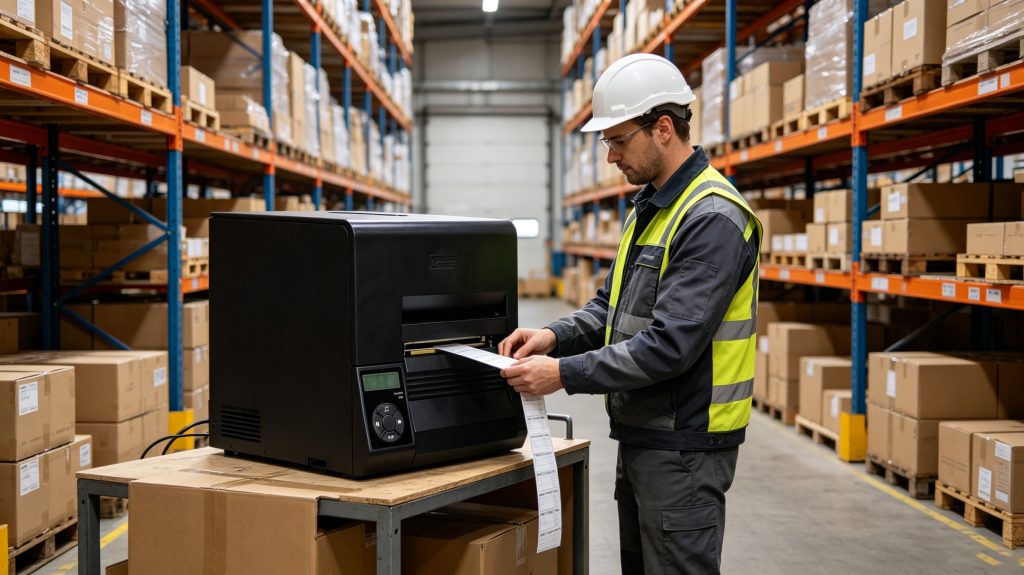
RFID label printer encoding smart labels inside a logistics warehouse
Operational Problems RFID Printers Actually Solve
Inventory Accuracy Drift
According to Auburn University RFID Lab, RFID technology significantly improves inventory visibility in retail and logistics environments.
What often gets ignored is how inventory errors accumulate gradually.
Not dramatically.
One incorrect manual entry here. One missed outbound scan there.
After several months, the system no longer reflects reality.
RFID labeling reduces that silent drift because identification becomes more automatic and less dependent on repetitive human action.
RFID Label Printers vs Barcode Printers
| Feature | RFID Label Printers | Barcode Printers |
| RFID Encoding | Yes | No |
| Non-Line-of-Sight Reading | Yes | No |
| Multi-Item Reading | Yes | Limited |
| Automation Support | High | Moderate |
| Data Capacity | Larger | Smaller |
Barcode systems remain useful.
But in high-volume environments, RFID gradually becomes less of an upgrade and more of an operational necessity.
Real Deployment Observation
One unexpected thing we noticed during a warehouse RFID deployment:
The printing process itself became more disciplined.
Before RFID implementation, operators occasionally skipped labels during rush periods because barcode replacement was easy later. RFID workflows made labeling more structured because every encoded tag became part of a tracked data chain immediately.
Technology quietly changed worker behavior.
That happens more often than vendors admit.
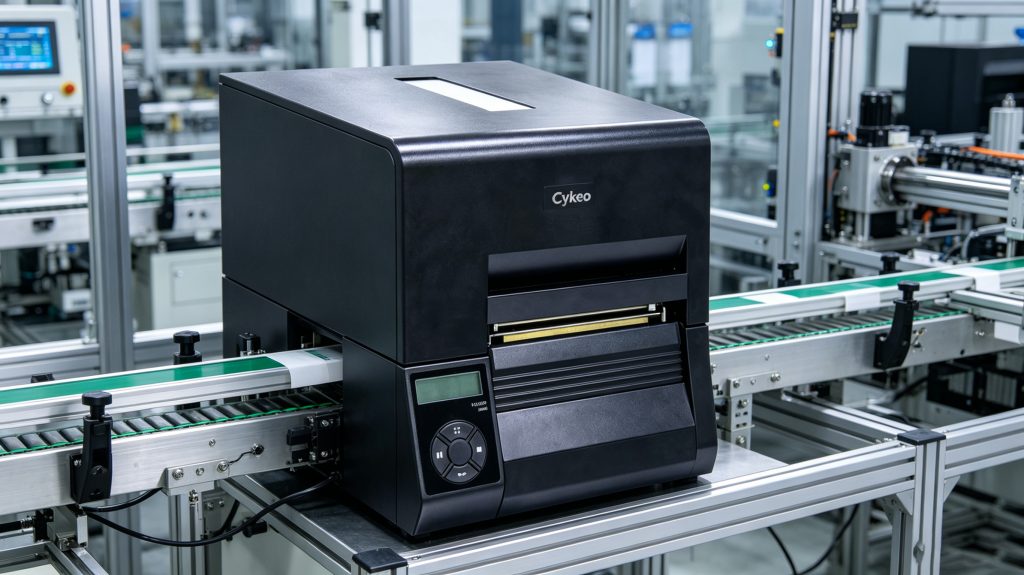
RFID label printing system supporting industrial production traceability
FAQ About RFID Label Printers
What are RFID label printers used for?
RFID label printers are used for printing and encoding RFID smart labels for inventory tracking, logistics, manufacturing, and retail management.
Can RFID printers print normal barcode labels?
Yes. Most RFID label printers support both RFID smart labels and standard barcode printing.
Are RFID label printers suitable for warehouses?
Yes. RFID printers are widely used in warehouses to improve inventory accuracy and automate logistics operations.
What industries use RFID label printers most?
Retail, healthcare, manufacturing, logistics, and asset management industries commonly use RFID label printers.
Final Thoughts
RFID label printers are not just output devices anymore.
Increasingly, they are the starting point of operational visibility.
Once smart labels enter a workflow, inventory systems stop depending entirely on manual confirmation. Movement becomes traceable. Exceptions become easier to identify. Audits become faster.
At Cykeo, we often see companies focus heavily on readers and software first.
But the real foundation usually begins earlier — with accurate RFID label generation itself.
If labels fail, everything downstream struggles quietly.
And in large operations, quiet problems become expensive very quickly.
That is why RFID label printers matter more than many organizations initially expect.
