Website Translation Services UK: How to Take Your Business Global in 2026
Author : vann bells | Published On : 02 Jun 2026
In an increasingly connected world, your website is often the first point of contact between your business and a potential customer. If that website only speaks one language, you are already limiting your reach before the conversation has even begun. For UK businesses with ambitions to grow beyond domestic borders, professional website translation services are one of the most impactful investments you can make.
This article explores why website translation matters, what the process involves, and how to choose the right service provider to help your business connect with international audiences effectively and authentically.
Why Website Translation Is a Business Priority
The internet is a global marketplace, but language remains one of its most significant barriers. Research consistently shows that the vast majority of online consumers prefer to browse and buy in their native language. A study by the Common Sense Advisory found that more than 70 percent of internet users spend most of their time on websites in their own language, and over 50 percent said they would not buy from an English-only website.
For UK businesses, this represents an enormous missed opportunity. The UK has strong trade relationships across Europe, the Middle East, Asia, Africa, and the Americas. In every one of these regions, there are millions of potential customers, partners, and investors who would engage far more readily with a business that communicates in their own language.
Website translation is not simply a courtesy. It is a commercial strategy that directly impacts traffic, conversion rates, and revenue.
The Difference Between Website Translation and Localisation
These two terms are often used interchangeably, but they describe different levels of language service.
Translation refers to the process of converting the text on your website from one language into another. This includes page copy, product descriptions, navigation labels, calls to action, error messages, and any other written content.
Localisation goes further. It adapts not just the language but the entire user experience for a specific target market. This can include adjusting date formats, currencies, and units of measurement, adapting images or visual references that may not resonate culturally, modifying tone and style to suit local communication preferences, and ensuring that any legal or regulatory content is appropriate for the target country.
For businesses that want to make a genuine impact in international markets, localisation is the gold standard. A professionally localised website does not feel like a translated website. It feels as though it was built specifically for that market.
Languages in High Demand for UK Website Translation
UK businesses operating in international markets most commonly seek website translation into the following languages, though demand varies significantly by sector and target market.
Spanish is one of the most requested languages for UK website translation, given the size of the Spanish-speaking world across Spain, Latin America, and the United States.
French remains essential for businesses targeting France, Belgium, Switzerland, Canada, and large parts of Africa and the Caribbean.
Arabic is increasingly important for UK businesses with interests in the Gulf Cooperation Council countries, North Africa, and the broader Middle East. Arabic website localisation requires particular care due to the right-to-left script direction and the significant cultural nuances involved.
German is critical for businesses targeting the DACH region, which represents one of the largest and most prosperous consumer markets in Europe.
Mandarin Chinese is essential for businesses engaging with markets across mainland China, Taiwan, Hong Kong, and the large Chinese diaspora communities in Southeast Asia and beyond.
Portuguese covers both the large Brazilian market and European Portugal, each with its own distinct variant of the language.
Polish, Romanian, and other Central and Eastern European languages are increasingly relevant for UK businesses with supply chains, employees, or customer bases in those regions.
A professional Website Translation Services UK will have experienced native translators across all major language pairs, as well as the technical capability to handle the specific demands of each script and language direction.
The Technical Side of Website Translation
Website translation is not just a linguistic exercise. It involves a range of technical considerations that a professional agency will be equipped to handle.
Content Management System Compatibility
Most modern websites are built on content management systems such as WordPress, Shopify, Drupal, Joomla, or custom-built platforms. A professional website translation service will be familiar with the multilingual capabilities and plugins available for each platform, whether that is WPML for WordPress, Shopify's language settings, or custom API integrations for bespoke builds.
File Format Handling
Website content often needs to be extracted from the CMS, translated in specialist translation software, and then reintegrated into the site. Professional agencies work with industry-standard translation tools that support a wide range of file formats and help maintain consistency across large volumes of content.
Right-to-Left Languages
Languages such as Arabic, Hebrew, and Urdu are written and read from right to left. This has significant implications for website layout, navigation, and design. A professional translation service will flag these requirements and work with your development team to ensure the translated site renders correctly.
SEO for Multilingual Websites
Translating the visible text on your website is only part of the picture. To rank in search engines in your target markets, your multilingual website also needs properly translated and localised meta titles, meta descriptions, alt text, URL structures, and hreflang tags. Overlooking the SEO dimension of website translation means missing out on a significant portion of the potential traffic benefit.
Ongoing Maintenance
Websites are living entities. New pages are added, products change, blog posts are published, and promotional content is updated regularly. A professional website translation service can support ongoing maintenance to ensure your translated content stays current alongside the original.
Common Mistakes to Avoid with Website Translation
Many businesses make avoidable errors when approaching website translation for the first time. Being aware of these pitfalls can save significant time, cost, and reputational risk.
Relying on Machine Translation Alone
Tools like Google Translate have improved significantly in recent years, and they can be useful for getting a rough sense of content in an unfamiliar language. However, machine translation still makes frequent errors, particularly with idiomatic expressions, technical terminology, ambiguous phrasing, and cultural nuance. Publishing machine-translated content on a professional website sends a clear signal to visitors that quality is not a priority.
Using Bilingual Staff Who Are Not Translators
Having an employee who speaks another language is not the same as having a professional translator. Translation is a skilled discipline that requires not just fluency but also subject-matter expertise, an understanding of register and tone, and the ability to produce polished, accurate written content in the target language.
Translating Only Part of the Website
A partially translated website creates a frustrating and disjointed user experience. If a visitor lands on a translated product page but then finds that the checkout process, terms and conditions, or customer support pages are only available in English, trust is immediately undermined.
Ignoring Cultural Differences
Successful website localisation goes beyond words. Images of people, colour choices, idioms, humour, and cultural references all need to be considered carefully when adapting content for a new market. What works in the UK may not work, or may actively cause offence, in another culture.
Choosing a Website Translation Service in the UK
When selecting a website translation provider, UK businesses should look for a combination of linguistic expertise, technical capability, and sector knowledge.
The best providers work with native-speaking translators who have professional expertise in the relevant subject area, whether that is e-commerce, legal, financial, technical, or creative content. They have robust quality assurance processes that include independent proofreading and review. They understand the technical requirements of multilingual web builds and can work alongside your development team. And they offer a scalable service that can grow with your business as you expand into new markets.
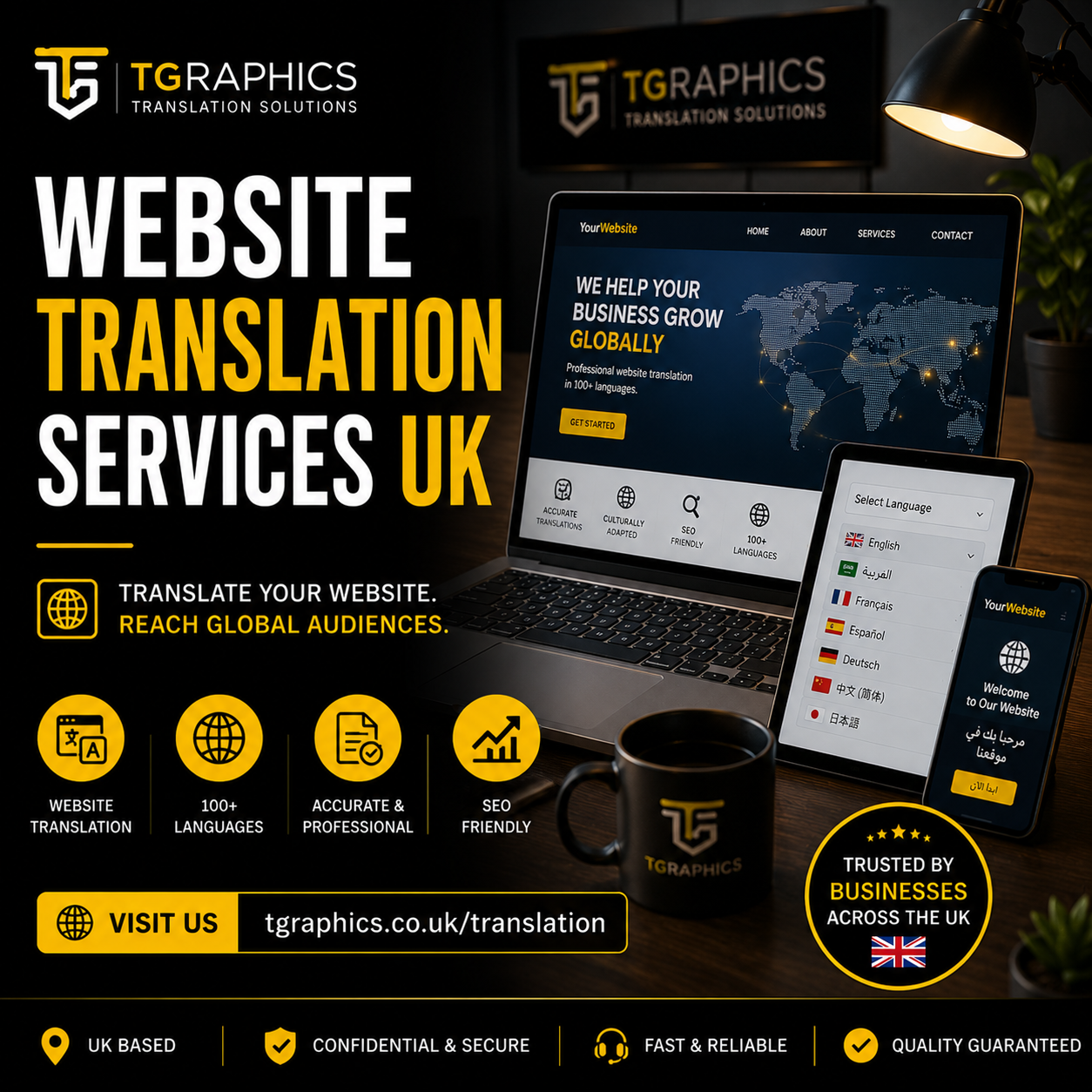
For businesses across the UK seeking a reliable and professional website translation service, TGraphics Translation Services offers comprehensive multilingual solutions tailored to the needs of businesses operating in competitive international markets.
The Return on Investment from Website Translation
The costs of professional website translation are often recouped quickly when set against the commercial opportunity that multilingual web presence unlocks. Businesses that invest in quality website translation and localisation typically see measurable increases in international traffic, improved conversion rates from non-English speaking visitors, stronger brand perception in target markets, and a competitive advantage over rivals who have not yet made the investment.
For UK businesses with genuine international ambitions, website translation is not an optional extra. It is a foundational element of a credible global strategy.
Conclusion
A well-translated website opens doors that an English-only site keeps firmly closed. It signals respect for your international audience, builds trust with potential customers and partners, and creates the conditions for meaningful commercial relationships across borders.
The UK has always been a trading nation with global reach. In 2026, that reach extends further than ever before, and your website is your most important international ambassador. Make sure it speaks the right language.
For professional website translation services in the UK, visit TGraphics Translation Services.
