Vespa.ai: The Engine Quietly Powering Real-Time AI Search at Scale
Author : Covalense Digital | Published On : 08 Jul 2026
Introduction
In the age of AI-driven applications, the ability to search, rank, and recommend content in real time — at massive scale — has become a critical engineering challenge. While most engineers reach for Elasticsearch or Redis, Vespa.ai is a platform that has been quietly powering search and recommendations at Yahoo, Spotify, Vinted, Farfetch, and Otto.de for years.
What is Vespa.ai?
Vespa.ai is an open-source, big data serving engine built for real-time computation over large datasets. Originally developed at Yahoo! in the late 1990s, it evolved into the engine powering Yahoo’s search, news, advertising, and recommendation systems — processing billions of queries per day.
Unlike traditional search engines that had vector search bolted on as an afterthought, Vespa.ai was designed from day one to handle:
- Text search (BM25, exact matching, boolean logic)
- Vector/semantic search (ANN with HNSW)
All of this in a single unified query — no glue code, no data pipelines between systems, no external reranking hops.
Why Vespa.ai? The Case Against the Alternatives
The Problem with Vector Databases
Pure vector databases like Pinecone, Weaviate, and Qdrant are excellent at approximate nearest neighbour (ANN) search. But in production, vector search rarely works alone. Real applications need:
- Exact keyword matching alongside semantic search
- Metadata filters (price range, availability, region, category)
- Business rules (boost promoted items, suppress out-of-stock)
- Real-time data (live inventory, session signals)
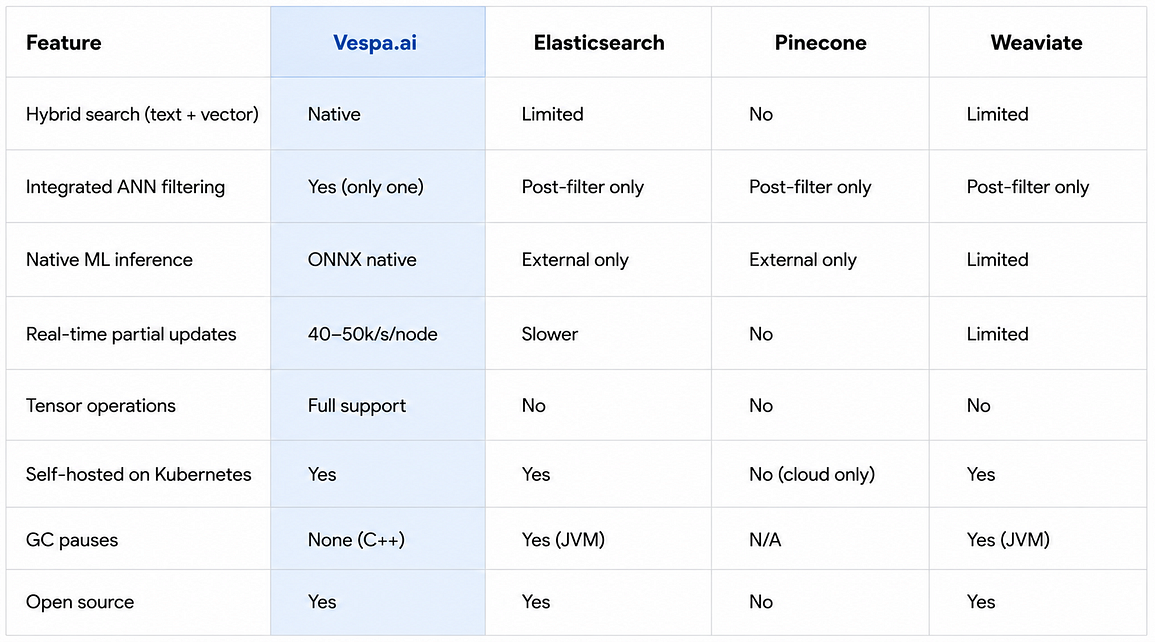
When you try to add these to a pure vector database, you end up doing post-filtering — running ANN first, then filtering the results. This has a fundamental flaw: if your filter is strict (e.g., only show items in stock in New York under $50), you may filter out all of your top ANN results and return nothing, or worse — low-quality results.
Vespa.ai’s solution: It is, to date, the only ANN implementation that supports integrated filtering — eligibility criteria are evaluated during the search itself, not after. When filters become highly restrictive, Vespa.ai intelligently falls back to brute-force search to guarantee result quality.
The Problem with Elasticsearch
Elasticsearch is great for text search, but:
- It has no native dense vector ranking support at production scale
- JVM garbage collection pauses cause latency spikes
- It cannot run ML models natively — inference must happen externally
- Multi-threaded search per share is limited
In benchmarks, Vespa.ai is 8.5x2 faster than Elasticsearch for dense vector ranking. Vespa.ai’s C++ core avoids JVM GC entirely, and its architecture supports multi-threaded search per node — not one thread per share.
Vespa.ai Architecture — How It Works
The Three Node Types
1. Config Server/Admin Node
- The brain of the cluster
- Manages application package deployment
- Runs ZooKeeper for distributed coordination
- Must reach quorum before any other node can function
- Exposes health at :19071/state/v1/health
2. Container Nodes (Stateless)
- Handle incoming queries and feed requests
- Execute custom search logic, ranking expressions, ML models
- Route queries to the right content nodes
- Stateless — can be scaled up/down freely
- Exposes services at :8080
3. Content Nodes (Stateful)
- Store the actual documents and indexes
- Execute first-phase ranking (close to the data)
- Handle HNSW vector index for ANN search
- Stateful — scaling requires data redistribution
- Persistent volumes required for durability
The Query Flow
- User Request arrives at Container Node
- Container Node parses query, applies first-pass business logic, fans out to Content Nodes
- Content Nodes run in parallel: text matching (BM25/exact), ANN search (HNSW with integrated filters), first-phase ranking (fast, lightweight)
- Container Node merges results, applies second-phase ranking (expensive ML models), applies final business rules
- Response returned to user in milliseconds
Deploying Vespa.ai on Kubernetes
Kubernetes Mapping
Vespa.ai maps naturally to Kubernetes primitives:
- Admin/Config Server → StatefulSet
- Container Node → StatefulSet or Deployment
- Content Node → StatefulSet + PVC
- Inter-node communication → Headless Services
- External access → Ingress + Service
Deployment Order Matters
This is a critical operational insight — you cannot deploy Vespa.ai components in any order. The dependency chain is strict:
- Namespace
- Headless Service (DNS for pod-to-pod communication)
- ConfigMap (config server addresses)
- Admin Node (ZooKeeper quorum)
- Config Server (waits for ZooKeeper)
- Container Nodes (waits for config server)
- Content Nodes (waits for config server)
- Application Package Deployment
Vespa.ai vs The Competition
Real-World Use Cases
Spotify
Moved their entire podcast search and recommendation system to Vespa.ai. Natural language searches for over millions of episodes with ML-powered ranking — all in user time.
Vinted
Built a three-stage recommender system for homepage listings combining explicit user preferences (saved searches, categories) with implicit signals (clicks, purchases, session behaviour) — all served by Vespa.ai in real time.
Otto.de
Germany’s second-largest e-commerce platform improved autosuggestion and product search accuracy using Vespa.ai’s hybrid retrieval — handling vocabulary mismatches between how customers search and how products are described.
Conclusion
Search, ranking, and recommendation are no longer separate problems to be stitched together with glue code and external reranking hops — they are one problem, and Vespa.ai solves it inside a single query, close to the data, in milliseconds. For teams building real-time, AI-driven applications at scale, that architectural consolidation is what makes the difference — in both latency and operational complexity.
To discuss how these ideas apply to your own search and recommendation challenges, contact us at [email protected].
Source: covalensedigital.com
