Vertical Integration vs Strategic Partnership: Logistics Decision Framework
Author : Alex Turner | Published On : 12 Aug 2026
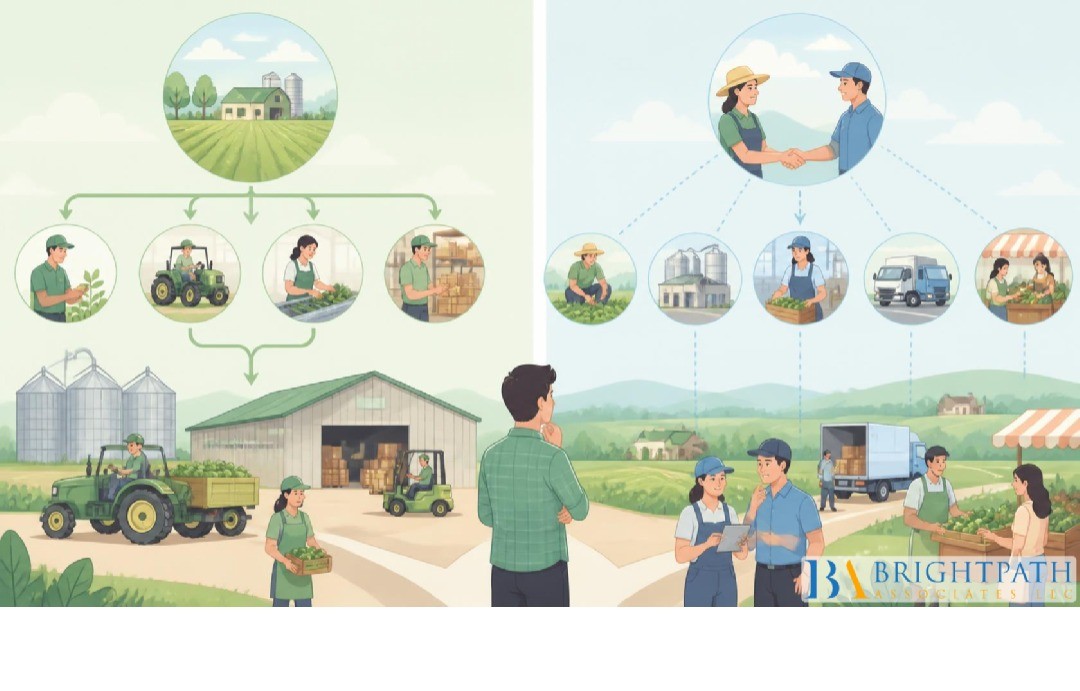
For farming businesses, logistics is no longer simply a matter of moving crops, livestock products, feed, equipment, and agricultural inputs from one location to another. Modern agricultural supply chains must respond to seasonal demand, fluctuating transportation costs, labor shortages, weather disruptions, changing customer expectations, and increasingly complex distribution networks. For small and mid-sized agricultural companies, one strategic question is becoming particularly important: Should logistics capabilities be brought in-house through vertical integration, or should the company build strategic partnerships with specialized logistics providers?
The answer depends on the company's size, resources, growth objectives, operational complexity, and appetite for risk. There is no universal model that works for every agricultural enterprise. Instead, business leaders need to evaluate which structure provides the best balance of control, flexibility, cost efficiency, scalability, and resilience. Companies operating throughout the Farming Industry can benefit from treating logistics as a strategic capability rather than simply an operational expense.
Vertical integration involves bringing more stages of the supply chain under company ownership or direct management. A farming company might invest in its own trucks, warehouses, cold-storage facilities, distribution centers, processing operations, or logistics technology. The objective is to gain greater control over activities that previously depended on outside suppliers or service providers. In theory, this can provide better coordination and greater visibility across the supply chain.
One of the strongest arguments for vertical integration is control. Agricultural companies frequently deal with products that are seasonal, perishable, temperature-sensitive, or highly dependent on precise timing. When transportation and storage are controlled internally, management can potentially respond more quickly to changing production conditions. A company can prioritize shipments, adjust delivery schedules, and coordinate transportation with harvesting and processing activities without depending entirely on an outside provider's availability.
Control can also become valuable when logistics directly affects product quality. Fresh produce, dairy products, meat, and other agricultural goods can lose value when transportation or storage conditions are poorly managed. An organization with its own cold-chain infrastructure may have greater ability to establish consistent handling standards and monitor conditions throughout the process.
However, vertical integration requires substantial investment. Purchasing vehicles, constructing warehouses, hiring drivers, maintaining equipment, implementing logistics software, and managing compliance can quickly increase capital requirements. For a small or mid-sized farming business, those investments may compete with other priorities such as land acquisition, machinery upgrades, irrigation systems, technology adoption, or production expansion.
There is also a utilization risk. Agricultural demand is rarely perfectly consistent throughout the year. A company's internal fleet or warehouse may be heavily utilized during harvest periods but underused during slower periods. Fixed assets continue generating costs regardless of utilization. Fuel, insurance, maintenance, depreciation, salaries, and facility expenses can therefore create financial pressure when volumes decline.
Strategic partnerships offer a different approach. Rather than owning every part of the logistics operation, farming companies can work with third-party transportation providers, warehouse operators, cold-chain specialists, freight companies, and technology providers. This allows businesses to access capabilities without making the same level of capital investment.
For many small and mid-sized agricultural businesses, flexibility is one of the biggest advantages of this model. A company can increase transportation capacity during peak harvest periods and reduce it when demand falls. Instead of maintaining a large fleet throughout the year, it can use external capacity when necessary. This variable-cost structure can make it easier to manage seasonal fluctuations.
Partnerships can also provide access to specialized expertise. A logistics provider may already have established transportation networks, route-optimization technology, cold-chain infrastructure, regulatory knowledge, and experienced personnel. Building equivalent capabilities internally could require years of investment and management attention.
Technology is also changing the vertical-integration-versus-partnership decision. Digital freight platforms, GPS tracking, warehouse management systems, Internet of Things sensors, automated scheduling, and real-time analytics can provide companies with greater visibility even when logistics activities are outsourced. This means businesses no longer necessarily need to own every physical asset to maintain strong oversight.
For example, a farming company could partner with transportation providers while using its own centralized logistics platform to monitor shipments, temperature conditions, delivery status, and exceptions. This creates a hybrid structure in which physical operations are outsourced but strategic visibility remains internal.
The hybrid model may ultimately be the most practical solution for many agricultural businesses. Companies can retain control over logistics activities that are strategically important while outsourcing areas where external providers have greater economies of scale. A business might own specialized cold-storage facilities but outsource long-distance transportation. Another might maintain a small internal fleet for urgent deliveries while using third-party carriers for regional distribution.
Another consideration is resilience. Agricultural supply chains are particularly exposed to disruption because production depends on weather, biological conditions, fuel availability, labor, and market demand. A logistics strategy should therefore include contingency planning. Companies should ask what happens if their primary carrier becomes unavailable, a major road is disrupted, fuel prices rise sharply, or demand suddenly increases.
Diversifying logistics partners can reduce dependency, while selective vertical integration can provide a reliable internal backup. The objective is not necessarily to eliminate external providers but to avoid creating a supply chain that depends entirely on a single point of failure. The original BrightPath article, Vertical Integration vs Strategic Partnership, examines the strategic considerations businesses should evaluate when deciding between ownership and partnerships.
The decision also has important workforce implications. Vertical integration requires companies to recruit and retain logistics managers, fleet supervisors, drivers, warehouse professionals, maintenance specialists, technology experts, and supply-chain leaders. Strategic partnerships reduce some internal staffing requirements but increase the need for professionals capable of managing vendor relationships, contracts, performance metrics, and supply-chain strategy.
This means talent strategy should be considered alongside the logistics model. A company cannot successfully integrate logistics without capable leadership, just as it cannot effectively manage strategic partnerships without strong vendor-management and supply-chain expertise.
Ultimately, the best logistics strategy is not necessarily the one that provides the greatest level of ownership. It is the one that delivers the right combination of reliability, flexibility, cost efficiency, scalability, resilience, and control for the company's specific circumstances. Farming businesses should regularly reassess their logistics structure as production volumes, customer expectations, technology, and market conditions change.
For small and mid-sized agricultural companies, the most effective strategy may involve selective ownership supported by carefully chosen strategic partners. By identifying which logistics capabilities create competitive advantage and which can be efficiently outsourced, businesses can avoid unnecessary capital commitments while maintaining control over the areas that matter most.
