US Tariffs & Amazon Pricing: 2026 Web Scraping Analysis Guide
Author : Actowiz Solutions | Published On : 24 Apr 2026
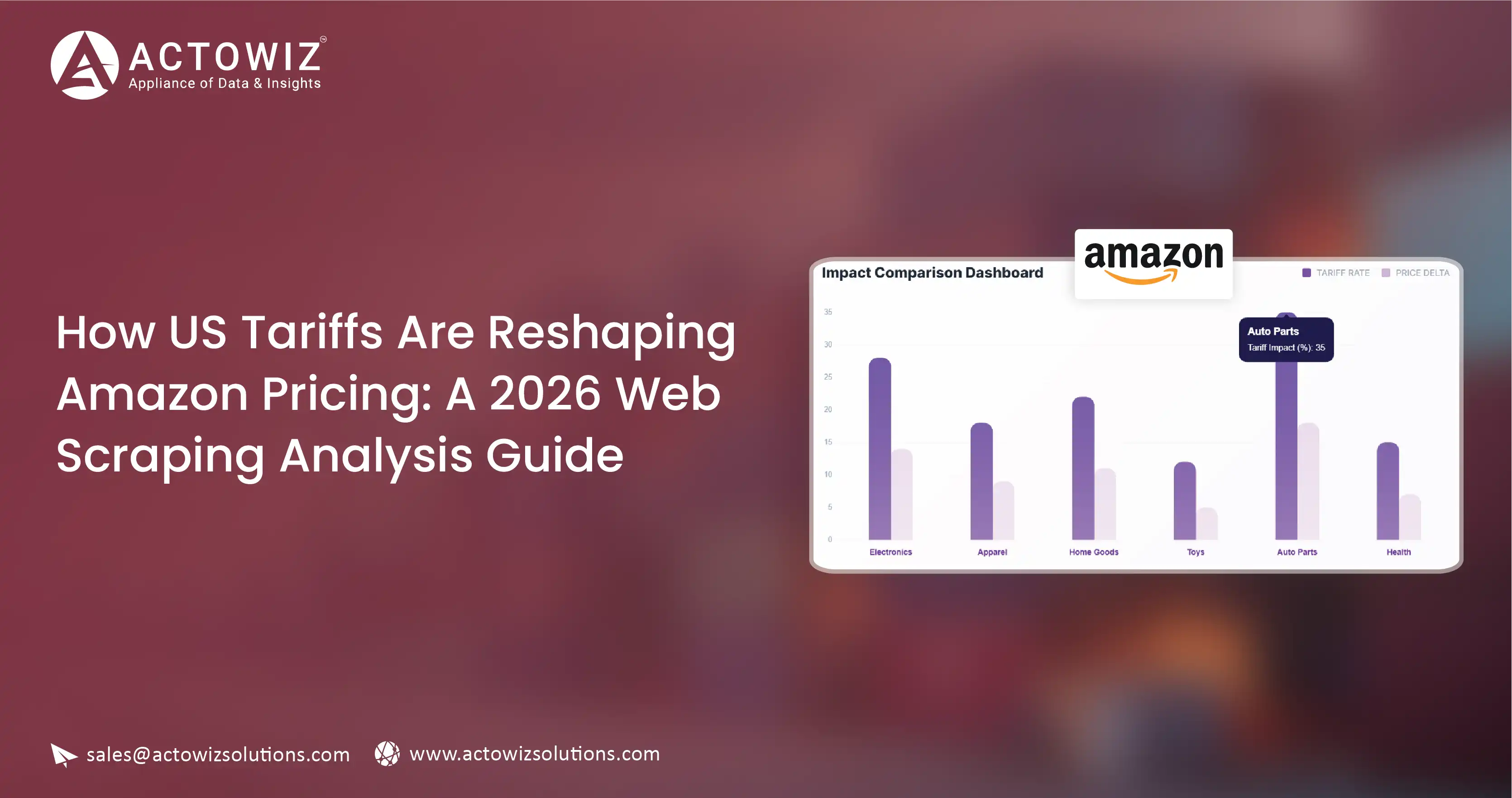
The Most Significant US Pricing Shift Since the 1970s Is Happening Right Now — And Most Brands Can’t Measure It
The US tariff landscape has transformed dramatically over 2024-2026. Rolling rounds of tariff adjustments on imports from China, Mexico, Vietnam, and other manufacturing hubs have cascaded through supply chains, importer pricing strategies, and ultimately consumer prices on Amazon, Walmart, and major US retailers. For brands, importers, retailers, analysts, and policy researchers, understanding the real-time impact of tariffs on consumer pricing has become one of the most strategically valuable analytics exercises of the decade.
But here’s the problem: the data most organisations need doesn’t exist in any packaged form.
Customs data tells you what’s imported and at what valuation — but only after the fact, and aggregated in ways that obscure individual products.
Amazon’s own pricing changes daily across millions of SKUs, but there’s no built-in “tariff impact” metric in any standard analytics tool.
Press coverage captures anecdotes — a $299 product that jumped to $379, a brand that absorbed costs, a brand that passed them through — but can’t give you category-level or brand-level signal.
The answer, increasingly, is systematic web scraping of Amazon and major US retailers to measure tariff pass-through in real-time. This guide breaks down exactly how this analysis works in 2026, what data infrastructure is required, and how leading analysts are turning it into decision-making insight.
Why Tariff-Impact Pricing Analysis Is So Urgent Right Now
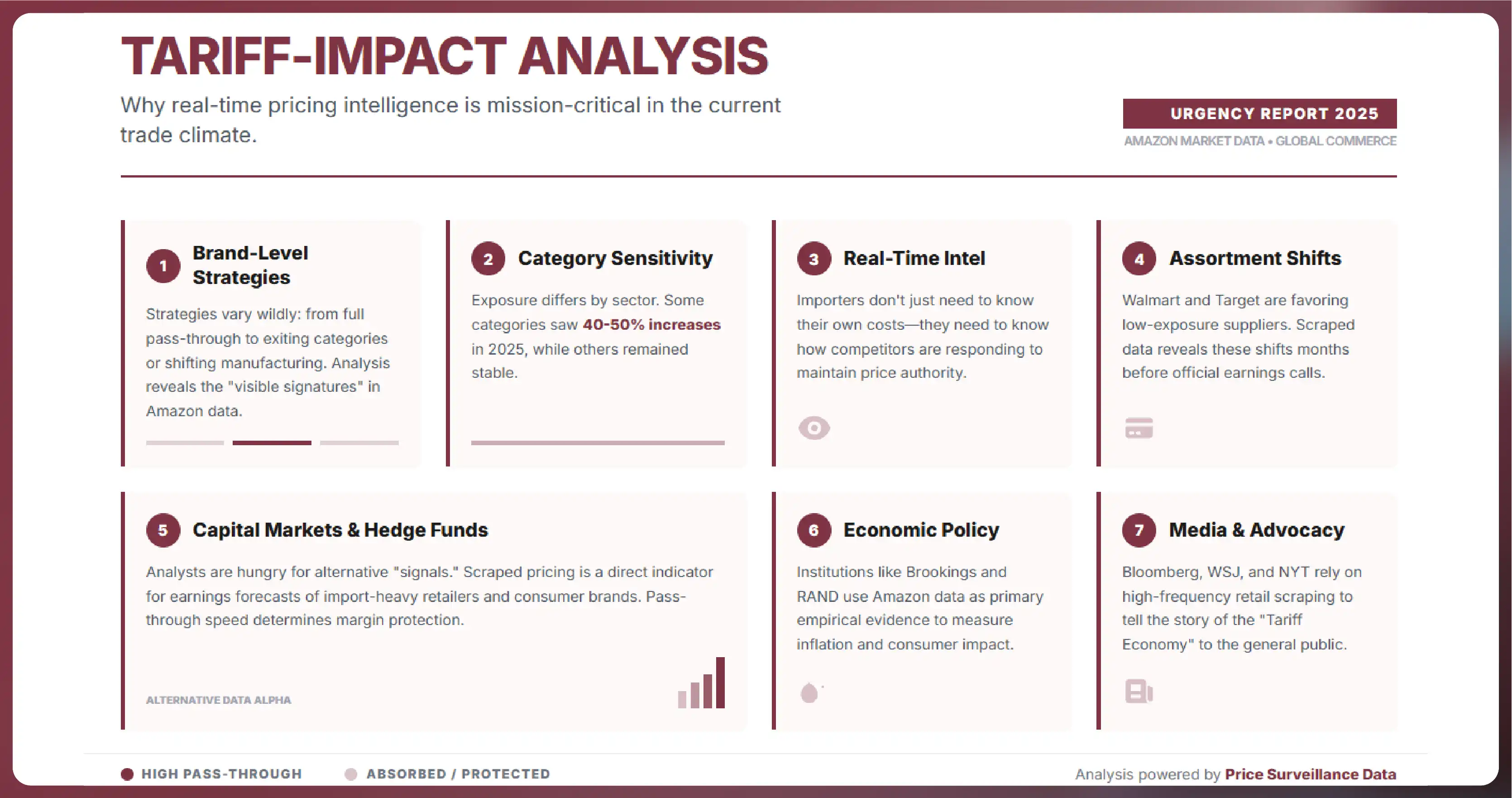
1. Brand-Level Pricing Strategies Vary Wildly
Some brands fully pass through tariff costs. Some absorb partially. Some exit categories entirely. Some shift manufacturing to alternative countries. Each strategy has different implications — and visible signatures in Amazon pricing data.
2. Category-Level Impacts Differ
Consumer electronics, apparel, toys, kitchenware, furniture, and dozens of other categories have different tariff exposures. Some categories saw 40-50% effective price increases in 2025. Others saw minimal change. Granular category-level data is commercially and policy-relevantly important.
3. Importers Need Real-Time Competitive Intelligence
If you’re an importer selling on Amazon, the question isn’t just “how much do tariffs cost me” — it’s “how are my competitors responding?” Real-time pricing surveillance is critical to pricing decisions.
4. Retailers Are Rebalancing Assortment
Walmart, Target, Costco, and Amazon itself are rebalancing assortment — favouring suppliers less exposed to tariff shocks. Scraped data reveals these assortment shifts before they hit earnings calls.
5. Hedge Funds Want the Signal
Public equity analysts, credit analysts, and hedge funds are hungry for alternative data on tariff pass-through. It’s directly relevant to earnings forecasts for import-heavy retailers, e-commerce giants, and consumer brands.
6. Policy Researchers and Think Tanks
Academic researchers, Brookings, RAND, Peterson Institute, and policy makers all want empirical data on tariff impact. Scraped Amazon data has become a primary evidence source for economic research.
7. Consumer Advocacy and Media
Consumer-focused media (NYT, WSJ, Bloomberg, CNBC, Axios) produce constant reporting on tariff impact. Their underlying data often comes from scraped retail prices.
What Data You Need for Comprehensive Tariff Impact Analysis
Amazon Product-Level Pricing Data
- ASIN, product title, brand, manufacturer
- Country of origin (where disclosed — often inferable from brand, manufacturer, and packaging)
- List price, Buy Box price, lowest offer
- Pricing history (daily, for at least 24 months for proper baselining)
- Stock status and “Ships from/Sold by” data
- Product weight, dimensions, and materials (for tariff category classification)
- Category taxonomy (Amazon’s + standard classifications)
Harmonised Tariff Schedule (HTS) Mapping
Each product must be mapped to its applicable HTS code to identify tariff exposure. This is non-trivial — HTS has over 17,000 codes — but essential for rigorous analysis.
Country-of-Origin Inference
Amazon rarely displays manufacturing country prominently. Inferring origin from brand, product line, FCC/UL/CE markings in product images, and seller identity requires a combination of techniques.
Competitive Cross-Retailer Pricing
Amazon isn’t the only story. Walmart, Target, Best Buy, Home Depot, Lowe’s, and other major retailers show how the same product is priced across channels — revealing where brands absorb tariffs and where they pass through.
Historical Baseline Data
Meaningful tariff-impact analysis requires pre-tariff pricing baselines. This means scraping infrastructure that was in place before tariff rounds — or continuous historical archives sourced from established scraping providers.
Currency and Input Cost Adjustments
To isolate tariff effects from other pricing drivers, analysis must control for input costs (commodity prices, freight rates, oil prices) and currency movements. This requires joining scraped retail data with external macro indicators.
Key Data Points Per Product Monitoring
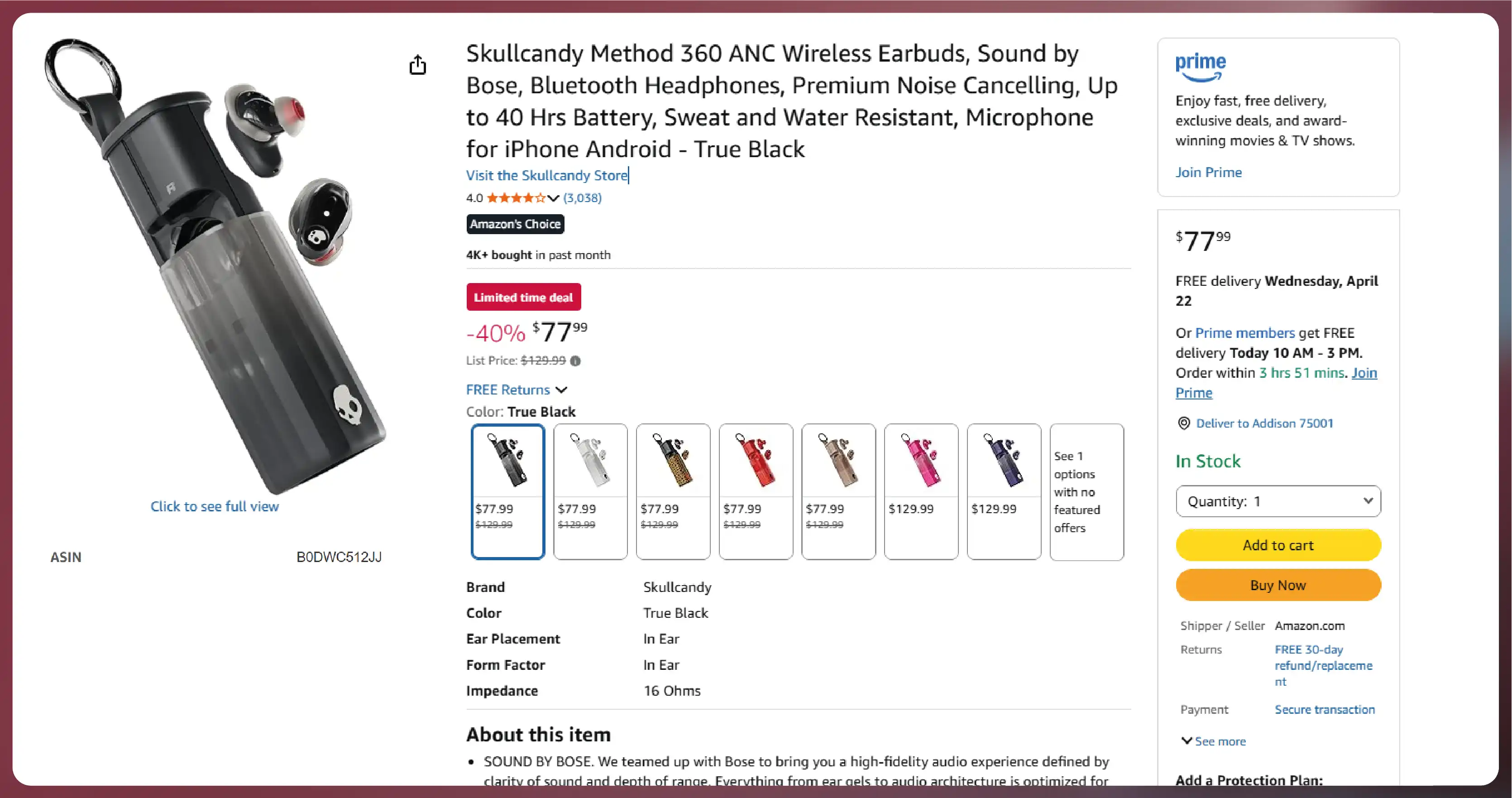
A proper tariff-impact pricing dataset includes, per product, per day:
- ASIN + canonical product identifier
- Date and timestamp
- Brand, manufacturer, country of origin (inferred or verified)
- HTS code mapping (primary + alternative classifications)
- Amazon price (list, Buy Box, lowest) with seller information
- Cross-retailer prices where applicable
- Price vs 30-day baseline, 90-day baseline, pre-tariff baseline
- Stock signals (in stock, low stock, out of stock duration)
- Category and sub-category
- Product size/weight (for shipping-adjusted analysis)
- Tariff rate applicable to the product’s HTS code (current and historical)
- Expected tariff pass-through vs observed price change (the headline metric)
Real-World Use Cases Generating Returns
Import-Heavy Brand Competitive Intelligence
A mid-sized US consumer electronics brand doing $80M in Amazon GMV tracks every major competitor’s pricing in real-time. When tariff rounds hit, they know within 24 hours who’s absorbing costs vs passing them through — and adjust their own strategy accordingly. In Q4 2025, this capability preserved 4 points of gross margin that competitors lost.
Retail Buyer Assortment Planning
A Target category buyer responsible for $400M in annual purchasing uses scraped data to benchmark supplier pricing across channels. When a supplier quotes a price increase citing tariffs, the buyer can validate whether competitor suppliers have passed through similar amounts or not.
Private Label Expansion Analysis
US retailers expanding private label offerings use tariff-impact data to identify categories where branded prices have increased most — creating the largest relative opportunity for private label entry at competitive price points.
Hedge Fund Retail Equity Strategy
A quantitative hedge fund tracking US retailers uses tariff pass-through data as a systematic factor in retail equity selection — penalising retailers with high import exposure and weak pricing power while favouring domestic-supply-chain-heavy retailers.
Economic Research and Policy Analysis
University economics departments and think tanks use scraped Amazon data to quantify tariff incidence — how much is absorbed by producers, retailers, and consumers. Academic papers published in 2025-2026 increasingly reference scraped retail datasets.
Consumer Advocacy Media
Consumer-focused media organisations use scraped data to produce “tariff tracker” content — showing readers how specific products have changed in price, building audience engagement and policy influence.
Supply Chain Consulting
Consulting firms (Kearney, BCG, Accenture, McKinsey) use scraped retail pricing data for client strategy work — advising on sourcing decisions, pricing strategies, and supply chain reconfiguration.
Importer Financial Planning
US importers use competitive pricing data to inform financial planning — projecting gross margins across multiple tariff scenarios and stress-testing business plans.
Technical Challenges of Tariff-Impact Pricing Analysis
1. HTS Code Mapping at Scale
Mapping millions of Amazon ASINs to the correct HTS codes is a non-trivial classification task. Manual mapping is impractical at scale; automated mapping requires careful model engineering.
2. Country-of-Origin Inference
When Amazon doesn’t display origin clearly, inference requires combining brand databases, image analysis (factory markings, packaging details), seller data, and product-specific metadata.
3. Baseline Construction
Without pre-tariff baseline data, “pass-through” analysis is meaningless. Brands and analysts who didn’t invest in historical archives before tariffs are retroactively trying to reconstruct baselines — imperfectly.
4. Controlling for Non-Tariff Price Changes
Prices change for many reasons — seasonality, promotional cycles, supply shocks, currency movements. Isolating the tariff signal requires rigorous controls, not just raw before/after comparisons.
5. Amazon’s Own Dynamic Pricing
Amazon runs its own algorithmic pricing on first-party inventory. Separating Amazon’s repricing behaviour from brand price decisions adds analytical complexity.
6. Multi-Seller Dynamics
On any given ASIN, multiple sellers may list at different prices. “The price” of a product is actually a distribution. Summarising pass-through across sellers requires careful methodology.
7. Assortment Changes vs Price Changes
Some “pass-through” is actually assortment exit — brands stopping to sell affected products entirely rather than raising prices. Distinguishing these outcomes requires tracking product availability, not just prices.
How Actowiz Powers Tariff-Impact Pricing Analysis
Actowiz Solutions operates enterprise-grade tariff impact data scraping infrastructure — serving import-exposed brands, retail buyers, hedge funds, consulting firms, consumer advocacy organisations, and academic researchers.
What we deliver:
- Continuous Amazon scraping across all categories with multi-year historical baselines
- HTS code mapping — proprietary classification models map ASINs to HTS codes at scale
- Country-of-origin inference — multi-signal models identifying product origin with confidence scoring
- Cross-retailer comparison data — Amazon alongside Walmart, Target, Best Buy, Home Depot, and more
- Baseline-adjusted price change metrics — not just absolute prices, but tariff-attributable pass-through estimates
- Controlled analytics — input cost and seasonality controls applied to isolate tariff signals
- Historical archives — pre-tariff baseline data available for rigorous analysis
- Policy-research-grade methodology — fully documented data provenance suitable for academic and policy use
- Flexible delivery — API, dashboards, custom research reports, raw data feeds
Our tariff-impact pricing analysis tracks 5M+ Amazon ASINs daily with 24+ months of historical baseline data.
FAQs
Is this analysis rigorous enough for academic research?
Yes — our methodology is designed to withstand peer review. Full data provenance, documented classification models, and transparent analytical controls are standard deliverables for academic and policy research engagements.
Can you map ASINs to HTS codes accurately?
Our proprietary HTS classification model achieves 85-92% accuracy (varying by category) on multi-level HTS codes. For mission-critical use cases, human-in-the-loop review ensures near-100% accuracy.
How far back does your Amazon pricing history go?
For priority categories, we maintain continuous historical archives dating back to 2022, spanning pre-tariff baselines through subsequent rounds. Coverage varies by category.
Can you differentiate between Amazon first-party dynamic pricing and third-party brand pricing?
Yes — “Ships from/Sold by” attribution is captured, allowing first-party vs third-party price analysis.
Do you integrate customs and trade data?
We offer optional integration with customs data sources (trade statistics, HTS classification references) for clients requiring end-to-end tariff analysis.
What’s the turnaround for custom research?
Standard tariff-impact research reports have 2-4 week turnaround. Data feeds for ongoing internal analysis are available immediately upon engagement.
What’s the engagement pricing?
Tariff-impact pricing engagements start at $6,000/month for focused category analysis. Enterprise plans with multi-retailer coverage, HTS mapping, and custom research are quoted based on scope.
Learn More >> https://www.actowizsolutions.com/us-tariffs-amazon-pricing-web-scraping-analysis.php
Originally published at https://www.actowizsolutions.com
