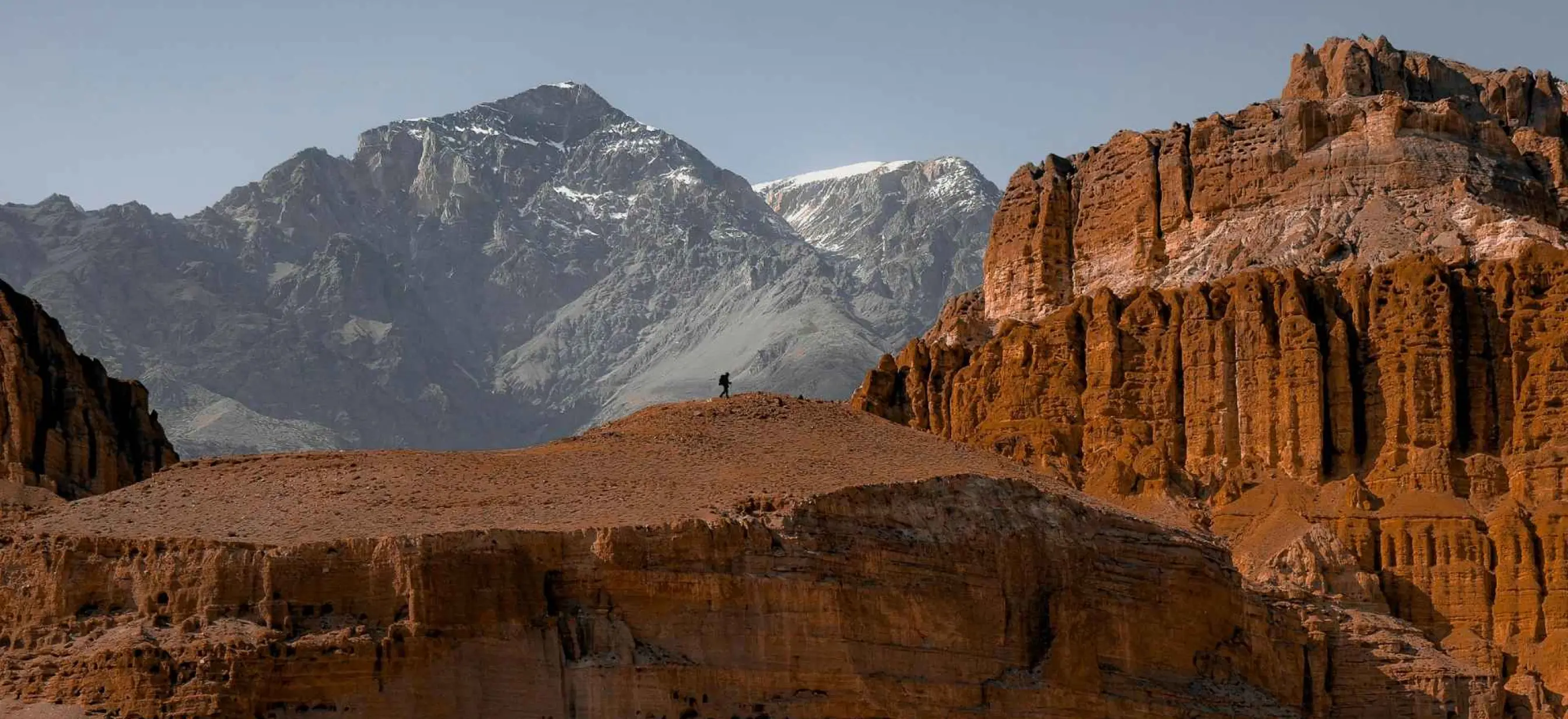
Nepal has no shortage of dramatic trekking country, but nothing in the country looks quite like Upper Mustang. Sitting in the rain shadow of the Annapurna and Dhaulagiri ranges, this high-altitude desert of red cliffs, wind-carved canyons, and centuries-old cave dwellings was closed to outsiders until 1992. Even today, entry requires a special restricted-area permit — which is part of why it remains one of the least crowded, most culturally intact regions in the entire Himalaya.
A Landscape Unlike Anywhere Else in Nepal
Most Himalayan treks build through forest and farmland before opening into alpine terrain. Upper Mustang skips that script entirely. Once you cross the checkpoint at Kagbeni, the scenery shifts almost immediately into eroded badlands, ochre and crimson cliffs, and canyon walls pocked with thousands of hand-carved "sky caves" — some estimated to be over 2,000 years old. It's often compared to the high plateaus of Tibet, which makes sense: culturally and geographically, Upper Mustang has always had more in common with Lhasa than Kathmandu.
The trail passes through a string of walled villages — Chele, Syangboche, Ghami, Charang — each with its own chortens, mani walls, and monasteries, before arriving at the walled city of Lo Manthang. Founded in 1380 and continuously inhabited ever since, Lo Manthang was the seat of the Kings of Lo for over five centuries and remains one of the best-preserved medieval cities in the world. Its royal palace and three great monasteries — Jampa, Thubchen, and Chodey Gompa — hold murals and religious artwork that scholars still travel here to study.
Moderate Altitude, Different Kind of Challenge
Compared to treks like Everest Base Camp or the Manaslu Circuit, Upper Mustang is gentler on paper — its highest point, Chogo La, tops out at 4,230 meters, well below the altitudes reached on those routes. But the trek trades one challenge for another. Instead of a single dramatic pass, the route crosses a dozen smaller ones, most between 3,600 and 4,230 meters, creating a constant rhythm of ascents and descents. Add in strong afternoon winds, intense high-altitude sun, and bone-dry desert air, and the physical demand ends up higher than the altitude numbers alone would suggest.
The upside is that this is a genuinely achievable trek for fit first-timers. There's no glacier travel and no technical climbing anywhere on the route — the only "hands-on" moment is an optional climb through the ladders of Jhong Cave, a five-storey, 40-room cliff complex near Lo Manthang that ranks among the more remarkable archaeological sites in the Himalaya.
Best Time to Go
Because Upper Mustang sits in a rain shadow, it has one of the longest trekking seasons in Nepal — running from March through November, with only deep winter closing the region down. Spring brings the Tiji Festival, three days of masked dances held in Lo Manthang's royal square. Autumn offers the clearest mountain views. Unusually for Nepal, even the monsoon months of June to August are workable here, since the surrounding mountain ranges block most of the rainfall — making Upper Mustang one of the only treks in the country worth considering during the wet season.
Permits and Practicalities
Because it's a restricted area, Upper Mustang requires a Restricted Area Permit issued by Nepal's Department of Immigration, alongside an Annapurna Conservation Area Permit. Independent trekking isn't allowed — visits must be arranged through a registered agency with a licensed guide, and a minimum group size of two applies, though reputable operators run fixed departures that solo travelers can join. Given the region's remoteness — no hospitals, limited connectivity, and helicopter evacuation as the only fast way out — proper travel insurance with high-altitude coverage isn't optional.
For a full day-by-day itinerary, current permit costs, and departure dates, Places Nepal's dedicated trip page lays out the complete route and logistics for anyone planning an upper mustang trek of their own.
If You're Still Deciding
Upper Mustang isn't for trekkers chasing the highest possible altitude or a technical mountaineering challenge — for that, routes like the Manaslu Circuit Trek or Everest Base Camp Trek are better fits. But for anyone drawn to living Tibetan Buddhist culture, medieval architecture, and landscapes that genuinely don't look like anywhere else in Nepal, few trails in the Himalaya offer as much reward for a moderate physical ask. It's less a trek up a mountain than a walk into a kingdom that, until recently, the outside world simply wasn't allowed to see.
