Understanding NVIDIA H100: A Powerful Foundation for Modern AI Computing
Author : 10petabyte 10PB | Published On : 02 Nov 2026
Artificial intelligence has moved beyond simple automation and is now being used in research, business operations, healthcare, financial services, engineering, and many other industries. Behind these developments is a growing need for computing infrastructure capable of processing large amounts of data and performing complex calculations efficiently.
Traditional computing systems remain useful for everyday workloads, but advanced AI applications often require a different level of parallel processing capability. This is where specialised graphics processing units have become important. Among the technologies developed for these demanding workloads, NVIDIA H100 has gained attention as a high-performance GPU platform designed for artificial intelligence and high-performance computing.
Understanding what makes this GPU useful requires looking beyond its specifications. Its importance is connected to the changing requirements of AI model development, data processing, and large-scale computing environments.
Why Modern AI Workloads Need Powerful GPUs
AI models learn patterns from large datasets through repeated calculations. During training, a model processes information, compares results, adjusts internal parameters, and repeats the process until it reaches the required level of accuracy.
These operations can involve billions or even trillions of parameters in advanced models. Processing such workloads using conventional CPUs alone may take considerable time because CPUs generally handle a smaller number of complex tasks at a time.
GPUs are designed to perform many calculations simultaneously. This parallel processing capability makes them particularly useful for workloads such as:
- Deep learning model training
- Large language model development
- Generative AI applications
- Image and video processing
- Scientific simulations
- Data-intensive research
As models become larger and more sophisticated, computing infrastructure must be able to support increasing processing requirements without creating unnecessary performance bottlenecks.
What Makes NVIDIA H100 Important?
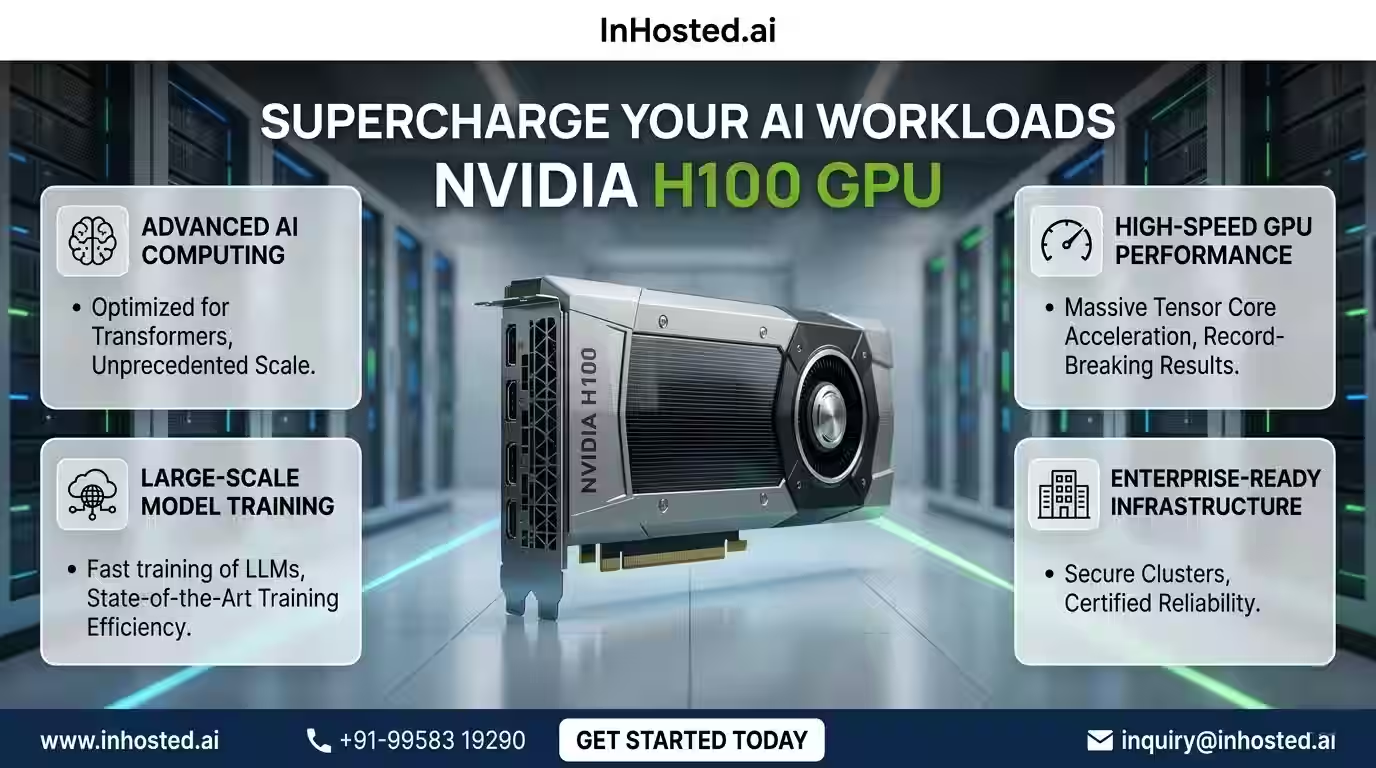
The NVIDIA H100 belongs to the Hopper GPU architecture generation. It was developed to address demanding computing requirements associated with modern AI and high-performance computing.
One of its important characteristics is its focus on accelerating AI-related calculations. The architecture includes specialised processing capabilities designed to improve performance for supported AI operations.
This makes it relevant to organisations that work with large datasets, develop machine learning systems, or operate applications that require substantial computational resources.
Rather than being limited to one particular industry, the GPU can support a broad range of workloads. Its usefulness depends on the software environment, workload design, system configuration, and available infrastructure.
Major Applications of NVIDIA H100
1. Large Language Models
Large language models require extensive computational resources during training and inference. They process text, identify relationships between words, and generate responses based on learned patterns.
Developing and operating these models involves complex mathematical operations. High-performance GPUs can help accelerate these processes, making them an important part of modern language model infrastructure.
2. Generative Artificial Intelligence
Generative AI systems can create text, images, audio, and other forms of digital content. These applications often depend on deep learning models that require substantial computing power.
GPU infrastructure can support model training, experimentation, and deployment. It also helps development teams manage workloads that involve repeated processing of large datasets.
3. Scientific Research
Researchers use high-performance computing for simulations, numerical analysis, climate modelling, molecular research, and other computationally demanding activities.
These tasks may require large numbers of calculations to be completed efficiently. GPU acceleration can help researchers process suitable workloads more effectively.
4. Computer Vision
Computer vision applications analyse images and videos to identify objects, recognise patterns, and extract useful information.
Industries such as manufacturing, healthcare, transportation, and security use computer vision for different purposes. Training advanced vision models can involve processing millions of images, making GPU resources valuable for these workloads.
5. Data Science and Machine Learning
Data science teams frequently experiment with different models, datasets, and algorithms. Faster processing can help reduce the time required for suitable training and analytical tasks.
A powerful GPU environment can therefore support experimentation, model evaluation, and the development of machine learning applications.
Understanding the Role of GPU Memory and Bandwidth
GPU performance is not determined by processing power alone. Memory capacity and memory bandwidth also influence how effectively a system handles demanding workloads.
Large AI models need access to model parameters, datasets, and intermediate calculations during processing. If memory resources are insufficient, workloads may require adjustments or additional system resources.
High memory bandwidth helps move data between memory and processing units. This is particularly important when applications repeatedly access large amounts of information.
When selecting a GPU environment, organisations should consider the complete system configuration rather than focusing on a single specification.
Dedicated GPU Infrastructure Versus Shared Resources
Businesses and development teams can access GPU computing through different infrastructure models.
A dedicated GPU environment provides access to assigned hardware resources. This can be useful when workloads require consistent access to computing capacity or when teams need greater control over their execution environment.
Shared infrastructure can offer flexibility for workloads with changing resource requirements. However, users should understand how resources are allocated and what limitations may apply.
The right choice depends on several factors:
- Expected workload intensity
- Model size and computational requirements
- Budget and usage duration
- Data security requirements
- Software compatibility
- Required availability and scalability
A clear understanding of these factors helps organisations choose infrastructure that matches their actual requirements.
What to Consider Before Choosing an H100 GPU Environment
Selecting an appropriate GPU platform requires more than comparing hardware specifications. The surrounding infrastructure can also affect the overall experience.
Workload compatibility: Confirm that the applications, frameworks, and libraries support the intended GPU environment.
Resource availability: Check the GPU configuration, memory capacity, and resource allocation offered by the provider.
Networking: Distributed AI workloads may depend on efficient communication between multiple computing systems.
Storage performance: Large datasets and model files require suitable storage and data transfer capabilities.
Security: Organisations handling sensitive information should review access controls, isolation, and data management practices.
Technical support: Reliable documentation and technical assistance can help teams resolve configuration and deployment challenges.
Evaluating these areas can help prevent infrastructure-related problems after a project has started.
The Growing Importance of Cloud GPU Computing
Not every organisation wants to purchase and maintain expensive computing hardware. Building an in-house GPU environment can involve equipment costs, power requirements, cooling, maintenance, and infrastructure management.
Cloud GPU platforms provide another approach. They allow teams to access computing resources through a service model instead of managing every part of the physical infrastructure themselves.
This approach can be useful for startups, research teams, developers, and businesses that need specialised computing capacity for particular projects.
A cloud-based environment can also make it easier to experiment with different workloads and adjust resource requirements as projects evolve. However, organisations should evaluate pricing, availability, performance, and usage policies before choosing a platform.
Final Thoughts
Advanced AI applications are increasing the demand for specialised computing infrastructure. From large language models and generative AI to scientific simulations and computer vision, modern workloads often require substantial parallel processing capabilities.
The NVIDIA H100 represents an important development in GPU computing, offering architecture designed for demanding AI and high-performance computing applications. Its practical value depends on the workload, system configuration, software compatibility, and infrastructure supporting it.
For organisations planning their next AI project, understanding GPU architecture and evaluating the complete computing environment are essential steps. A suitable GPU platform can provide the foundation needed to develop, test, and operate computationally intensive applications.
Frequently Asked Questions
1. What is NVIDIA H100 used for?
It is designed for demanding workloads such as artificial intelligence, deep learning, large language models, generative AI, and high-performance computing.
2. Is NVIDIA H100 suitable for AI model training?
Yes. Its architecture is designed to accelerate supported AI workloads, including model training and other computationally intensive tasks.
3. Can NVIDIA H100 support large language models?
It can be used in infrastructure for training and running large language models, depending on model requirements and the overall system configuration.
4. What is the difference between CPU and GPU computing?
CPUs are designed to handle a broad range of general-purpose tasks, while GPUs are particularly effective at performing many calculations in parallel.
5. Should businesses choose dedicated or cloud GPU infrastructure?
The decision depends on workload requirements, budget, resource availability, security needs, and the level of infrastructure control required.
6. What should be checked before renting an H100 GPU?
Review GPU availability, memory resources, software compatibility, networking, storage, security, pricing, and technical support.
