Turkey Food Logistics Market Report: Size, Trends, Growth Opportunities and Forecast, 2026-2034
Author : Sonpal Singh | Published On : 21 Aug 2026
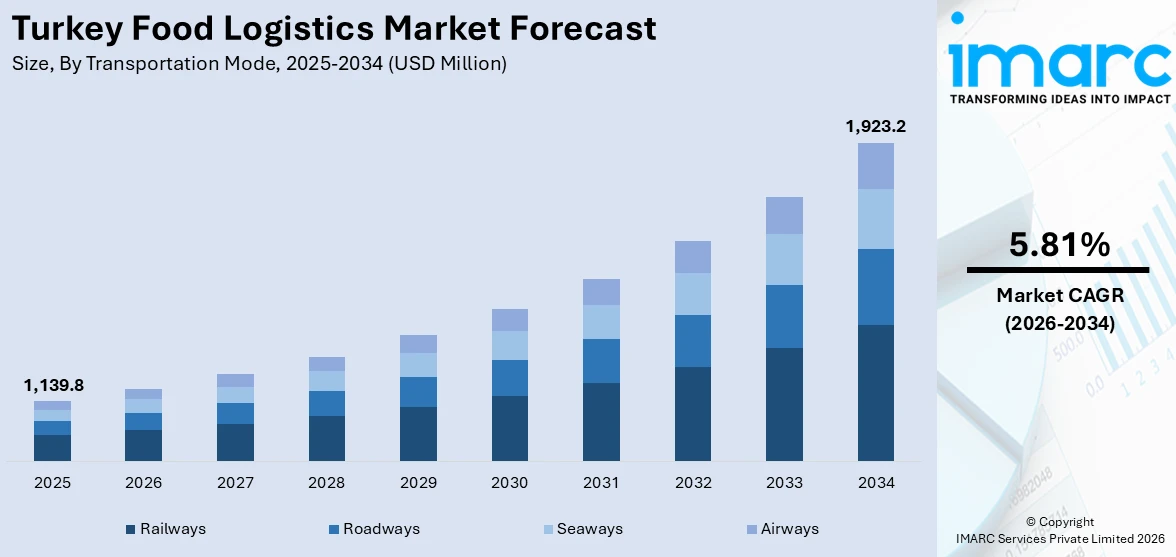
The Turkey Food Logistics Market supported by rising tourism activity, expanding food and beverage distribution networks, growing demand for temperature-controlled transportation, and rapid adoption of digital logistics technologies. Turkey food logistics market size reached USD 1,139.8 Million in 2025. The market is projected to reach USD 1,923.2 Million by 2034, exhibiting a growth rate (CAGR) of 5.81% during 2026-2034. Turkey's strategic position between Europe, Asia, and the Middle East is also strengthening its role as a regional food trade and distribution hub. The country welcomed approximately 52.6 Million international visitors, generating around USD 61.1 Billion in tourism income, creating substantial demand for efficient food storage, transportation, and distribution across hotels, restaurants, resorts, and catering businesses.
How AI is Reshaping the Future of Turkey Food Logistics Market?
- AI-powered demand forecasting is helping food logistics companies analyze purchasing patterns, seasonal demand, tourism activity, weather conditions, and inventory levels to improve stock planning and reduce food spoilage across complex distribution networks.
- AI-enabled route optimization systems analyze traffic conditions, delivery schedules, vehicle capacity, and customer locations to determine efficient transportation routes. These solutions can help logistics operators reduce delivery times, fuel consumption, and operational costs while improving service reliability.
- IoT-enabled temperature monitoring is transforming cold chain logistics by allowing operators to track temperature, humidity, vehicle conditions, and product location in real time. Turkey's Ministry of Agriculture and Forestry has developed a Cold Chain Monitoring System, with relevant officials from 81 provincial directorates and 8 institutes participating in its implementation and training activities.
- AI-supported inventory management enables food distributors to monitor stock levels and identify products approaching their expiry dates. By combining predictive analytics with warehouse management systems, logistics providers can prioritize shipments and reduce unnecessary food waste.
- AI and digital platforms are also supporting rapid grocery and meal delivery. Turkey's fast commerce sector reached TRY 388.7 Billion, increasing by 55.6%, while food accounted for 69.5% of fast-commerce activity. These developments are encouraging logistics providers to invest in automated fulfillment, real-time tracking, route optimization, and digitally connected delivery networks.
Grab a sample PDF of this report: https://www.imarcgroup.com/turkey-food-logistics-market/requestsample
Market Growth Factors
The Turkey food logistics market is driven by strong tourism activity and the expanding foodservice ecosystem. International tourism generates significant demand for reliable food transportation, warehousing, and distribution services across hotels, restaurants, resorts, cafes, and catering operators. Turkey's tourism sector welcomed approximately 52.6 Million international visitors and generated around USD 61.1 Billion in tourism income, increasing the requirement for consistent supplies of fresh produce, dairy products, seafood, meat, beverages, and packaged food. Seasonal fluctuations in tourism also encourage logistics providers to maintain flexible transportation and temperature-controlled storage capabilities to meet sudden increases in food demand.
The expansion of cold chain infrastructure and food safety initiatives is another important growth factor. Temperature-sensitive products require controlled conditions throughout transportation and storage to preserve freshness and minimize spoilage. Turkey's Ministry of Agriculture and Forestry is implementing the Cold Chain Monitoring System, involving software and monitoring devices designed to strengthen cold chain oversight. The national food loss and waste strategy also emphasizes effective cold chain management, improved vehicles and equipment for transporting perishable food, minimum standards for cold-chain vehicles, and roadside inspections. These measures are encouraging logistics providers to modernize refrigerated fleets, warehouses, monitoring systems, and food handling processes.
Digital commerce and the modernization of logistics infrastructure are further accelerating market development. Turkey's fast-commerce activity reached TRY 388.7 Billion, while food represented 69.5% of fast-commerce transactions, highlighting the growing need for rapid and reliable food fulfillment. Government initiatives are also supporting logistics connectivity. The Ministry of Trade has outlined plans to establish logistics distribution networks abroad, develop intermodal transfer centers, strengthen strategic transportation corridors, and expand global supply chain integration. In addition, the Ministry of Transport and Infrastructure reported TRY 189 Billion in investment across 44 completed transportation and communications projects, supporting the broader road, rail, airport, and logistics infrastructure required for efficient food distribution.
Market Segmentation
Transportation Mode Insights:
- Railways
- Roadways
- Seaways
- Airways
Product Type Insights:
- Fish, Shellfish, and Meat
- Vegetables, Fruits, and Nuts
- Cereals, Bakery and Dairy Products
- Coffee, Tea, and Vegetable Oil
- Others
Service Type Insights:
- Cold Chain
- Non-Cold Chain
Segment Insights:
- Transportation
- Packaging
- Instrumentation
Regional Insights:
- Marmara
- Central Anatolia
- Mediterranean
- Aegean
- Southeastern Anatolia
- Black Sea
- Eastern Anatolia
Recent Developement & News
- May 2024: The Turkish Ministry of Agriculture and Forestry conducted an information meeting for its Cold Chain Monitoring System, introducing the system's software and monitoring devices. Officials responsible for cold chain operations from 81 provincial agriculture and forestry directorates and 8 institutes participated, highlighting the government's focus on strengthening monitoring of temperature-sensitive products.
- June 2024: Getir secured a USD 250 Million investment led by Abu Dhabi-based Mubadala Investment Company. The transaction was identified as the largest Turkish startup investment deal in the quarter, while the delivery and logistics sector recorded USD 256.8 Million in total deal volume during the period.
- May 2025: Uber announced an agreement to acquire an 85% controlling stake in Trendyol GO for approximately USD 700 Million. Trendyol GO operated with 19,000 couriers and more than 90,000 restaurant and market partners, strengthening the digital food delivery and grocery logistics ecosystem in Turkey.
- November 2025: CEVA Logistics completed its acquisition of 100% of Borusan Tedarik for USD 383 Million. Following the transaction, CEVA managed approximately 1.19 Million square meters of warehouse space in Turkey and nearly 1 Million domestic full-truckload transports annually, strengthening the country's third-party logistics infrastructure.
- November 2025: The Ministry of Transport and Infrastructure participated in the launch meeting of the Innovative Learning for Cold Chain Food Logistics Erasmus+ Project in Istanbul. The initiative brought together Turkish and international logistics organizations and established a roadmap for implementation activities, supporting skills development and innovation in cold chain food logistics.
- May 2026: Turkey's Ministry of Trade reported that fast commerce had reached TRY 388.7 Billion, with food accounting for 69.5% of the segment. The figures highlighted the growing importance of rapid food fulfillment, last-mile delivery, and digitally enabled logistics services.
- June 2026: Turkey's Ministry of Trade reported that the country's micro-export volume had grown approximately 15-fold over a decade, while its latest logistics report examined the use of road, air, Ro-Ro, and sea transportation in cross-border e-commerce. The development reflects increasing demand for multimodal logistics infrastructure supporting food and other consumer-product distribution.
If you require any specific information that is not covered currently within the scope of the report, we will provide the same as a part of the customization.
About Us
IMARC Group is a global management consulting firm that helps the world's most ambitious changemakers to create a lasting impact. The company provide a comprehensive suite of market entry and expansion services. IMARC offerings include thorough market assessment, feasibility studies, company incorporation assistance, factory setup support, regulatory approvals and licensing navigation, branding, marketing and sales strategies, competitive landscape and benchmarking analyses, pricing and cost research, and procurement research.
Contact Us
IMARC Group,
134 N 4th St. Brooklyn, NY 11249, USA,
Email: [email protected],
Tel No: (D) +91 120 433 0800,
United States: +1-201971-6302
