Total Waste Management Ecosystems: Creating Closed-Loop Operations
Author : Ellen Gomes | Published On : 21 Sep 2026
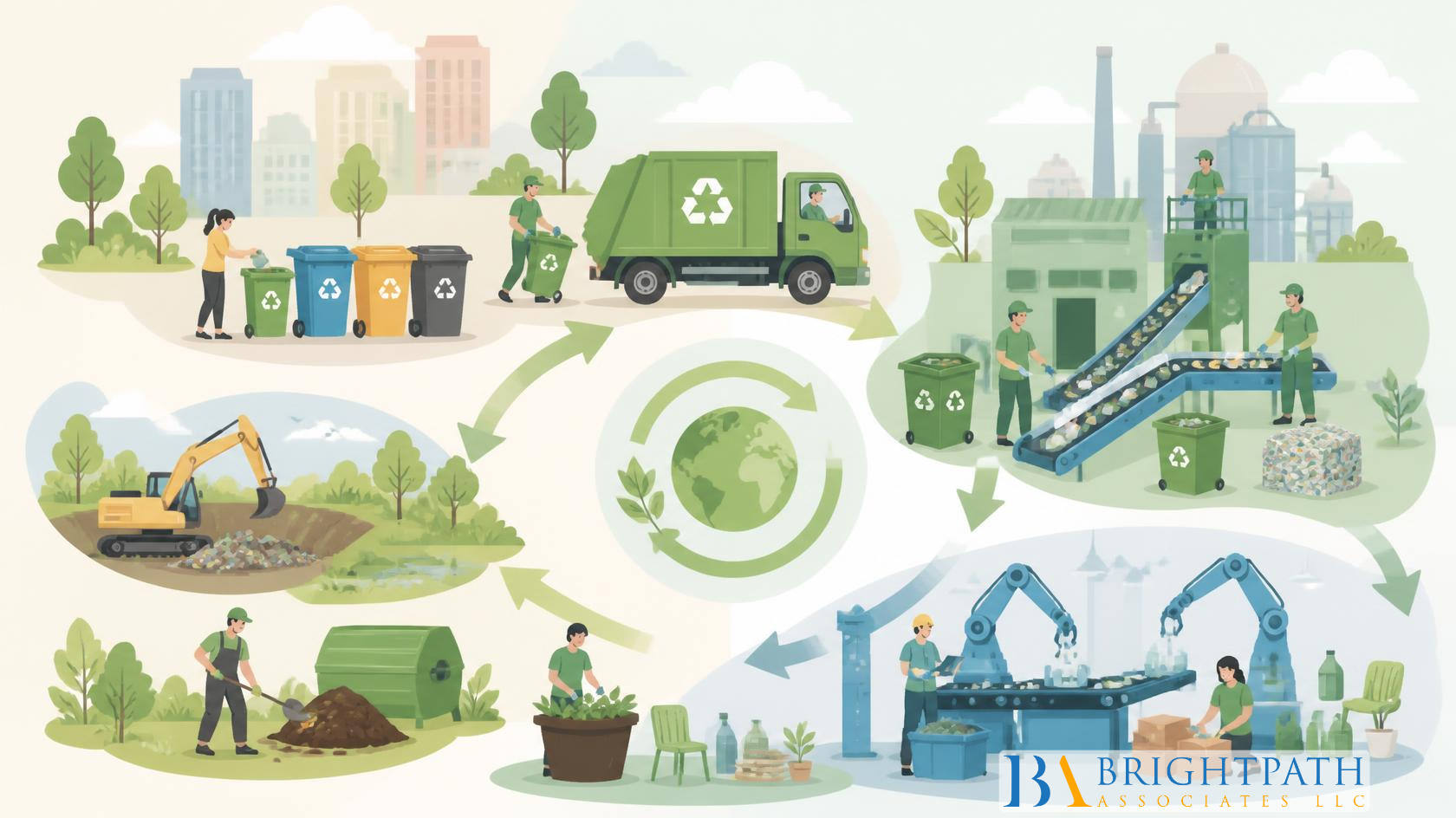
For decades, waste management was largely understood as a linear process: collect waste, transport it, process what could be recovered, and dispose of the remainder. That model is increasingly being challenged by rising resource costs, sustainability expectations, regulatory pressure, and growing recognition that discarded materials can retain significant economic value.
The next evolution is not simply better waste disposal. It is the development of integrated waste management ecosystems in which materials are tracked, recovered, processed, reused, and returned to productive economic activity.
For environmental-services companies, this shift creates an important strategic question: What happens when waste management becomes less about removing materials from a customer's operations and more about helping customers continuously recover value from those materials?
The Shift From Linear Waste Management to Circular Operations
A traditional waste management relationship often focuses on service transactions. A business generates waste, a provider collects it, and the material is transported to a recycling, treatment, or disposal facility.
A closed-loop ecosystem operates differently. It considers the entire material lifecycle. Materials are identified at the point of generation, separated according to their potential value, transported through optimized reverse-logistics networks, processed using appropriate technologies, and ultimately returned to manufacturing or another productive application.
This approach changes the role of environmental-services providers. Instead of functioning primarily as downstream waste handlers, they can become strategic partners in resource management. The broader environmental-services sector is already moving toward this model. Waste management solutions are increasingly being connected with resource recovery, data, clean technologies, and circular-economy strategies.
Why Closed-Loop Systems Matter to Businesses
The environmental argument for circularity is clear, but the business case can be equally significant. Every organization purchases materials, consumes energy, generates by-products, and manages waste. When recoverable materials are treated as disposal liabilities rather than potential resources, companies may be overlooking opportunities to reduce costs or create additional value.
A closed-loop system can help organizations reduce landfill dependency, improve material utilization, recover secondary raw materials, and potentially reduce exposure to fluctuations in virgin-material prices.
Consider an industrial manufacturer generating metal scrap. Under a conventional model, the primary objective may be to remove the scrap efficiently. Under a closed-loop model, the objective becomes more sophisticated: segregate material correctly, maintain quality, establish reliable recovery channels, track volumes, and return usable metal to the supply chain.
Data Is the Infrastructure Behind the Circular Economy
A closed-loop ecosystem cannot function effectively without visibility. Environmental-services companies increasingly need to understand where materials originate, how much is generated, what condition they are in, where they travel, how they are processed, and what ultimately happens to them.
Digital tracking systems can connect collection activities with processing facilities, customers, transportation networks, and downstream buyers. Sensors, analytics platforms, automated sorting technologies, and digital reporting can make material flows more transparent.
This data can also reveal operational inefficiencies. If a facility repeatedly produces mixed waste streams that could have been separated at the source, the environmental-services provider can identify an opportunity for process improvement rather than simply collecting more waste. The result is a shift from reactive waste management toward data-driven resource management.
Advanced Sorting and Recovery Technologies
Modern material recovery facilities can combine optical sorting, machine vision, robotics, artificial intelligence, sensors, and automated quality-control systems. These technologies can improve the identification and separation of different materials while reducing dependence on manual sorting for certain applications.
The objective is not automation for its own sake. The real objective is to produce consistent, specification-grade recovered materials that downstream manufacturers can actually use. This distinction is critical.
A recycling system that collects large quantities of material but produces inconsistent or contaminated outputs may struggle to create sustainable economics. A system capable of producing reliable secondary feedstocks can potentially establish stronger commercial relationships with manufacturers.
Reverse Logistics Becomes a Strategic Capability
Closed-loop operations also require a different approach to transportation. In a linear model, logistics primarily moves waste away from the generator. In a circular model, logistics must manage movement in both directions.
Materials may move from manufacturers to customers and later return as packaging, components, scrap, or end-of-life products. These materials must be collected, consolidated, transported, processed, and potentially returned to manufacturers or secondary markets.
Efficient routing, centralized collection, material tracking, consolidation, and regional processing can all influence the economics of recovery. The most effective ecosystems will likely be those where environmental services, logistics, processing, and downstream demand are coordinated rather than managed independently.
Conclusion: Waste Could Become the Beginning, Not the End
The concept of a closed-loop waste ecosystem represents a fundamental change in how businesses think about discarded materials. Waste no longer has to represent the final stage of a product's lifecycle. With the right infrastructure, technology, partnerships, data, and leadership, it can become the starting point for another productive cycle.
For environmental-services companies, that creates an opportunity to redefine their value proposition. The future may belong not to organizations that simply manage more waste, but to those that can help customers extract more value from every material they use.
For a deeper perspective on how integrated waste management ecosystems can support closed-loop operations, explore Total Waste Management Ecosystems: Creating Closed-Loop Operations.
As environmental-services businesses expand their capabilities across recycling, resource recovery, technology, and circular operations, having the right leadership and specialized professionals becomes increasingly important. Learn more about opportunities and capabilities across the Environmental Services Industry and consider how the right talent strategy can support your organization's next stage of growth.
