Top 5 Turning Inserts for Better CNC Machining Performance
Author : Surya makeyoueasy | Published On : 03 Oct 2026
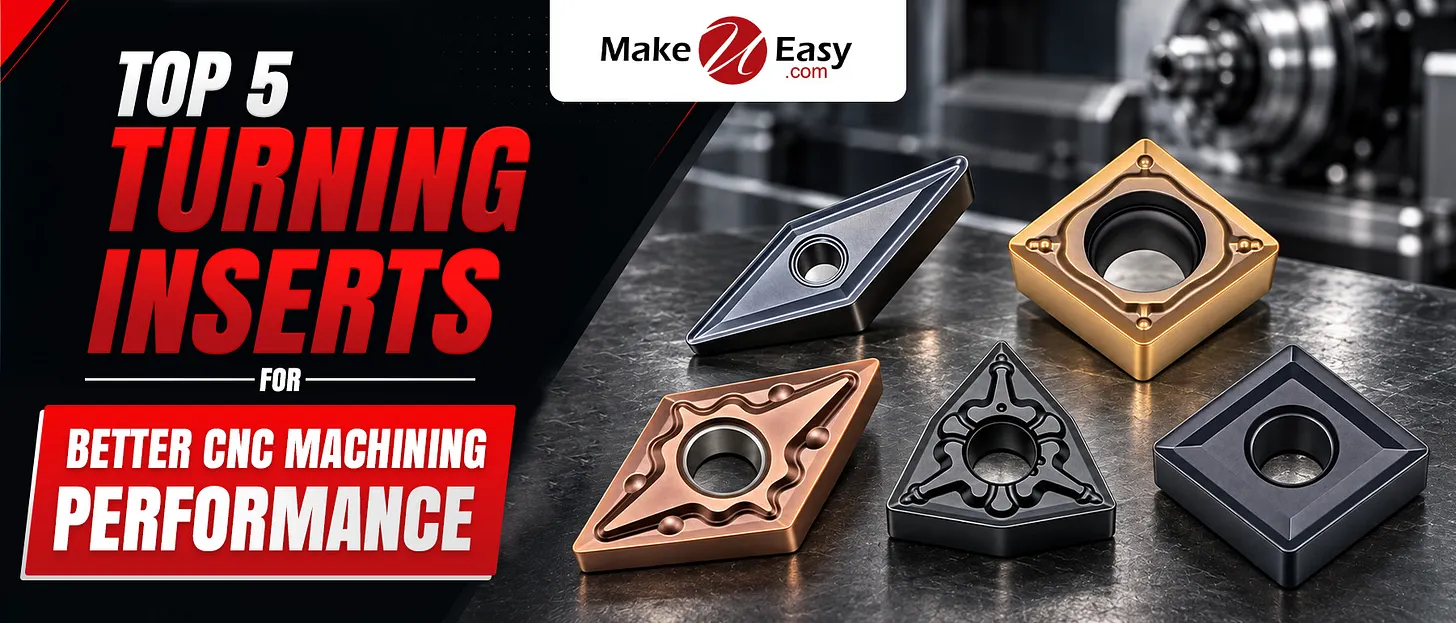
Introduction
Choosing the right CNC turning insert can have a major impact on machining performance, tool life, surface finish, and productivity. Different carbide turning inserts are designed for specific applications such as roughing, finishing, profiling, facing, and internal turning. Factors such as workpiece material, cutting depth, feed rate, cutting speed, insert geometry, and chip breaker all influence insert performance. In this guide, we explore five commonly used CNC lathe inserts and explain where each type can be used to achieve efficient and consistent machining results.
1. CNMG Turning Inserts
CNMG turning inserts are widely used for general-purpose CNC turning because of their strong negative-rake geometry. Their diamond-shaped design provides a robust cutting edge and multiple usable corners, making them suitable for demanding turning applications.
CNMG inserts are commonly used for roughing, semi-finishing, facing, and external turning. They can be selected for materials such as steel, stainless steel, cast iron, and other commonly machined metals when the appropriate carbide grade and chip breaker are used.
Best suited for: CNC roughing, general turning, facing, and medium-to-heavy machining.
2. DNMG Turning Inserts
DNMG inserts feature a 55° diamond-shaped geometry that provides good accessibility for profile machining and angled surfaces. Their geometry offers a useful balance between cutting-edge strength and profiling capability.
These CNC turning inserts can be used for external and internal turning, semi-finishing, and profile machining. Selecting the correct grade and chip breaker according to the workpiece material can help improve chip control and tool life.
Best suited for: Profiling, semi-finishing, external turning, and general CNC machining.
3. VNMG Turning Inserts
VNMG turning inserts feature a 35° diamond geometry with a sharp cutting point. This geometry makes them suitable for detailed profiling, finishing, and machining components with complex contours.
The narrow cutting point provides good access to angled surfaces and smaller features. VNMG inserts can be particularly useful when surface finish and dimensional accuracy are important.
Best suited for: Precision profiling, finishing, and complex contours.
4. WNMG Turning Inserts
WNMG inserts use a trigon-shaped geometry designed to provide a strong cutting edge and multiple usable corners. Their robust design makes them suitable for applications involving higher cutting loads.
They are commonly used for CNC roughing, semi-finishing, and general turning. With the correct carbide grade, chip breaker, and cutting parameters, WNMG inserts can provide consistent performance in demanding machining operations.
Best suited for: Roughing, semi-finishing, heavy-duty turning, and general machining.
5. CCMT Turning Inserts
CCMT inserts use a positive-rake geometry designed for lower cutting forces and a smoother cutting action. Their sharp cutting edge makes them suitable for finishing and lighter machining applications.
CCMT inserts are frequently used for smaller components, internal turning, and applications where reduced cutting resistance is required. The appropriate insert grade and cutting parameters can help achieve a good CNC turning surface finish.
Best suited for finishing, light turning, internal machining, and precision applications.
How to Choose the Right CNC Turning Insert
Selecting the right turning insert for CNC machining depends on several factors. Choosing an insert based only on its shape may result in poor tool life or chip control.
1. Consider the Workpiece Material
Different materials require different insert grades, coatings, and cutting geometries. Steel, stainless steel, aluminium, cast iron, and hardened materials all have different machining characteristics.
Always select a carbide insert designed for the material being machined and follow the recommended cutting conditions.
2. Identify the Machining Operation
Determine whether the operation involves roughing, finishing, profiling, facing, or internal turning.
For heavy roughing, a stronger insert geometry may be preferred. For finishing operations, a sharper geometry can help reduce cutting forces and improve surface quality.
3. Select the Correct Insert Geometry
Insert geometry affects cutting-edge strength, cutting forces, tool accessibility, and surface finish.
For example, CNMG and WNMG inserts are commonly associated with robust turning applications, while VNMG and CCMT geometries can be useful for profiling and finishing.
4. Choose the Correct Chip Breaker
Chip control is essential for efficient CNC turning. A suitable chip breaker helps control chip formation and evacuation, particularly during continuous machining.
The chip breaker should be selected according to the depth of cut, feed rate, workpiece material, and machining operation.
5. Match the Insert Grade to the Application
Insert grade and coating play an important role in tool life and cutting performance. The correct grade depends on the workpiece material and machining conditions.
Using the recommended insert grade can help reduce premature wear and maintain consistent cutting performance.
CNC Turning Insert Selection for Better Tool Life
Even a high-quality CNC lathe insert can wear quickly when used with unsuitable cutting parameters. Cutting speed, feed rate, depth of cut, coolant, machine rigidity, and workholding all influence insert performance.
To improve tool life:
-
Use the correct insert grade for the workpiece material.
-
Select the appropriate chip breaker for the operation.
-
Maintain recommended cutting speed and feed.
-
Avoid excessive depth of cut beyond the insert’s application range.
-
Ensure proper workholding and machine rigidity.
-
Monitor flank wear and replace the insert when required.
Improve CNC Machining Performance with the Right Turning Insert
CNMG, DNMG, VNMG, WNMG, and CCMT are five widely used turning insert geometries, but each has different characteristics and applications. CNMG and WNMG are commonly selected for robust general turning and roughing, while DNMG and VNMG provide useful profiling capabilities. CCMT inserts are particularly useful for lighter turning and finishing applications.
The key to better CNC machining performance is not simply choosing a particular insert shape. It is about matching the insert geometry, carbide grade, chip breaker, workpiece material, and cutting parameters to the machining operation.
With the right CNC turning inserts, manufacturers can work toward improved tool life, better chip control, consistent surface finish, and more efficient machining.
Frequently Asked Questions
1. What are CNC turning inserts?
CNC turning inserts are replaceable cutting tips used on CNC lathes for material removal.
2. Which insert is best for roughing?
CNMG and WNMG inserts are commonly used for roughing due to their strong cutting edges.
3. Which insert is suitable for finishing?
CCMT and VNMG inserts are commonly used for finishing and precision turning.
4. How do I select the right carbide turning insert?
Consider the workpiece material, machining operation, cutting conditions, and required surface finish.
5. How can I increase insert tool life?
Use the correct insert grade, chip breaker, and recommended cutting parameters.
Popular Search Keywords
CNC turning inserts, carbide turning inserts, CNC lathe inserts, turning inserts for CNC machines, CNMG turning inserts, DNMG turning inserts, VNMG turning inserts, WNMG turning inserts, CCMT turning inserts, CNC cutting inserts, carbide inserts for CNC turning, CNC turning tools
