Thread Milling Inserts: Complete Guide to Types, Grades, Applications & Selection
Author : Surya makeyoueasy | Published On : 02 Nov 2026
Introduction
Thread milling inserts are replaceable cutting components used in specialized thread milling cutters to produce accurate internal and external threads. They help manufacturers machine different thread profiles while controlling thread quality, tool wear, and production costs.
Selecting the right insert requires more than matching the thread size. The thread standard, pitch, workpiece material, cutter design, carbide grade, and machining conditions all affect performance.
This guide explains thread milling insert types, grades, applications, and practical selection tips for CNC machining.
What Are Thread Milling Inserts?
Thread milling inserts are precision-ground cutting inserts mounted in compatible thread milling cutters. As the cutter rotates and follows a programmed helical path, its cutting edges generate the required thread profile.
Depending on the tooling system, inserts may support internal or external threads, different thread standards, and specific pitch ranges.
Key benefits include:
-
Replaceable cutting edges that can reduce tooling costs.
-
Accurate thread production with suitable tooling and CNC programming.
-
Flexibility for selected thread sizes and profiles.
-
Potentially lower cutting forces than tapping in suitable applications.
-
Easier recovery from a broken tool than with some tapping operations, particularly for valuable components.
Types of Thread Milling Inserts
1. Full-Profile Thread Milling Inserts
Full-profile inserts are designed to generate the complete specified thread profile, including the thread crest within the limits of the insert design.
Advantages:
-
Produces a consistent, defined thread profile.
-
Helps control thread crest geometry.
-
Can reduce additional finishing operations when correctly selected.
Applications: Production threading, precision components, and applications requiring a specified thread form.
Selection tip: Match the insert to the thread standard and pitch. A full-profile insert designed for one pitch may not be suitable for another.
2. Partial-Profile Thread Milling Inserts
Partial-profile inserts generate the thread flanks without necessarily finishing the complete crest profile. One insert may cover a range of pitches within its specified operating limits.
Advantages:
-
Greater flexibility across compatible pitches.
-
Useful for workshops producing varied thread sizes.
-
Can reduce the number of insert types required.
Applications: Job shops, maintenance work, and mixed-production machining.
Selection tip: Verify the required thread depth and crest dimensions. Additional chamfering or finishing may be necessary.
3. Single-Point Thread Milling Inserts
Single-point systems engage the thread progressively rather than cutting the entire thread length simultaneously. The cutter follows a helical path to generate the thread.
Advantages:
-
Can provide controlled cutting engagement.
-
Useful for selected larger threads and demanding materials.
-
May reduce cutting load per engaged tooth.
Applications: Large-diameter threads, specialized components, and selected difficult-to-machine materials.
4. Multi-Tooth Thread Milling Inserts
Multi-tooth designs use several cutting teeth to machine successive portions of the thread profile during the operation.
Advantages:
-
Can improve productivity in suitable production applications.
-
Supports higher feed rates when recommended by the manufacturer.
-
Reduces the number of helical passes required in some operations.
Applications: Repetitive production, compatible thread profiles, and high-volume machining.
Selection tip: Confirm the cutter’s pitch compatibility, available clearance, and machine capability before choosing a multi-tooth system.
Insert terminology varies between manufacturers. Single-point and multi-tooth describe cutting engagement, while full-profile and partial-profile describe the thread geometry produced.
Thread Milling Insert Grades Explained
Carbide grade selection affects wear resistance, toughness, heat resistance, and cutting-edge stability. The best grade depends on the workpiece material, cutting conditions, and insert design.
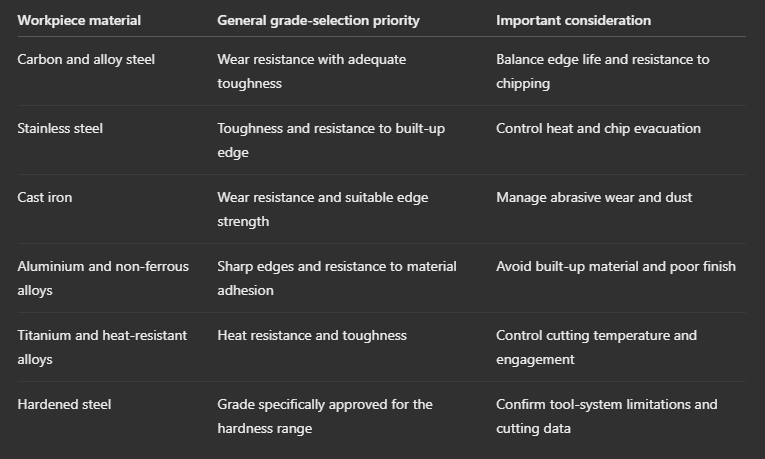
Manufacturers use different grade names, coatings, and substrate compositions. ISO material groups such as P, M, K, N, S, and H provide a useful starting point, but they do not identify one universal grade. Always use the insert manufacturer’s recommendations for the actual material and operation.
Applications of Thread Milling Inserts
Internal Thread Milling
Internal thread milling produces threads inside a drilled or pre-machined hole. It is useful for precision components, housings, flanges, and threaded mounting holes.
The hole diameter, cutter diameter, thread depth, and available clearance must all match the tooling system.
External Thread Milling
External thread milling generates threads on the outside of a component, such as a shaft, connector, or specialized fastener.
Correct tool positioning and programmed interpolation are essential for achieving the required major diameter and thread profile.
Special Thread Profiles
Compatible thread milling systems can produce different thread standards, including ISO metric, Unified, Whitworth, and selected pipe threads. Availability depends on the cutter and insert range.
Thread milling can be especially useful when thread specifications are demanding or when a workshop needs flexibility across different components.
How to Choose the Right Thread Milling Insert
-
Identify the thread standard. Confirm whether the application requires ISO metric, Unified, Whitworth, pipe, or another specified profile.
-
Check the pitch. Match the insert’s supported pitch and thread geometry to the drawing.
-
Confirm internal or external threading. Verify that the insert and cutter are designed for the intended operation.
-
Select the grade. Choose a manufacturer-recommended grade based on workpiece material, hardness, and cutting conditions.
-
Choose the insert profile. Use full-profile inserts when the complete specified profile is required, or partial-profile inserts when their pitch flexibility suits the job.
-
Evaluate productivity. Compare single-point and multi-tooth systems based on thread size, production volume, and machine capability.
-
Verify compatibility. Check insert dimensions, cutter body, clamping method, and permitted cutting parameters.
-
Optimize the CNC program. Confirm the correct helical interpolation, cutter compensation, entry strategy, and cutting direction.
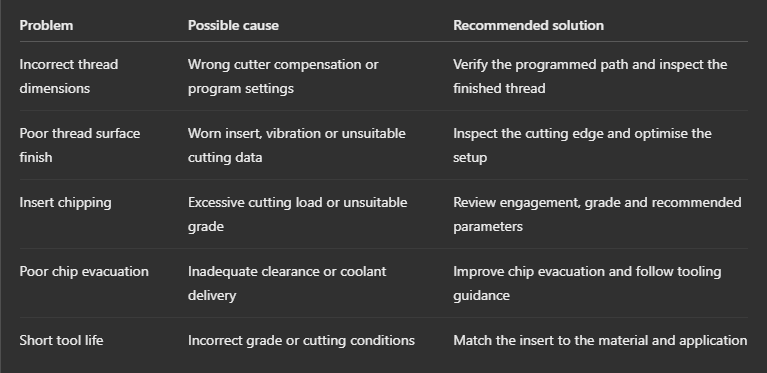
Common Thread Milling Problems and Solutions
Why Choose MakeYouEasy?
MakeYouEasy provides CNC tooling information and machining resources to help manufacturing professionals understand cutting tools and make informed tooling decisions.
Understanding insert geometry, grade selection, and thread requirements helps machinists reduce selection errors and achieve more consistent threading results.
Explore machining resources at MakeYouEasy.com.
Conclusion
Thread milling inserts offer flexibility for producing accurate internal and external threads across a range of machining applications. Full-profile and partial-profile inserts serve different thread geometry requirements, while single-point and multi-tooth systems provide different approaches to cutting engagement and productivity.
For reliable results, match the insert to the thread standard, pitch, workpiece material, carbide grade, and compatible cutter system. Always verify manufacturer specifications and recommended cutting parameters before machining.
FAQs
1. What are thread milling inserts used for?
Thread milling inserts are used in compatible cutters to produce internal or external threads on CNC milling machines.
2. What is the difference between full-profile and partial-profile inserts?
Full-profile inserts generate the specified complete thread profile, while partial-profile inserts form the flanks and may support multiple compatible pitches.
3. How do I choose the correct thread milling insert grade?
Choose a manufacturer-recommended grade based on workpiece material, hardness, cutting conditions, and the required tool life.
4. Can thread milling inserts produce internal and external threads?
Some tooling systems support both applications, but the insert and cutter must be specifically compatible with the intended thread operation.
5. Are multi-tooth thread milling inserts more productive?
They can increase productivity in suitable applications by machining multiple thread portions per pass, provided the machine and tooling support the required cutting conditions.
Popular Search Keywords
thread milling inserts, thread milling insert types, thread milling carbide grades, indexable thread milling inserts, full-profile thread milling inserts, partial-profile thread milling inserts, internal thread milling, external thread milling, CNC thread milling tools, thread milling insert selection, carbide thread milling cutters.
