The Hygiene Routine That Keeps BJJ Ringworm From Returning
Author : Kimura Soap Co | Published On : 26 Aug 2026
BJJ ringworm that shows up once is close to unavoidable.
You train with strangers, on shared mats, in a warm room, with skin under friction for an hour at a time. That first ring on your forearm is bad luck, the kind that comes with signing up for a contact sport.
The second one is different. A ring in roughly the same spot four months later, after the first one cleared and you went back to training exactly the way you had been, is a pattern, and patterns have causes. Most grapplers treat BJJ ringworm as a skin event, something that shows up, gets treated, and goes away, then file the return under the cost of doing this sport.
It is not the cost of doing this sport. Dermatophyte fungus survives on shared mats, in damp gear, and in laundry that never ran hot enough to kill it. This is a supply problem, and the supply is usually sitting in your own bag, not on the mat you keep blaming.
This article treats BJJ ringworm as a gym problem rather than a one-time skin problem. That means looking at how long the fungus survives on gear and laundry, the three routes that carry it back to you, and where a post-training routine actually closes the loop.

Why Ringworm From the Gym Keeps Coming Back
BJJ ringworm shows up in almost every academy at some point, and one case is close to unavoidable.
You train with strangers. You share mats with a dozen different training partners a week. Skin spends an hour under friction in a warm room. That combination makes a first infection something close to the price of admission for the sport.
Once is Exposure; Three Times is A Pattern
Catching it three times in a year has a different cause. Ringworm is caused by dermatophyte fungi, and the version grapplers pick up on the mat has its own name in the research: tinea gladiatorum. The name exists because contact sports produce a distinct exposure pattern, one that repeat cases usually trace back to something other than a stranger’s skin.
What the Contamination Data Shows
A systematic review and meta-analysis in Current Microbiology looked at this exact pattern in wrestlers. The findings point away from person-to-person contact as the only source.
Species behind most cases
Trichophyton tonsurans was responsible for 92 percent of cases in the wrestlers studied. That level of concentration in a single species suggests a shared environmental source rather than scattered, unrelated exposures.
Average contamination across facilities
Dermatophyte contamination in wrestling halls averaged five percent overall. Even at that baseline, the fungus was present on surfaces regardless of whether any athlete had an active, visible infection at the time.
Contamination in the worst facilities
Individual facilities measured as high as 56 percent contamination. A number that high means an athlete training in that room faces meaningful surface exposure on nearly every visit.
Those numbers describe surfaces, not people. A mat can carry live fungus without anyone on it showing a symptom. An athlete who cleared an infection and changed nothing about his gear, his bag, or his laundry is training back into the same exposure that caused the first case.
The Three Routes That Carry It Back
Three routes carry the dermatophyte back to an athlete who thinks they already dealt with it. The mat someone trains on, the bag that gear travels in, and the laundry cycle that either kills the fungus or just moves it around a wash of warm water.
The mat
The mat carries whatever the last several classes left behind on it. Contact with an infected surface can reintroduce the fungus even when every training partner that day was symptom-free.
The gym bag
The gym bag holds worn gear in a warm, dark, damp space between sessions. Those conditions let the fungus survive against clean gear packed in the same compartment.
The laundry cycle
The laundry cycle either kills the fungus with heat or simply relocates it to clean clothes. A cold or lukewarm wash does not reliably kill dermatophytes, which means the cycle can spread the problem instead of solving it.
Close all three routes and the recurrence stops. That is the actual fix for BJJ ringworm that keeps coming back, and it has very little to do with bad luck on the mat.
Treating Ringworm as a Gym Problem, Not Just a Skin Problem
BJJ ringworm keeps circulating in gyms because most athletes treat it as something that happens to their skin instead of something that happens to their gear. That framing misses where the fungus actually lives between infections. It also explains why the same ring keeps appearing on the same person months apart.
The Loop That Keeps Repeating
A ring appears. The athlete sees a doctor or picks up a cream at the pharmacy. The infection clears within a few weeks. Training resumes, and the same rashguard comes out of the same bag it sat in the whole time the infection was active. A new lesion opens up somewhere in the following month, often in a similar spot.
Unwashed gear reentering rotation
The gear that was in the bag during the infection often gets worn again without a proper hot wash. That gear can still be carrying spores from the original infection.
The bag itself untouched
The bag rarely gets emptied or dried out during the weeks the skin is healing. A closed, damp bag gives the fungus a place to wait out the treatment period.
Training resuming at full pace
Once the skin looks clear, most athletes return to full training without changing anything else. The routine that allowed the first infection stays the same.
Why the timing makes this hard to catch
Tinea corporis has an incubation period of roughly one to three weeks. By the time a ring becomes visible, the exposure that caused it happened two or three Tuesdays earlier. Nobody can reliably trace a specific class, partner, or piece of gear back that far. Most athletes stop trying to find the source and just treat the symptom in front of them.
That gap between exposure and visible infection is exactly why the actual cause, whether it is the bag, the laundry, or the mat, stays untouched. The infection gets treated. The routine that produced it does not.
What a Repeat Infection Actually Costs
The cost of BJJ ringworm shows up on the training calendar, not just on the skin. Missing three weeks during a competition prep block does not just cost those three weeks. It costs the peak an athlete was building toward that cycle.
Lost training blocks
A recurring infection can knock out training right before a tournament or a belt test. That timing is rarely convenient, since ringworm does not wait for a good moment to show up.
Partners growing cautious
Training partners notice a pattern faster than the athlete does. Some start choosing other partners to roll with, and given the contagion risk, that caution is reasonable rather than unfair.
Treating BJJ ringworm as a one-time skin event keeps the actual source in place. The infection clears. The bag, the laundry, and the routine around them stay exactly as they were, which is why the same ring tends to come back.
Returning to Training After Ringworm Clears
BJJ ringworm raises one more question once the visible symptoms fade. Whether it is actually gone is not something an athlete can determine by looking in a mirror. That call belongs to a doctor, and skipping it is how a cleared-looking case turns into the next recurrence.
Confirming the Infection Has Resolved
A ring can look faded or flat while spores are still active underneath the surface. Self-assessment misses this because it relies on appearance alone, and appearance is not a reliable marker for a fungal infection clearing completely.
Getting a professional check
A doctor can confirm whether the infection has actually resolved rather than just quieted down. This step matters most for anyone who has already had a repeat case, since it breaks the guessing that led to the pattern in the first place.
Following the full course of treatment
Stopping treatment early because the skin looks better is a common reason infections return. Finishing the full course, even after visible symptoms fade, gives the fungus less chance to come back.
What is the Athlete’s Responsibility to Disclose
Confirming the infection is a doctor’s job. Telling the people an athlete trains with is not. That part sits entirely with the athlete, and it is not optional in a sport built on direct skin contact.
Informing training partners
Partners deserve to know if someone they roll with has had an active infection, especially if it is a repeat case. This is a basic courtesy in a sport where skin contact is constant.

Informing coaches
A coach can make better calls about pairing and mat time when they know an athlete’s history with BJJ ringworm. Leaving them uninformed removes their ability to protect the rest of the room.
How BJJ Compares to Wrestling’s Formal Standard
High school wrestling does not leave this to individual judgment. NFHS rules require a referee to perform skin checks before a dual meet. They also require written clearance from a health care professional for any suspected condition, and state plainly that covering a communicable condition is not acceptable.
Jiu jitsu has no equivalent rule. Most academies run on an honor system instead, which means the standard in any given room is whatever the people training there decide to hold themselves to. Given how easily ringworm spreads through repeated exposure, treating disclosure with the same seriousness that wrestling requires by rule is a reasonable standard to hold voluntarily.
Pack Kimura Soap Before It Happens Again
Stopping BJJ ringworm from coming back is a three-step protocol: wash gear hot after every session, unpack the bag the same day, and shower immediately after training.
Most athletes are already doing one or two of these consistently. The recurrence usually comes from whichever one keeps getting skipped, whether that is the cold, once-a-week laundry load, the bag left zipped in the trunk, or the shower that gets pushed back until after the drive home.
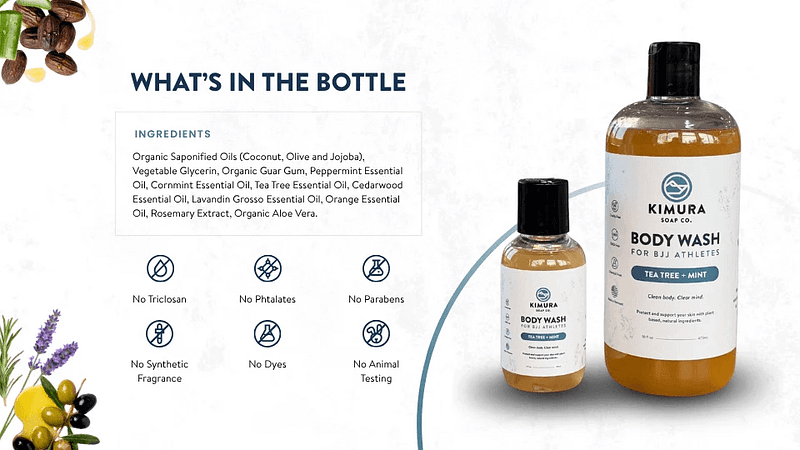
Closing that gap is the whole fix. Put the 3 oz travel bottle in the gym bag so the post-training shower never depends on being home, or start with the 16 oz and 3 oz combo and cover the home shower and the gym bag at the same time. Clean body. Clear mind.
Frequently Asked Questions
Can you train BJJ with ringworm?
No. Ringworm spreads through direct skin contact, and jiu jitsu is built on exactly that kind of contact. Training with an active lesion puts every partner you roll with at risk. Stay off the mat until a doctor confirms the infection has cleared.
How long is ringworm contagious?
Ringworm stays contagious as long as active spores are present on the skin, which without treatment can last for weeks or longer. With antifungal treatment, most sources put the contagious window at around 48 hours after starting the medication. A doctor can confirm when it is safe to return to training.
How long does ringworm take to heal?
Mild cases typically clear within two to four weeks with consistent antifungal treatment. Scalp or nail involvement takes longer and usually needs prescription medication for one to three months. Stopping treatment early because the skin looks better is a common reason it comes back.
What does ringworm look like when it first appears?
It usually starts as a small, red, slightly scaly patch rather than a full ring. As it grows, the center often clears while the outer edge stays raised and defined, which is what eventually gives it the ring shape. Itching is common from the earliest stage.
How do you get ringworm from jiu jitsu?
Direct skin contact with an infected training partner during rolling or drilling is the most common route. Contaminated mats, gis, and towels can also carry the fungus to the next person who touches them. This is why both hygiene habits and surface cleaning matter, not just avoiding infected partners.
