Sweetener Manufacturer in Spain: A Food Technologist’s Checklist
Author : Riley Molina | Published On : 10 Oct 2026
Lucia works in R&D at a dessert company, and her director just said the words every technologist dreads: less sugar, same taste, by January. Where do you even start? With the sweetener, obviously, and with whoever makes it. Picking a sweetener manufacturer in Spain looks easy on paper and gets messy the second a hot, acidic recipe is involved.
Edulcodiet’s homepage speaks to that exact situation. It talks about sugar reduction in drinks, desserts and chocolate, and also jams and baked goods, plus support on dosage and stability. Lucia read it on her lunch break, a bit suspicious, the way R&D people read anything that sounds helpful.
Start with the process, not the packaging
Lucia’s first question wasn’t about price. It was whether a bulk industrial sweetener would survive her process: heat and acid, and months on a shelf. The page says as much, pointing to dosage, solubility, stability and flavour profile as the things to study in each application. Cost per finished dessert comes after, not before.
The FAQ goes further for drinks. It says the right sugar substitute depends on sensory profile, sweetness level, composition and process, and Edulcodiet assesses each application before recommending anything. Lucia liked that. A supplier who answers “it depends” and then explains what it depends on is usually the honest kind.
What each sweetener brings to the bench
On paper there are six zero calorie industrial sweetener products to test. Stevia is mild and easy for shoppers to accept. Monk fruit is the newer one. Sucralose is high intensity and priced to compete. Erythritol comes as Plus, with extra sweetening power, and as Gold for baking and cooking. A third version, Date, blends erythritol with date.
Lucia’s dessert line leans toward baking, so Erythritol Gold went on her list first. Her drinks colleague wanted something different. Nobody on the team could predict what would happen in the oven or in a bottle without trying it, which is, to be fair, the whole reason for sampling.
What owning the plant changes for R&D
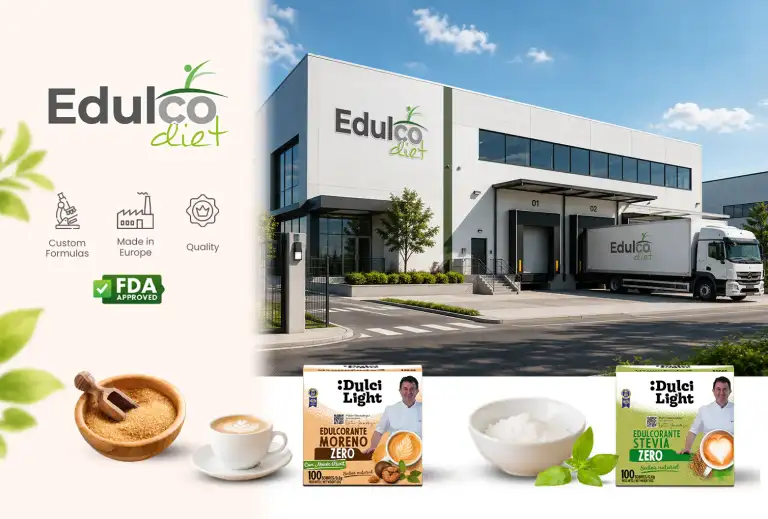
Edulcodiet makes its industrial sweetener at its own plant in Perafort, near Tarragona, rather than buying finished goods from somebody else. For Lucia that meant a single technical contact. Questions about dosage or stability didn’t have to travel through a sales rep who’d never opened a lab report.
The page promises technical advice from the first contact and a proposal tailored to volume and market. It also says every batch comes with documents for quality and R&D teams. Lucia filed that last point under “boring but vital”, which is how most R&D people file paperwork until audit season.
Bulk industrial sweetener formats and the 1,000 kg question
Formats go from about 20 kg industrial bags and boxes up to 500 kg Big Bags, with sachets, boxes and doypacks for retail and foodservice. Lucia’s plant would sit at the big end if the dessert range took off. For lab trials, though, she cared about one thing only: how fast a small sample could land on her bench.
Minimums matter for a trial too. As a guide, the page says standard solutions often start at 1,000 kg, while certain blends or high intensity sweeteners can go lower, depending on formulation, raw material, format and process. Her buyer wanted the number in writing from a sweetener manufacturer in Spain before approving anything.
A sample on the bench beats a brochure
The process as described: tell them the application, volume, channel and market, get a proposal and samples, fine tune formula, format and packaging until the product meets your technical and commercial needs, then production and delivery. Lucia likes step three most, since fine tuning is where R&D actually lives.
Samples arrive for lab testing and product development, plus validation at industrial scale, depending on the project and the product, and the customer can arrange shipping. Lucia ran two trial batches on that basis. One was fine. The other tasted a little flat in the cold dessert, so she adjusted. That’s normal. It’s the job.
When a standard sweetener isn’t enough
For certain projects Edulcodiet builds customer specific blends. The goals are a particular sweetness level, a better sensory profile, easier dosing or a lower cost per application. To start, they want the finished food and the starting recipe, plus the process in between.
Lucia kept this in her back pocket. Her recipe might not need a blend, and the page itself says it’s only for some projects. Still, knowing that a custom route exists, and what information it needs, changed how she wrote her brief. Shorter wish list, clearer questions.
Orders that cross a border
Edulcodiet ships bulk industrial sweetener to more than 35 countries and serves customers in more than 10 languages, with product and documents prepared for export operations. If Lucia’s company ever sells the dessert line abroad, that history helps. Each destination has its own commercial and documentation rules, and the page says they review those in advance.
On the retail side the page mentions DulciLight, the company’s own brand in supermarkets and online, whose products won the Superior Taste Award and the SIAL Innovation Award in 2022. Lucia doesn’t sell sweeteners herself. Still, a supplier that runs its own consumer brand probably understands how taste complaints reach a customer service desk.
Reading the reviews with a cool head
Three companies are quoted on the page. Between them they mention speed and personal service, plus traceability and flexibility. Lucia treats that as a reason to ask for references, not as proof. A vendor’s own site would naturally show its happiest customers, she reminded herself, so she planned two phone calls with real users before signing anything. She also asked what a supplier would need to know about her recipe first.
Her checklist, in the end, is short and a bit boring, which she likes. Taste and dosage first, then a sample, then paperwork that holds up. Everything else follows from a good industrial sweetener match and a supplier who explains things plainly. Lucia sent the brief on a Thursday and, for once, felt calm about January.
Before the next meeting
A food technologist’s checklist for a sweetener manufacturer in Spain fits on a sticky note. Does it survive the process, and does a real sample taste right? Edulcodiet’s page lays most of that out in plain language. Whether it suits your recipe is for the lab to say, which is why the bench comes before the contract.
Short answers for busy labs
What should R&D check before choosing an industrial sweetener?
Taste and sweetness first, then solubility and stability in your process, then dosage and cost per finished product.
Can I get samples for lab tests?
Yes, depending on the project and product. Terms are agreed with the sales team, and the customer can arrange shipping.
Are there bulk industrial sweetener formats for a plant?
Yes, from about 20 kg industrial bags to 500 kg Big Bags.
Does the team build custom blends?
For certain projects, yes. They need the final food, the starting formulation and the process.
Which countries do they export to?
More than 35 countries, with customer service in more than 10 languages.
