Streamlining Inventory with Blockchain-Verified Chain of Custody
Author : Kabir Pathan | Published On : 02 Sep 2026
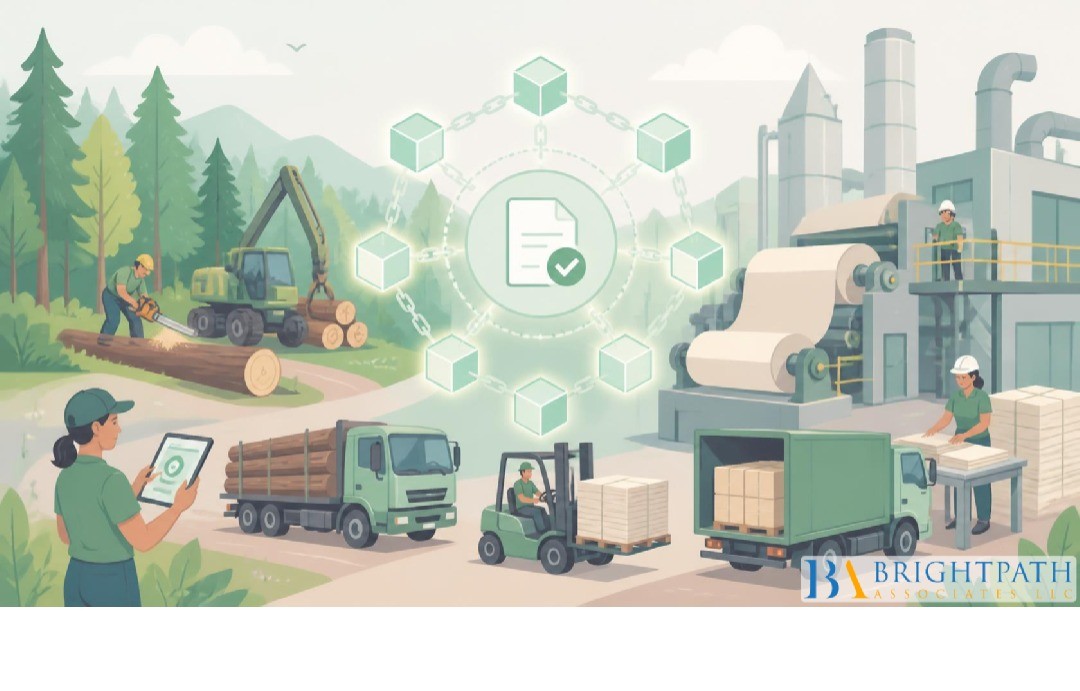
For decades, inventory management in the paper and forest products industry has depended on spreadsheets, invoices, shipping documents, certificates, enterprise systems, and supplier records. These tools remain essential, but increasingly complex supply chains are exposing a persistent challenge: knowing not only how much material a company has, but also where that material came from, how it moved, and whether the information surrounding it can be trusted.
Blockchain is not a replacement for enterprise resource planning systems, warehouse management platforms, or conventional inventory controls. Instead, it can provide an additional layer of shared, tamper-resistant information that connects different organizations across the supply chain. For companies dealing with timber, pulp, paper, recycled fiber, lumber, and engineered wood products, that capability could become strategically important.
Why Inventory Visibility Is Becoming a Leadership Issue
When material records are inaccurate or fragmented, the consequences can spread across procurement, manufacturing, logistics, finance, compliance, and customer relationships. Excess inventory can tie up capital, while insufficient raw materials can disrupt production schedules. Missing documentation can create additional work during audits, while uncertainty about material origins can create reputational and regulatory risks.
Timber may move from a harvesting operation to a transportation provider, then to a sawmill, manufacturer, distributor, and ultimately a customer. Paper and pulp supply chains can involve suppliers, recycling operations, mills, logistics companies, converters, and distributors. Every handoff creates another opportunity for information to become disconnected.
Creating a More Reliable Chain of Custody
The fundamental concept is straightforward. When material enters a supply chain, relevant information can be recorded digitally. As the material moves, changes ownership, or undergoes processing, additional transactions can be added to the record.
For example, timber originating from an approved source could receive a digital record at the beginning of its journey. Information about harvesting, volume, supplier, transportation, and receiving facilities could subsequently be connected to that record. When the timber is processed into lumber or another product, the transformation can also become part of the digital history.
However, executives should recognize an important limitation: blockchain does not automatically make inaccurate information accurate. If incorrect information is entered at the beginning, the technology cannot independently determine that the information is false. Supplier verification, auditing, data governance, and strong operational controls remain essential.
Supporting Responsible Sourcing and Compliance
Responsible sourcing is becoming increasingly important across the forest products sector. Companies may need to demonstrate where materials originated, how they were handled, and whether sourcing practices align with environmental and regulatory expectations.
Instead of gathering information from multiple disconnected systems whenever an audit or customer inquiry occurs, organizations can potentially trace specific batches through different stages of the supply chain. Compliance teams may spend less time reconciling records, while executives gain greater visibility into potential sourcing risks.
This becomes particularly valuable for organizations operating across regions or international markets where documentation requirements can vary. For businesses evaluating their broader capabilities, specialized expertise across the Paper & Forest Products Industry is becoming increasingly relevant as technology, sustainability, compliance, and operational leadership converge.
Blockchain and the Circular Economy
Traceability is also becoming important as paper manufacturers and forest product companies pursue more circular business models.
Recycled paper and recovered fiber can pass through numerous collection, sorting, processing, and manufacturing stages. Maintaining reliable information throughout that journey can be difficult when several organizations are involved.
This has potential implications beyond compliance. Customers increasingly want credible information about sustainability claims, and companies need stronger evidence to support those claims. A reliable traceability system can help connect sustainability objectives with verifiable supply-chain information.
Connecting Blockchain With Modern Manufacturing
Paper mills and forest product manufacturers are already adopting automation, sensors, advanced process controls, data analytics, artificial intelligence, and connected manufacturing technologies. These systems can generate enormous amounts of operational information, including production quantities, material movements, machine performance, and inventory changes.
An ERP system may provide a company's internal view of inventory, while blockchain can create a shared transaction layer between suppliers, manufacturers, logistics providers, distributors, and customers.
This distinction is important. Companies do not necessarily need to put every piece of operational information onto a blockchain. Instead, leadership teams should identify the transactions where shared verification provides genuine business value.
Preparing for a More Transparent Forest Products Supply Chain
The future of inventory management in the paper and forest products sector will likely involve more than simply counting physical stock. Companies will increasingly need to understand the story behind that inventory.
Where did the material originate? Who handled it? How was it transformed? Does the documentation support the company's sourcing and sustainability claims? Can the organization quickly demonstrate that information to customers, regulators, auditors, or business partners?
Its greatest value may ultimately come from creating trust between organizations that do not share the same internal systems. When combined with automation, analytics, connected manufacturing, and disciplined data governance, blockchain can contribute to a more transparent and resilient supply chain.
For a deeper look at how blockchain can strengthen inventory visibility, sourcing transparency, compliance, and supply-chain accountability, explore the original Blockchain-Verified Chain of Custody analysis.
The Next Competitive Advantage May Be Trust
Paper and forest product companies are operating in an environment where sustainability expectations, regulatory requirements, customer scrutiny, and technological change are converging. In such an environment, the ability to prove what a product is, where it came from, and how it moved through the supply chain can become just as important as the product itself.
Blockchain will not solve every inventory or sourcing challenge. But for organizations willing to combine technology with strong governance, reliable data, and capable leadership, it can become an important component of a more transparent supply chain.
The larger question for executives is no longer whether traceability matters. It is whether their organization has the technology, processes, and leadership capabilities needed to make traceability a competitive strength.
