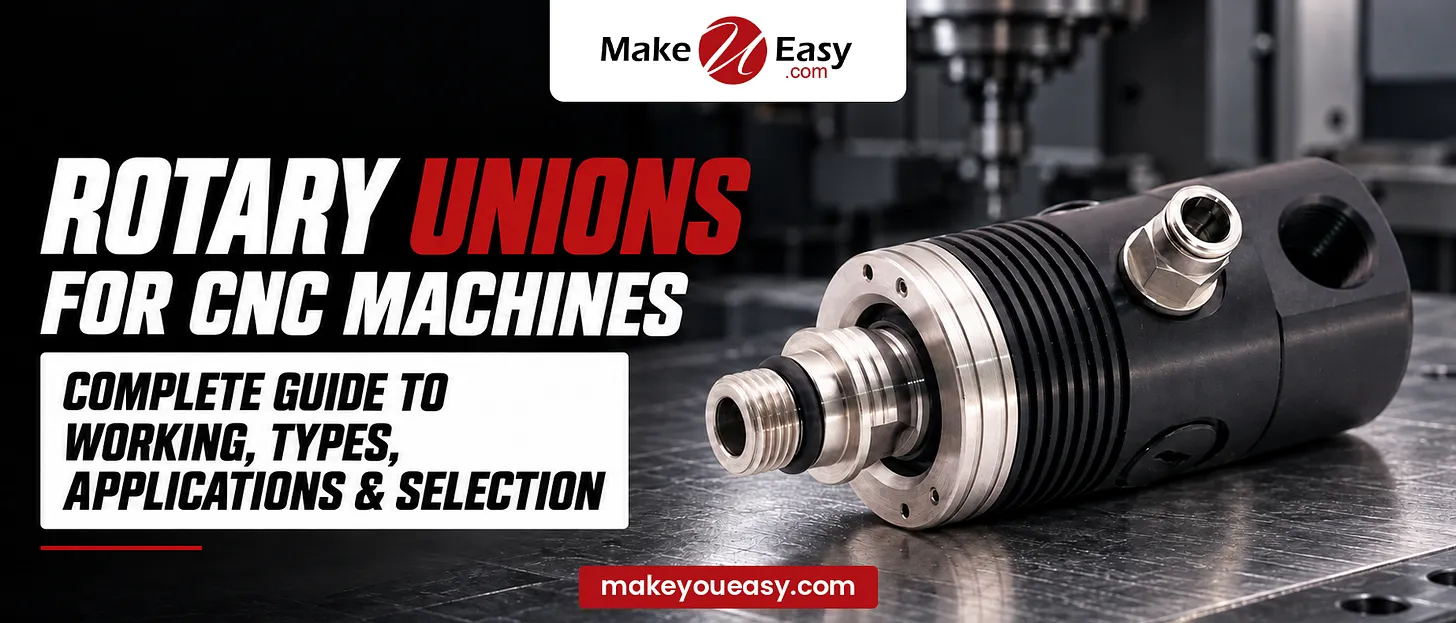
Rotary Unions for CNC Machines: Complete Guide to Working, Types, Applications & Selection
Author : Surya makeyoueasy | Published On : 21 Oct 2026
Introduction
Modern CNC machines require reliable coolant delivery, hydraulic clamping, and compressed-air supply for different machining operations. When these services must reach a rotating spindle, rotary table, or fixture, an ordinary fixed pipe connection cannot accommodate continuous rotation.
A rotary union for CNC machines transfers fluids or gases from a stationary supply to a rotating component while maintaining a sealed connection. Selecting the correct rotary union helps support reliable operation, reduce leakage, and protect critical machine components.
What Is a Rotary Union?
A rotary union, also called a rotary joint, is a precision mechanical device that transfers a medium such as coolant, cutting oil, compressed air, or hydraulic fluid between stationary and rotating components.
In CNC machining centers, rotary unions are commonly used in through-spindle coolant (TSC) systems. They can also supply hydraulic pressure to rotary fixtures and chucks, depending on the machine configuration.
How Does a CNC Rotary Union Work?
A typical rotary union consists of a housing, rotating element, seals, bearings on supported designs, and fluid passages.
Its working process involves four main steps:
-
Medium supply: Coolant, air, or hydraulic fluid enters through a stationary supply line.
-
Rotary transfer: The union transfers the medium into the rotating spindle, shaft, table, or fixture.
-
Sealing: Internal sealing components help prevent unwanted leakage between the fluid passage and surrounding areas.
-
Delivery: The medium reaches its intended destination, such as a cutting tool or hydraulic clamping circuit.
For through-spindle coolant, the union enables coolant to pass into the spindle and through compatible toolholders and cutting tools. This helps deliver coolant closer to the cutting edge and supports chip evacuation during suitable drilling and milling operations.
Types of Rotary Unions for CNC Machines
1. Bearing-Supported Rotary Unions
These units include bearings that support the rotating element independently within the assembly.
Benefits:
-
Self-supported construction in suitable designs.
-
Convenient installation in compatible applications.
-
Suitable for a range of spindle and rotary-table requirements.
Applications: CNC spindles, coolant delivery systems, and selected rotary fixtures.
2. Bearingless Rotary Unions
Bearingless designs rely on the machine’s spindle or shaft arrangement to support and align the rotating element.
Benefits:
-
Compact construction.
-
Potentially lower rotational inertia and vibration when correctly integrated.
-
Suitable for specific high-speed spindle designs.
Applications: Machine-tool spindles designed for compatible bearingless rotary unions.
Installation and alignment are particularly important because the machine structure supports the rotating element.
3. Single-Passage Rotary Unions
Single-passage units transfer one medium through a dedicated flow path.
Benefits:
-
Straightforward design.
-
Suitable for applications requiring one supply channel.
-
Useful for dedicated coolant or air delivery.
Applications: Through-spindle coolant and other single-circuit requirements.
4. Multi-Passage Rotary Unions
Multi-passage rotary unions contain separate channels for transferring multiple media or serving independent circuits.
Benefits:
-
Supports multiple fluid or air connections in one assembly.
-
Helps accommodate more complex machine configurations.
-
Can support separate hydraulic circuits that are specifically designed.
Applications: Rotary tables, hydraulic fixtures, and machine systems requiring multiple isolated passages.
5. High-Pressure Coolant Rotary Unions
These rotary unions are specifically designed for the pressure, speed, fluid, and sealing requirements of high-pressure coolant systems.
Benefits:
-
Support through-tool coolant delivery within the rated operating conditions.
-
Helps maintain reliable sealing under specified pressure and speed.
-
Supports chip evacuation in suitable machining operations.
Applications: Deep-hole drilling, demanding milling operations, and CNC machining centers equipped with high-pressure through-spindle coolant.
Note: Rotary unions must be selected according to the manufacturer’s pressure, speed, temperature, and media ratings. These categories can overlap; for example, a high-pressure unit may also be bearing-supported and single-passage.
Applications of Rotary Unions in CNC Machining
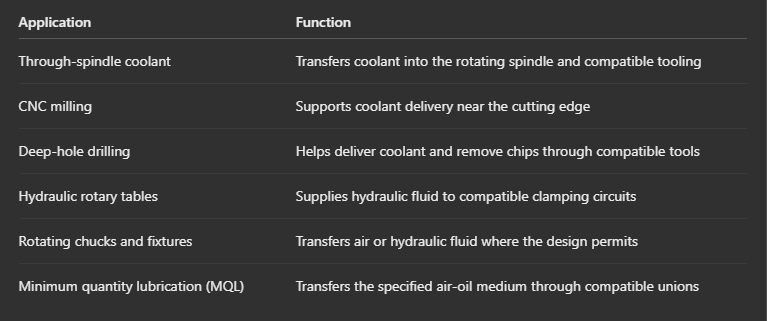
Rotary unions are also used in selected machine-tool systems for compressed air and tool-related functions. The correct configuration depends on the machine builder’s design.
Benefits of Rotary Unions for CNC Machines
-
Reliable fluid transfer: Enables media delivery between stationary and rotating components.
-
Improved coolant access: Supports direct coolant delivery through compatible spindles and tools.
-
Better chip evacuation: Appropriate through-tool coolant can help clear chips from deep or confined cutting zones.
-
Support for hydraulic clamping: Enables fluid transfer to compatible rotary fixtures and tables.
-
Reduced hose twisting: Avoids relying on a fixed hose connection that would wind up during continuous rotation.
-
Improved operational reliability: Correct selection and maintenance help reduce leakage-related interruptions.
Actual performance benefits depend on the machine design, coolant system, cutting operation, and condition of the rotary union.
Common Rotary Union Problems and Solutions
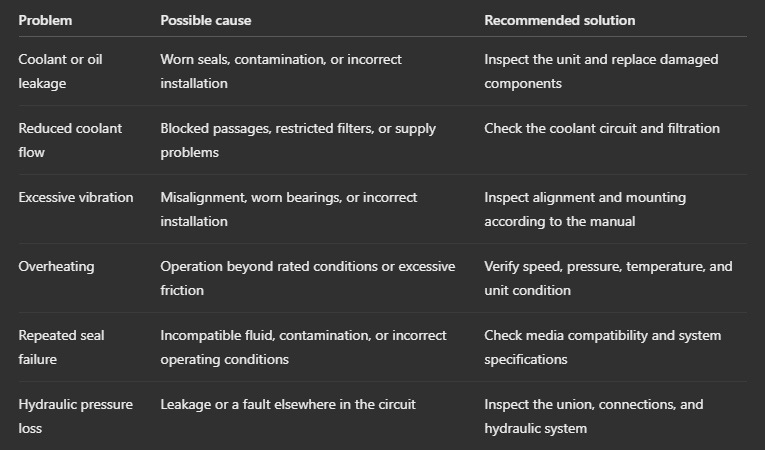
Do not automatically replace a rotary union whenever coolant pressure drops. The pump, filters, toolholder, coolant passages, and other system components may also be responsible.
How to Select the Right Rotary Union
Consider these factors before purchasing a replacement or specifying a new unit:
-
Medium type: Identify whether the union will carry coolant, cutting oil, compressed air, hydraulic fluid, or MQL.
-
Maximum pressure: Confirm the required operating pressure and the unit’s permitted pressure at the intended speed.
-
Rotational speed: Check the maximum spindle or table RPM supported by the selected configuration.
-
Number of passages: Choose single-passage or multi-passage construction according to the required circuits.
-
Mounting arrangement: Verify the thread, flange, rotor connection, dimensions, and available installation space.
-
Seal and material compatibility: Ensure that the seals and body materials are suitable for the fluid and temperature.
-
Filtration requirements: Follow the manufacturer’s requirements for coolant cleanliness and filtration.
-
Maintenance support: Consider replacement seals, serviceability, warranty, and technical assistance.
Important: Never choose a rotary union based on dimensions alone. Confirm that its pressure and speed ratings are suitable together for the actual application.
Why Choose MakeYouEasy?
MakeYouEasy supports manufacturing professionals with CNC cutting tools, tool holders, machining accessories, and technical resources for industrial applications.
Understanding machine-tool components and their operating requirements helps manufacturers make informed decisions about maintenance and machining performance.
Explore products and resources at MakeYouEasy.com.
Conclusion
Rotary unions are important components in CNC machines that require fluid or gas transfer between stationary and rotating assemblies. From through-spindle coolant delivery to hydraulic rotary-table systems, the correct design supports reliable operation and reduces the risk of leakage-related downtime.
For dependable performance, select a rotary union based on its medium, pressure, speed, passage configuration, mounting arrangement, and maintenance requirements.
Frequently Asked Questions
1. What is a rotary union used for in a CNC machine?
It transfers coolant, air, or hydraulic fluid from a stationary supply to a rotating spindle, table, or fixture.
2. What is the difference between bearing-supported and bearingless rotary unions?
Bearing-supported units have their own bearing support, while bearingless designs rely on the machine’s spindle or shaft arrangement.
3. Can a rotary union handle high-pressure coolant?
Yes, if the selected model is specifically rated for the required coolant pressure, rotational speed, and operating conditions.
4. What causes a CNC rotary union to leak?
Common causes include seal wear, contamination, misalignment, incompatible fluids, and operation beyond the specified limits.
5. How do I choose the correct rotary union?
Match the medium, pressure, RPM, number of passages, mounting dimensions, and seal compatibility to the machine requirements.
Popular Search Keywords
rotary unions for CNC machines, CNC rotary union, rotary union working principle, rotary joint types, through-spindle coolant rotary union, CNC spindle rotary union, high-pressure coolant rotary union, bearingless rotary union, multi-passage rotary union, CNC rotary union applications, rotary union troubleshooting, rotary union selection guide.
