Relific vs SoulAce: A Practical Comparison for Smarter CSR Management in 2026
Author : relific tech | Published On : 30 Jul 2026
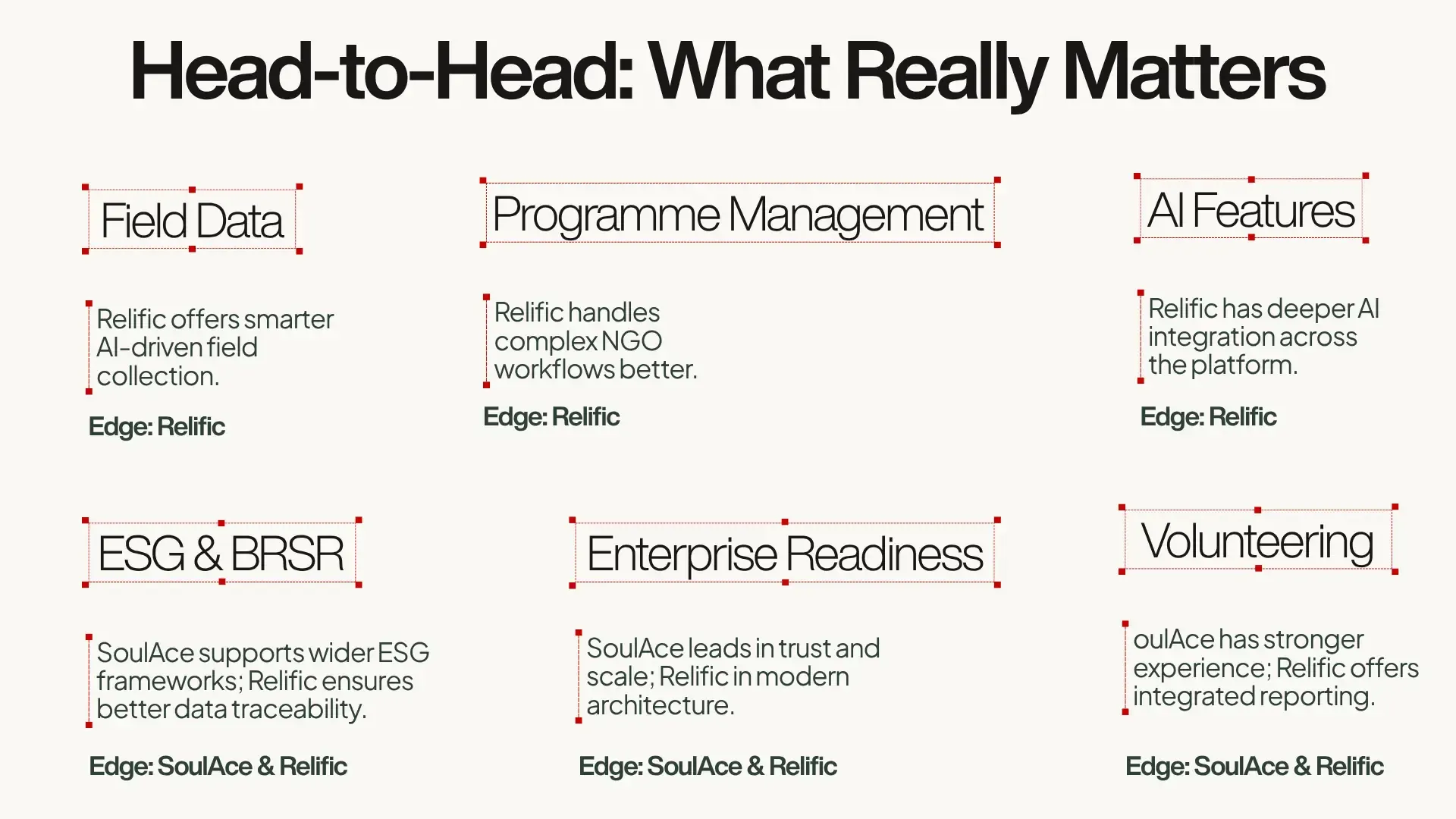 Corporate social responsibility is becoming increasingly difficult to manage with traditional tools. Companies today need to work with multiple NGO partners, monitor projects across different locations, track spending and outcomes, manage employee volunteering, and prepare reliable information for ESG disclosures. In this changing environment, the Relific vs SoulAce comparison can help businesses understand which type of CSR technology is better suited to their needs. While Relific focuses on AI-powered impact operations, field-level data, and traceability, SoulAce combines CSR technology with more than 15 years of consulting and advisory experience.
The two platforms are designed to address many of the same broad challenges, but their strengths are different. For one organisation, the priority may be better data collection and smoother NGO management. For another, the most important factor may be an experienced CSR partner with established security credentials and broad ESG reporting capabilities.
The best choice depends on the problems your CSR team needs to solve today and the reporting requirements it expects to face in the future.
Why Companies Need Better CSR Technology
CSR management has changed significantly over the last few years.
A CSR team may now be responsible for everything from selecting NGO partners and approving grants to tracking programme milestones, monitoring beneficiaries, evaluating outcomes, and preparing reports for senior leadership.
When these activities are managed across spreadsheets, email threads, shared folders, and disconnected reporting systems, it can become difficult to maintain a consistent view of what is actually happening.
The problem becomes even more important when companies need to demonstrate the reliability of their ESG information.
SEBI's BRSR Core framework has introduced a phased requirement for reasonable assurance on selected ESG KPIs. The scope has expanded to include the top 1,000 listed entities from FY 2026-27.
This development means companies need to think beyond the final report. They also need to consider the quality of the information that supports each reported metric.
If a board member, regulator, or assurance provider asks where a particular number came from, the organisation should ideally be able to follow that number back to its original source.
This is one of the reasons CSR technology is becoming a more important part of corporate impact management.
Relific: Creating a Stronger Data Foundation
Relific takes a technology-first approach to CSR management.
The platform is built around the idea that better reporting begins with better operational data. If information is collected inconsistently at the field level, fixing it later can be time-consuming and expensive.
For example, a company may work with several NGOs that use different reporting formats. One partner may send an Excel spreadsheet, another may submit a PDF, and a third may provide information through email. CSR teams then have to consolidate everything manually.
Relific aims to create a more structured process by connecting field data collection, programme management, and reporting.
Surve-R: Capturing Information From the Field
Surve-R focuses on mobile field data collection.
Its AI-guided adaptive forms are designed to help field teams capture structured information while working in different environments. The platform also supports offline functionality, which can be useful for programmes operating in areas with unreliable connectivity.
GPS tagging and photo capture provide additional ways to document field activities.
For CSR programmes in areas such as education, healthcare, agriculture, and climate action, this type of functionality can be valuable because much of the important programme information originates outside the corporate office.
The underlying goal is to make data more consistent at the point where it is collected.
ProGran: Bringing Programme Activities Into One Workflow
ProGran is Relific's programme and grants management solution.
It supports activities across the programme lifecycle, including programme planning, grant applications, NGO onboarding, milestone management, disbursement tracking, monitoring and evaluation, and outcome reporting.
This can be particularly helpful for organisations working with multiple implementation partners.
As the number of NGOs increases, so does the administrative workload. CSR teams may need to monitor agreements, payments, documentation, deadlines, milestones, and impact results at the same time.
A connected system can help bring these activities together and reduce dependence on disconnected spreadsheets and manual processes.
Voluntee-R: Tracking Employee Volunteering
Employee volunteering is also part of Relific's broader ecosystem.
Voluntee-R is designed to support volunteer campaigns and track employee participation and volunteering hours. Keeping this information within the wider CSR platform can make it easier to incorporate employee engagement into overall CSR reporting.
Drive-R: Turning Operational Data Into Insights
Drive-R serves as an intelligence and analytics layer for impact information.
The wider platform is designed to create a flow of information from field activities to programme management and eventually to reporting.
The objective is to make reporting part of everyday CSR operations rather than something teams have to assemble manually at the end of each reporting cycle.
What Relific Does Particularly Well
Relific's strongest area is its focus on the data journey.
For companies preparing for BRSR Core assurance, having a clear connection between source data and reported metrics can be important.
If field information is collected in a structured way from the beginning, it may be easier for organisations to maintain a reliable trail leading to the final report.
Relific also focuses strongly on multi-NGO operations. Organisations working with several implementation partners can potentially use the platform to manage onboarding, programme milestones, documentation, disbursements, monitoring, and outcomes.
The platform's use of AI is another notable feature. AI is incorporated into areas such as adaptive data collection, anomaly detection, programme recommendations, and document processing.
However, companies should also consider the platform's maturity.
Relific is a younger solution compared with established CSR consulting organisations. While its customer base is growing, some companies may prefer vendors with a longer history and a larger pool of long-term enterprise references.
Implementation should also be assessed carefully. A platform can only deliver value if NGO partners and internal teams actually use it. Training, onboarding, and change management may therefore become important parts of the implementation process.
SoulAce: Combining CSR Expertise and Digital Tools
SoulAce approaches CSR management from a consulting-led perspective.
The organisation was founded in 2009 and has more than 15 years of experience in CSR advisory services. Its areas of work include CSR strategy, programme support, impact assessment, and fund utilisation reviews.
Alongside these services, SoulAce offers technology solutions for CSR grant management, ESG reporting, and employee volunteering.
This combination of technology and consulting expertise is one of its biggest differentiators.
SoulAce states that it has worked with more than 150 corporate clients across more than 200 districts and 26 states. Its published case studies cover sectors including insurance, pharmaceuticals, steel, and FMCG.
For companies that prefer an established CSR partner with experience across different industries and locations, this background may be an important consideration.
Enterprise Security Is a Key Consideration
Security requirements can have a major influence on enterprise software decisions.
SoulAce publicly documents ISO 27001:2013 certification and SOC 2 compliance. Its technology environment also includes AWS hosting, AES-256 encryption, VAPT audits, and multi-factor authentication.
These credentials may be particularly relevant for larger organisations where new technology must pass detailed reviews by IT, security, legal, and procurement teams.
For such companies, documented security practices can help make the procurement process easier.
ESG Framework Support
SoulAce also has an advantage in terms of ESG framework coverage.
Its ESG platform supports GRI, BRSR, SASB, and CDP.
This can be valuable for companies that have to report against several frameworks or operate in environments where both Indian and international ESG requirements need to be considered.
Relific's emphasis is somewhat different. Its focus is more heavily centred on the data and operational infrastructure that supports impact reporting and BRSR-related traceability.
Therefore, companies need to decide whether their main priority is broad reporting framework coverage or a stronger operational data foundation.
Relific or SoulAce: Start With Your Biggest Problem
The best way to compare the two platforms is to identify what is currently holding your CSR function back.
Relific may be worth considering if your organisation:
- Collects significant amounts of data from field locations
- Works with a large number of NGO partners
- Runs programmes in areas with limited connectivity
- Needs stronger traceability between source data and reports
- Wants AI integrated into day-to-day CSR operations
- Needs employee volunteering data connected with its wider CSR information
SoulAce may be more suitable if your organisation:
- Wants technology combined with CSR consulting
- Values a long-standing track record in the sector
- Has strict enterprise security requirements
- Needs support for GRI, BRSR, SASB, and CDP
- Requires established corporate references
- Wants strategic advice alongside technology
This is why there is no universal winner in the comparison. The right solution depends on the organisation's operating model.
Don't Stop at the Product Demonstration
A successful CSR technology implementation involves much more than choosing software with an attractive interface.
Before making a decision, companies should ask how quickly they can expect to produce their first board-ready report after implementation.
They should also understand the process of onboarding NGO partners.
For example, if a company works with 15 or 20 independent NGOs, every partner may need to be trained and supported during the transition. The amount of effort required can have a significant impact on implementation timelines and costs.
Another useful evaluation method is to test source-to-report traceability.
Ask the vendor to select a specific BRSR or ESG metric and demonstrate how the final number can be traced back to the original field record.
This practical exercise can provide a better understanding of the platform's real audit-readiness than a standard product presentation.
Customer references should also be carefully selected. Organisations should ideally speak with companies that have a similar number of programmes, NGO partners, geographic locations, and reporting requirements.
Understand the Total Cost Before Choosing
The software licence is rarely the complete cost of a CSR technology project.
Companies should consider the total cost of ownership over at least three years.
This may include implementation, configuration, NGO onboarding, training, internal resources, change management, and integrations.
NGO onboarding deserves special attention. A system that works well for internal teams may still face adoption challenges if external implementation partners find it difficult to use.
Understanding these factors in advance can help organisations avoid unexpected costs after implementation begins.
Could a Hybrid Approach Be Useful?
Some companies may find value in using both approaches.
For example, Relific could potentially be used for field data collection, programme operations, NGO management, and BRSR data tracking.
SoulAce could be engaged for strategic CSR consulting or independent impact assessments.
This could allow an organisation to combine a technology-focused operational platform with established CSR advisory expertise.
However, a hybrid model needs careful management. Data ownership, system integration, and reporting responsibilities must be clearly defined.
Otherwise, companies may end up creating additional information silos instead of simplifying their CSR operations.
Final Verdict: Choose Based on Your CSR Reality
Relific and SoulAce both offer solutions to the growing challenges of modern CSR management, but their approaches are fundamentally different.
Relific focuses on creating a connected, AI-powered impact operations environment. Its strengths include field data collection, multi-NGO programme management, operational workflows, and source-level traceability.
SoulAce combines CSR technology with more than 15 years of consulting experience. Its established client base, enterprise security credentials, and support for multiple ESG frameworks make it an attractive option for organisations seeking both technology and advisory capabilities.
If your main challenge is fragmented data, complex field operations, and managing multiple NGO partners, Relific may be a strong fit.
If you need an established CSR partner that can provide consulting expertise alongside technology, SoulAce may be more suitable.
Ultimately, the decision should be based on your organisation's actual needs. Consider the size of your NGO network, the locations where your programmes operate, the quality of your current data, your BRSR and ESG reporting requirements, your security expectations, and the amount of advisory support your team needs.
CSR management in 2026 is increasingly about connecting real-world impact with reliable evidence. Companies need to know not only how much they spend, but also what their programmes achieve and whether they can confidently support the information they report.
The right CSR platform should help create a clear connection between activities, outcomes, and accountability. Whether that means selecting Relific, choosing SoulAce, or exploring a combination of both, the best decision is the one that fits your organisation's operational reality and supports its long-term CSR goals.
