Real-Time Hotel Availability Data Scraping Live vs Cached Feeds
Author : Travel Scrape | Published On : 19 Nov 2026
Introduction
The hotel industry operates in a dynamic digital environment where room availability, pricing, booking conditions, and promotional offers can change multiple times throughout the day. Online travel agencies, hotel aggregators, travel management companies, and hospitality businesses need accurate information to help customers discover suitable accommodation and make confident booking decisions. However, maintaining updated hotel inventory across multiple booking platforms remains a significant operational challenge, particularly during holidays, major events, and peak travel seasons.
Real-Time Hotel Availability Data Scraping enables businesses to collect hotel inventory information from publicly accessible booking platforms and accommodation websites, helping them understand changing room availability and reservation opportunities. By combining automated extraction with structured data validation, companies can monitor inventory changes across destinations, properties, room categories, and travel dates.
Effective Hotel Data Intelligence helps organizations convert constantly changing accommodation information into actionable insights for inventory planning, competitive analysis, and booking optimization. One important consideration is hotel inventory refresh frequency monitoring, which determines how frequently collected information should be updated to remain useful.
Although live data feeds offer faster updates, cached feeds can reduce infrastructure costs and improve system performance. The challenge is determining the right balance between freshness, reliability, scalability, and processing expenses. A refresh interval of one to three hours can provide a practical starting point for many monitoring applications, provided that update frequency reflects market volatility, booking demand, and business requirements.
Understanding Real-Time Hotel Availability Data Scraping
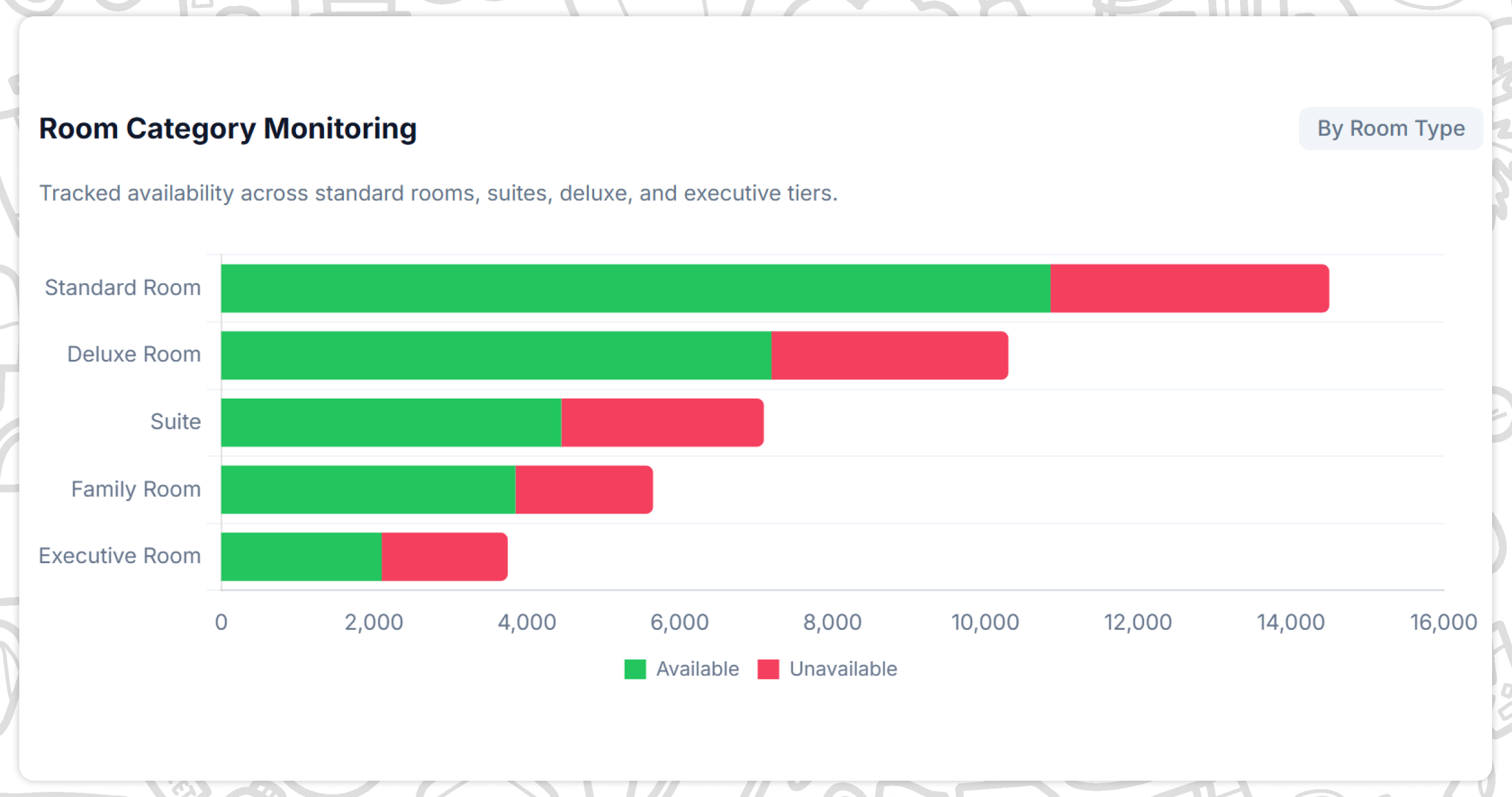
Hotel availability is not a static attribute. A property may offer several room categories, including standard rooms, deluxe rooms, suites, and family accommodation, each with different occupancy limits, prices, cancellation policies, and booking restrictions.
Availability can change when customers make reservations, cancel existing bookings, extend their stays, or modify travel dates. Hotels may also release additional inventory, close selected room categories, or adjust availability according to distribution agreements.
Hotel Data Scraping involves collecting relevant information from accessible hotel websites and booking platforms through automated extraction processes. Depending on the source and applicable permissions, collected information may include property identifiers, destination details, check-in and check-out dates, room types, displayed prices, availability indicators, and booking conditions.
The extracted information is then normalized into a consistent structure, allowing businesses to compare properties and identify inventory changes across multiple sources.
For example, a travel platform tracking 2,000 hotels across five destinations might need to evaluate thousands of property-date-room combinations. Manual checking would be time-consuming, inconsistent, and difficult to scale. Automated collection helps streamline this process while enabling systematic updates.
However, scraping does not automatically guarantee instantaneous information. Actual freshness depends on the source website, collection schedule, caching mechanisms, processing delays, and the availability of permitted interfaces or feeds.
Live vs Cached Hotel Availability Data Feeds
Understanding the distinction between live vs cached hotel availability data feeds is essential when designing a hotel inventory monitoring system.
Live Hotel Availability Feeds
Live feeds retrieve or receive information from an upstream source with minimal intentional delay. Depending on the provider, these feeds may be delivered through authorized APIs, partner integrations, or other supported data interfaces.
Their primary advantage is freshness. When a source updates its inventory and the integration retrieves that update promptly, businesses can identify availability changes sooner.
Live information is particularly valuable for last-minute bookings, high-demand destinations, event accommodation, and properties experiencing rapid inventory turnover.
Nevertheless, live feeds can require more frequent requests, greater processing capacity, and stronger infrastructure. They may also be subject to rate limits, network interruptions, provider delays, or differences between displayed availability and the final booking result.
A live feed should therefore not be interpreted as an absolute guarantee that a room remains bookable at the moment a customer completes a reservation.
Cached Hotel Availability Feeds
Cached feeds store previously collected information and reuse it for a defined period before refreshing the underlying data.
Caching can reduce repeated requests, improve response times, control infrastructure costs, and support applications receiving large volumes of user queries.
For example, a destination research dashboard may not require second-by-second inventory updates. Information refreshed every few hours could be sufficient for analyzing accommodation supply, identifying seasonal patterns, and evaluating broad competitive movements.
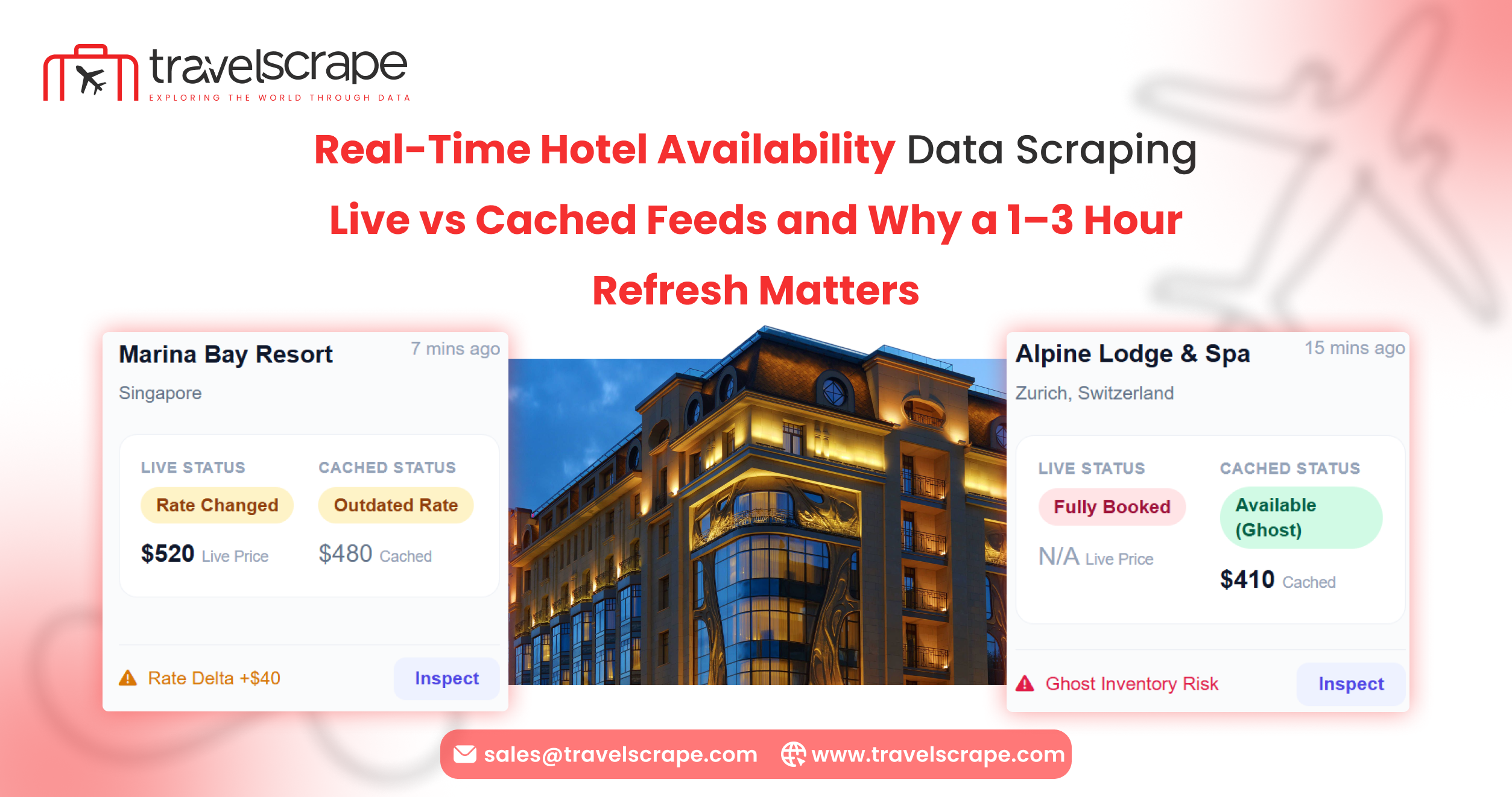
The limitation is that cached information can become outdated. A room displayed as available might already have been booked, while a previously unavailable room might have become bookable.
The effectiveness of caching depends on the age of the stored information, the rate at which inventory changes, and the consequences of presenting stale data.
Finding the Right Balance
The comparison between live vs cached hotel availability data feeds should focus on business outcomes rather than treating one approach as universally superior.
Live collection is suitable when immediate changes have a substantial commercial impact. Cached feeds work well when the objective is broad market analysis, historical comparison, or lower-cost data delivery.
A hybrid architecture often offers the most practical solution. Frequently changing properties can receive more frequent updates, while relatively stable inventory can follow a longer refresh schedule.
This approach directs processing resources toward the inventory where freshness matters most.
Why a 1–3 Hour Refresh Interval Matters?
A one-to-three-hour refresh interval provides a useful starting point for balancing inventory freshness with operational efficiency. It is not a universal industry standard or a guarantee of accuracy; the appropriate interval depends on observed booking activity and the intended application.
1. Reducing Stale Availability
Every hour that inventory remains unrefreshed creates an opportunity for discrepancies between collected information and the current source.
A room marked available at 9:00 a.m. may be reserved before the next scheduled collection. Refreshing at shorter intervals reduces the time during which such discrepancies can remain undetected.
This is especially important for travel marketplaces presenting accommodation across several booking channels.
2. Supporting Better Booking Decisions
Customers compare room availability, prices, location, amenities, and cancellation terms before choosing accommodation. Outdated inventory can create disappointment when a selected room is no longer available.
More frequent updates help booking platforms identify potential discrepancies earlier and trigger a fresh availability check before confirming a reservation.
The final booking decision should still rely on an authoritative source or confirmed booking response.
3. Improving Competitive Monitoring
Hotel prices and inventory often change alongside local demand, competitor activity, and travel patterns.
With Price Monitoring, businesses can evaluate how availability changes coincide with displayed rate movements. For instance, if a hotel repeatedly shows fewer available rooms while prices increase before a major event, analysts can investigate whether demand pressure or inventory restrictions may be contributing to the pattern.
Frequent collection provides more detailed observations, although availability changes alone do not establish the cause of a price movement.
4. Controlling Data Collection Costs
Refreshing every property every few minutes may create unnecessary processing costs when the inventory changes infrequently.
A one-to-three-hour schedule can reduce redundant collection compared with continuous polling, while still providing reasonably recent information for many analytical applications.
Businesses should evaluate the cost of collection against the commercial consequences of stale data instead of choosing a schedule solely on technical convenience.
5. Identifying Inventory Changes Earlier
Frequent snapshots help detect when rooms become available, disappear from search results, or return after a cancellation or inventory release.
These observations support operational alerts and historical analysis. However, a change between snapshots does not always reveal the precise time or reason it occurred.
A shorter interval narrows the observation window, making inventory movement easier to investigate.
Building an Effective Hotel Inventory Monitoring Workflow
A reliable monitoring workflow involves more than repeatedly collecting web pages. Businesses need a structured process that preserves data quality and distinguishes genuine inventory changes from technical inconsistencies.
Step 1: Identify Relevant Data Fields
Define the fields required for each property, including property ID, location, check-in date, check-out date, occupancy, room category, availability status, displayed rate, currency, and cancellation conditions.
Consistent identifiers help prevent duplicate records and make comparisons across collection periods more reliable.
Step 2: Establish Collection Priorities
Not every hotel requires the same refresh schedule. Properties in busy city centers, airports, popular holiday destinations, and event locations may experience rapid inventory changes.
By contrast, low-demand properties or datasets used exclusively for long-term research may tolerate longer refresh intervals.
Step 3: Collect Information Through Appropriate Sources
Use authorized APIs, licensed feeds, partner integrations, or permitted website collection methods. Respect applicable terms, access restrictions, privacy requirements, and technical limitations.
Where a provider offers an authoritative availability interface, it is generally preferable for reservation-critical information.
Step 4: Normalize and Validate Records
Different platforms may represent room types, occupancy, currencies, and cancellation conditions differently.
Normalization converts these fields into a consistent format. Validation checks can identify missing values, unexpected price changes, duplicate records, and inconsistent availability indicators.
Reliable comparisons require equivalent search conditions, particularly travel dates, guest counts, and room configurations.
Step 5: Compare Consecutive Snapshots
Store timestamped observations and compare each new collection with the preceding record.
This makes it possible to detect rooms disappearing from search results, changes in displayed prices, and inventory returning after a previous absence.
A missing record should not automatically be interpreted as a sold-out room. It may reflect a source error, a changed search result, or a collection failure.
Step 6: Trigger Targeted Refreshes
When a high-priority property shows a significant change, the system can schedule an additional check if the source permits it.
Targeted refreshes help concentrate resources on volatile inventory rather than repeatedly collecting every property at the same frequency.
How to Measure Hotel Availability Data Quality
Effective monitoring requires measurable performance indicators that reveal whether collected information is sufficiently fresh and dependable.
Data Freshness
Measure the elapsed time between collection and the latest available source update, when that update timestamp is accessible. If the upstream timestamp is unavailable, record the collection time and acknowledge that actual source freshness cannot be established precisely.
Refresh Success Rate
Monitor the percentage of scheduled collection attempts that complete successfully. Persistent failures can create gaps even when the intended refresh interval is short.
Availability Discrepancy Rate
Compare collected availability with a subsequent authoritative check under equivalent search conditions. This helps estimate how frequently stored records disagree with the source at verification time.
Inventory Change Frequency
Hotel room availability data tracking can reveal how often a property's inventory changes across defined observation periods. Higher observed volatility may justify more frequent checks, while stable properties may require fewer updates.
Refresh Interval Effectiveness
Through hotel availability refresh frequency analysis, businesses can compare different collection schedules against measured freshness, discrepancy rates, system costs, and operational requirements.
The objective is not to refresh as frequently as technically possible. It is to find the interval that delivers sufficient accuracy for the intended business use.
Common Challenges and How to Address Them
Several operational issues can undermine an otherwise well-designed inventory monitoring system.
- Inconsistent source structures: Booking platforms may organize room categories and availability differently. Use source-specific extraction rules followed by a standardized data model.
- Temporary access failures: Network interruptions, rate limits, and source changes can interrupt collection. Apply controlled retries, error logging, and permitted backoff strategies.
- False availability changes: A property disappearing from search results does not necessarily mean every room is sold out. Validate unusual changes before updating downstream dashboards.
- Excessive refresh requests: Unnecessary polling can increase costs and place avoidable pressure on source systems. Use adaptive schedules and respect source-imposed limits.
- Differences between displayed and confirmed inventory: Availability can change between search and checkout. Recheck with the booking provider before representing inventory as confirmed.
For real-time hotel inventory data scraping for booking platforms, these safeguards are particularly important because customers expect search results to reflect current booking conditions. Reliable systems combine timely collection with validation, clear timestamps, and authoritative confirmation during the reservation process.
Business Applications Across the Travel Industry
Accurate inventory observations support several important travel business functions.
- Online travel agencies can identify potentially stale listings and prioritize availability verification before customers proceed to booking.
- Hotel revenue managers can compare room availability with competitor pricing and evaluate inventory movements around holidays, conferences, and major local events.
- Travel metasearch platforms can improve the freshness of aggregated search results by tracking when underlying property information was last checked.
- Corporate travel providers can monitor accommodation options across frequently visited destinations and identify potential shortages around important business events.
- Market research teams can use historical snapshots to understand seasonal supply patterns, changing room availability, and differences across accommodation categories.
These applications depend on clearly distinguishing observed information from inferred conclusions. Availability data can indicate changing market conditions, but it cannot independently establish actual occupancy, remaining physical room capacity, or the precise cause of inventory changes.
How Travel Scrape Can Help You?
Inventory Collection
Collect relevant hotel availability, room categories, travel dates, and displayed rates from permitted sources, creating structured datasets for booking analysis and accommodation research.
Refresh Scheduling
Configure collection intervals according to property volatility, destination demand, and business priorities, helping balance information freshness with infrastructure requirements and permitted source-access limits.
Competitive Intelligence
Compare hotel availability and displayed pricing across properties and booking channels, helping analysts identify changing inventory patterns and investigate potential competitive positioning opportunities.
Data Quality
Apply normalization, timestamping, validation, and duplicate checks to improve consistency, identify incomplete observations, and make hotel inventory datasets easier to interpret and compare.
Market Insights
Analyze historical availability snapshots and seasonal movements to support destination research, accommodation benchmarking, inventory planning, and evidence-based travel business decisions.
Conclusion
Hotel availability changes continuously as customers book rooms, reservations are cancelled, and accommodation providers adjust their inventory. Businesses that rely on outdated information risk presenting inaccurate search results, overlooking market changes, and making decisions based on incomplete observations.
The choice between live and cached feeds should reflect the purpose of the data, the speed of inventory movement, and the commercial consequences of delays. Live feeds are valuable for booking-critical operations, while cached information can efficiently support research, benchmarking, and historical analysis. A hybrid strategy allows businesses to prioritize high-demand properties while keeping collection costs manageable.
A one-to-three-hour refresh interval offers a practical starting point for many monitoring workflows, but its effectiveness should be validated through measured freshness, discrepancy rates, inventory volatility, and operational costs. High-demand properties may require substantially faster checks, while stable datasets can operate on longer schedules.
With structured Real-Time Availability Tracking, travel businesses can identify inventory changes sooner, improve the quality of accommodation intelligence, and make more informed decisions. The strongest approach combines appropriate data sources, adaptive refresh schedules, reliable validation, and authoritative availability checks at the point of booking.
Ready to elevate your travel business with cutting-edge data insights? Scrape Aggregated Flight Fares to identify competitive rates and optimize your revenue strategies efficiently. Discover emerging opportunities with tools to Extract Travel Website Data, leveraging comprehensive data to forecast market shifts and enhance your service offerings. Real-Time Travel App Data Scraping Services helps stay ahead of competitors, gaining instant insights into bookings, promotions, and customer behavior across multiple platforms. Get in touch with Travel Scrape today to explore how our end-to-end data solutions can uncover new revenue streams, enhance your offerings, and strengthen your competitive edge in the travel market.
Source: https://www.travelscrape.com/hotel-availability-data-scraping-live-cached-feeds.php
Original: https://www.travelscrape.com
