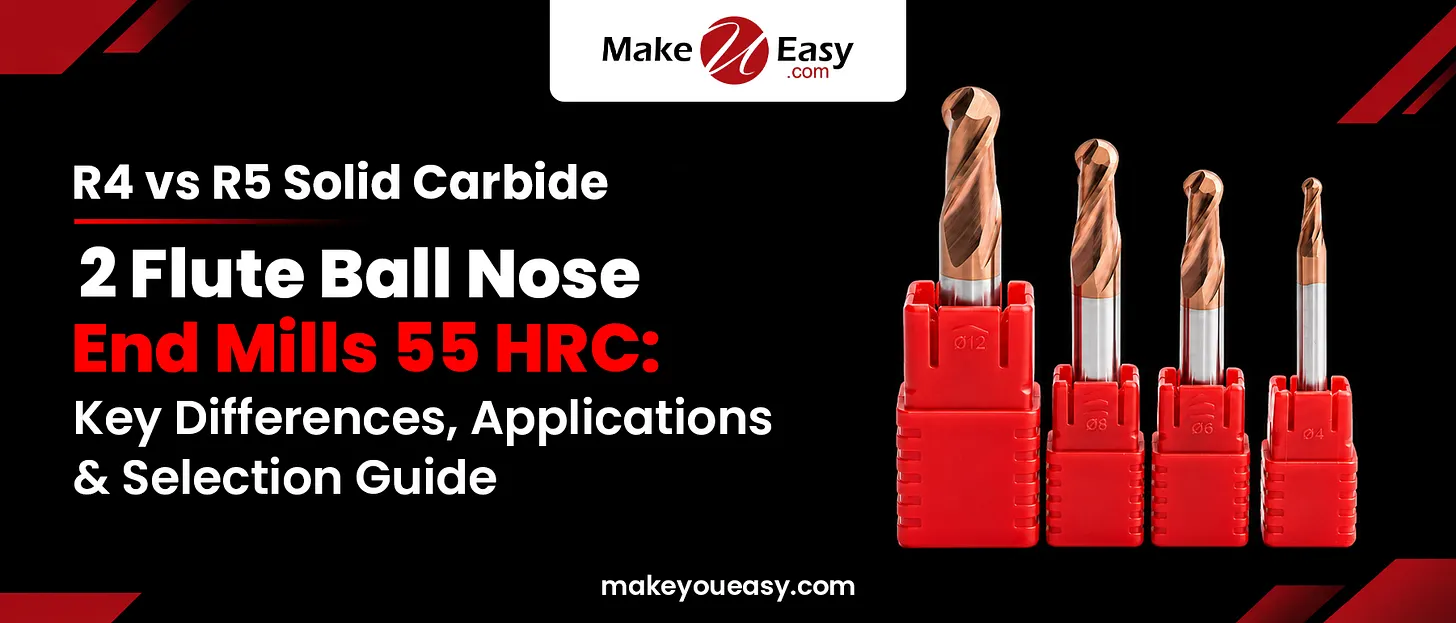
R4 vs R5 Solid Carbide 2 Flute Ball Nose End Mills 55 HRC: Key Differences, Applications & Selection
Author : Surya makeyoueasy | Published On : 17 Nov 2026
Introduction
R4 and R5 solid carbide 2-flute ball nose end mills are used for machining curved surfaces, mould cavities and 3D profiles in hardened materials. Although both tool sizes may be designed for machining up to 55 HRC, their different ball radii and cutting diameters affect accessibility, rigidity and finishing performance. Understanding these differences helps machinists select the right cutter for accurate and efficient CNC milling.
What Are R4 and R5 Ball Nose End Mills?
A ball nose end mill has a rounded cutting end that produces curved surfaces and 3D contours. In a full-radius ball nose design, the ball radius is half the cutting diameter.
-
R4: 4 mm ball radius with an 8 mm cutting diameter.
-
R5: 5 mm ball radius with a 10 mm cutting diameter.
Both versions can be manufactured with two cutting flutes and solid carbide construction. The 55 HRC designation indicates the tool’s intended workpiece hardness range, subject to the manufacturer’s specifications.
R4 vs R5: Key Differences
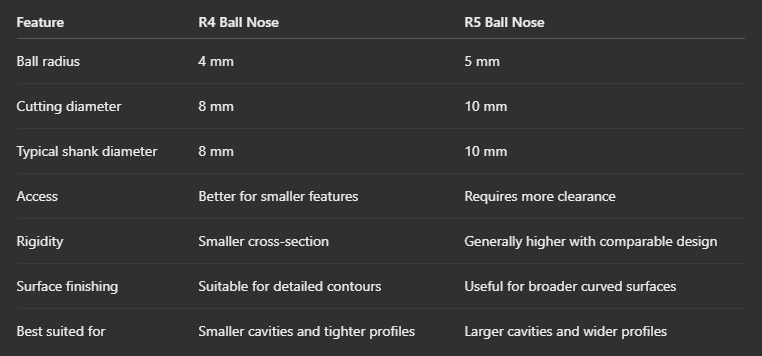
Dimensions are representative. Cutting length, shank diameter, and overall length can vary by manufacturer and tool series.
1. R4 Ball Nose End Mill: Features and Applications
The R4 ball nose end mill has a 4 mm radius and typically an 8 mm cutting diameter. Its smaller cutting profile makes it useful when machining features that require more access.
Key features:
-
Suitable for smaller curved profiles and cavity details.
-
Fits tighter internal radii than an R5 cutter.
-
Useful for 3D contouring and finishing operations.
-
Available in different cutting lengths and shank configurations.
Common applications:
-
Finishing smaller mould cavities.
-
Machining narrow curved sections.
-
Producing detailed 3D profiles.
-
Finishing components with smaller internal radii.
Choose R4 when the component geometry requires a smaller ball radius or when the R5 cutter cannot access the machining area.
2. R5 Ball Nose End Mill: Features and Applications
The R5 ball nose end mill has a 5 mm radius and typically a 10 mm cutting diameter. Its larger cutting section is useful for machining broader curved surfaces where sufficient tool clearance is available.
Key features:
-
Larger cutting diameter than R4.
-
Generally provides a more rigid cross-section with comparable tool design and overhang.
-
Can produce lower scallop height at the same lateral step-over on comparable surfaces.
-
Suitable for wider 3D finishing paths.
Common applications:
-
Finishing larger mould and die cavities.
-
Machining broad curved surfaces.
-
Producing larger 3D contours.
-
Finishing components with wider internal radii.
Choose R5 when the machining area has enough clearance and the larger radius supports the required surface finish and productivity.
How Does the Ball Radius Affect Surface Finish?
Ball radius influences the scallop height left between adjacent tool passes. Under comparable machining conditions, a larger ball radius generally produces a smaller scallop at the same step-over distance.
This means an R5 cutter may achieve a similar surface finish with a wider step-over than an R4 cutter. However, the actual result also depends on the CAM toolpath, surface curvature, tool runout, vibration and cutting conditions.
How to Select the Right R4 or R5 End Mill
1. Check the Component Geometry
Measure the smallest internal radius and inspect narrow areas. Select R4 for tighter features and R5 for larger accessible surfaces.
2. Consider Tool Rigidity
A larger diameter generally offers better bending resistance when tool design and overhang are comparable. Use the shortest practical tool projection to reduce deflection and vibration.
3. Review the Required Surface Finish
For broader curved surfaces, R5 may allow a wider step-over for a similar scallop height. R4 may be more suitable when smaller details and restricted access are priorities.
4. Verify Workpiece Hardness
Confirm that the selected carbide grade and coating are recommended for the actual material and hardness. A 55 HRC rating should not be treated as a universal guarantee for every steel or cutting condition.
5. Follow Recommended Cutting Data
Use the manufacturer’s cutting-speed, feed-per-tooth and step-over recommendations for the exact tool. Do not automatically apply the same RPM and feed to both diameters.
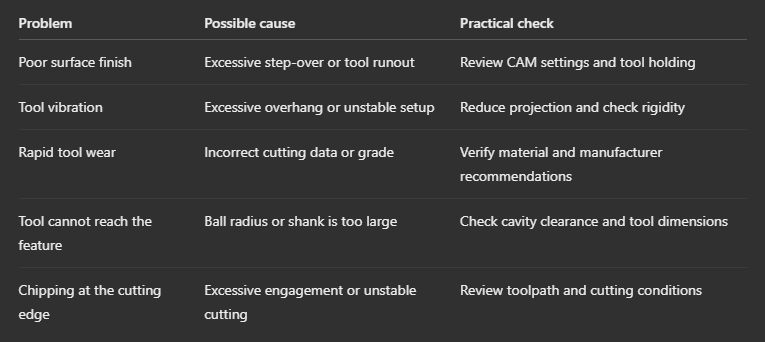
Common Machining Problems and Solutions
Why Choose the Right Ball Nose End Mill?
Selecting the correct ball nose cutter helps machining professionals achieve suitable surface quality, dimensional accuracy and reliable tool performance. MakeYouEasy helps users explore CNC cutting tools and machining accessories for different manufacturing requirements. Always verify the complete tool specification before selecting an R4 or R5 end mill.
Conclusion
R4 and R5 solid carbide 2-flute ball nose end mills are useful for 3D contouring and finishing applications in hardened materials. R4 is better suited to smaller features and tighter internal radii, while R5 is a practical choice for broader surfaces where its larger cutting diameter can be accommodated.
The right selection depends on component geometry, tool rigidity, surface-finish requirements and manufacturer-recommended cutting conditions.
Explore CNC milling tools and accessories at MakeYouEasy.com.
FAQs
1. What is the main difference between R4 and R5 ball nose end mills?
R4 has a 4 mm ball radius and typically an 8 mm cutting diameter, while R5 has a 5 mm radius and a 10 mm cutting diameter.
2. Which is better for smaller mould cavities, R4 or R5?
R4 is generally more suitable for smaller cavities and tighter internal radii because of its smaller cutting profile.
3. Is an R5 ball nose end mill more rigid than R4?
Generally, yes, when the tool design and overhang are comparable, because R5 has a larger cross-section.
4. Can R4 and R5 ball nose end mills machine 55 HRC steel?
They can when the selected tool grade and coating are approved by the manufacturer for the material and machining conditions.
5. Which ball nose end mill provides a better surface finish?
R5 can produce a lower scallop height at the same step-over on comparable surfaces, but the final finish also depends on toolpath and cutting conditions.
Popular Search Keywords
R4 ball nose end mill, R5 ball nose end mill, R4 vs R5 end mill, 55 HRC ball nose end mill, solid carbide ball nose cutter, 2 flute ball nose end mill, CNC ball nose milling cutter, hardened steel milling tools, mould finishing end mill, ball nose end mill selection guide
