R3 Solid Carbide 2 Flute Ball Nose End Mill 55 HRC: Cutting Parameters, Applications & Selection Gui
Author : Surya makeyoueasy | Published On : 18 Nov 2026
Introduction
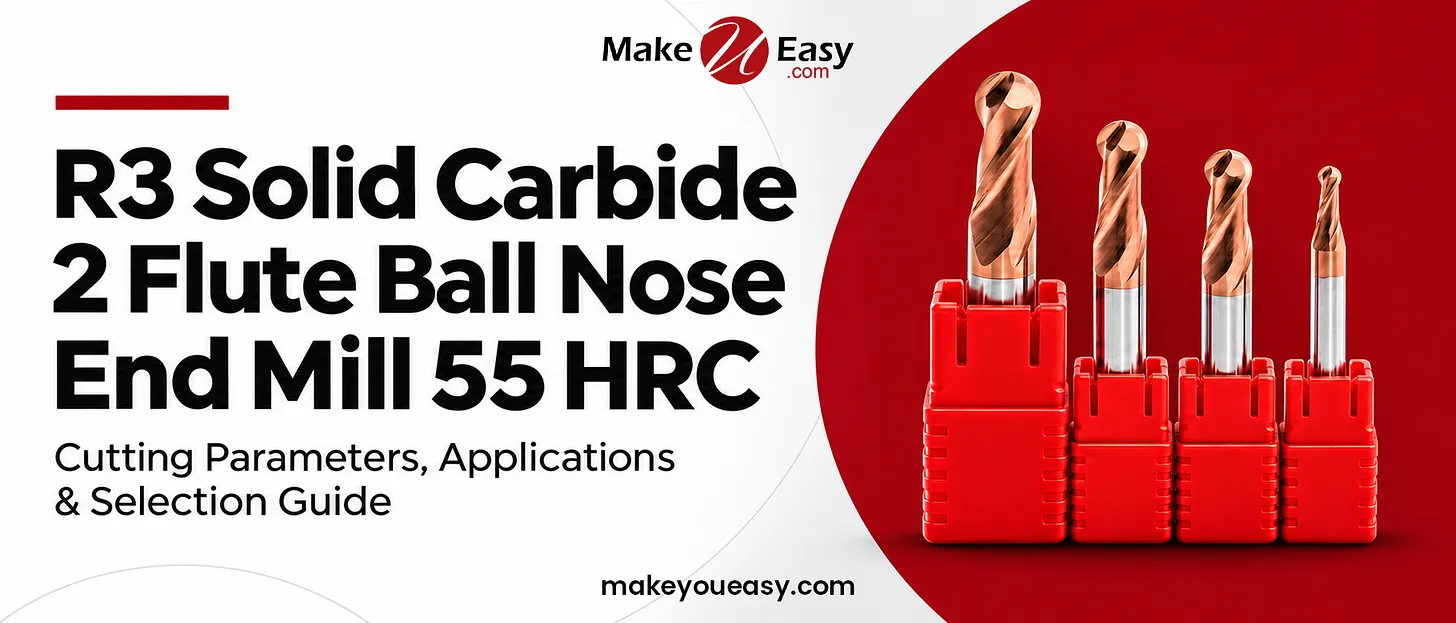
An R3 solid carbide 2-flute ball nose end mill is designed for machining curved surfaces, mould cavities and detailed 3D profiles. With a 3 mm ball radius and typically a 6 mm cutting diameter, it is suitable for finishing and contouring applications in hardened materials when the tool grade and coating are appropriate. Choosing the correct cutting speed, feed rate and step-over helps achieve consistent surface quality and tool life.
What Is an R3 Ball Nose End Mill?
An R3 ball nose end mill has a spherical cutting end with a radius of 3 mm. Its typical specifications include:
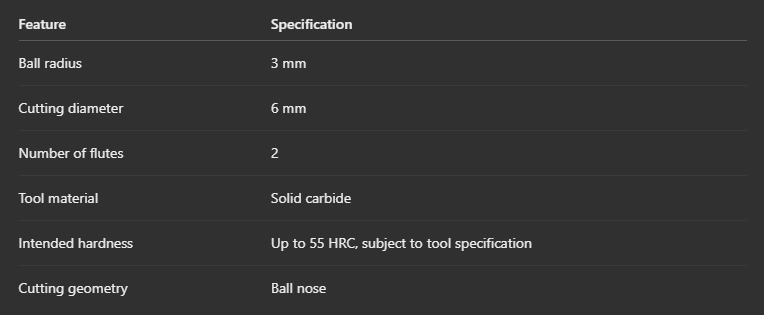
The two-flute design provides chip space for machining operations such as 3D contouring, ramping and cavity finishing. Actual flute length, shank diameter, coating and overall length vary by manufacturer.
Cutting Parameters for R3 Ball Nose End Mills
Correct cutting parameters depend on workpiece hardness, carbide grade, coating, machine rigidity, tool overhang and the type of operation.
Important parameters include:
-
Cutting speed (Vc): The surface speed between the cutting edge and workpiece, measured in metres per minute.
-
Spindle speed (n): The rotational speed of the cutter, measured in RPM.
-
Feed per tooth (fz): The distance advanced by the workpiece for each cutting tooth.
-
Feed rate (Vf): The linear cutting feed, measured in mm/min.
-
Axial depth of cut (ap): The depth of engagement along the tool axis.
-
Radial engagement (ae): The width of cutter engagement.
Example Cutting Data
One published manufacturer catalogue provides the following reference values for its 6 mm diameter, R3, two-flute ball nose end mill in hardened steels of 55–65 HRC:
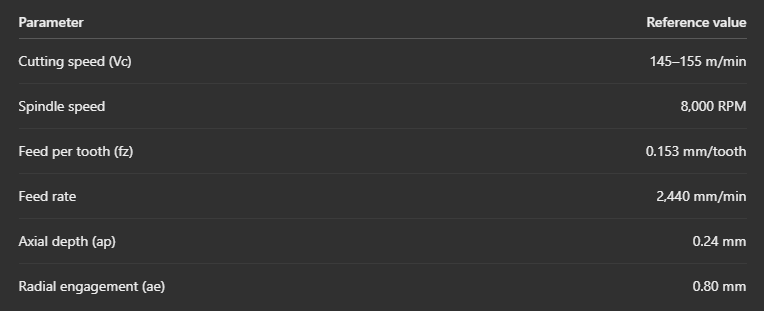
Important: These are manufacturer-specific reference values, not universal settings for every R3 cutter. Use the cutting chart supplied for the exact tool model and begin conservatively when machine conditions are uncertain.
Cutting Parameter Formulas
Use these formulas to calculate spindle speed and feed rate:
Spindle speed:
[
n=frac{1000times V_c}{pitimes D}
]
Feed rate:
[
V_f=ntimes ztimes f_z
]
Where:
-
(V_c) = Cutting speed in m/min
-
(D) = Cutter diameter in mm
-
(n) = Spindle speed in RPM
-
(z) = Number of flutes
-
(f_z) = Feed per tooth in mm
For ball nose machining, remember that the effective cutting diameter changes with the contact position on the spherical end. The actual cutting speed can be much lower near the tool tip.
Applications of R3 Ball Nose End Mills
R3 ball nose cutters are commonly used for:
-
Mould cavity finishing: Machining curved surfaces and detailed cavity profiles.
-
Die and mould manufacturing: Finishing hardened tool-steel components.
-
3D contour milling: Producing complex curved shapes and freeform surfaces.
-
Fillet machining: Creating rounded transitions between adjoining surfaces.
-
Aerospace component machining: Finishing suitable curved profiles and blade features.
-
Precision component manufacturing: Machining detailed surfaces where controlled tool paths are required.
The actual suitability depends on the tool manufacturer’s material and hardness recommendations.
Step-Over and Surface Finish
Step-over is the distance between two adjacent tool passes. It directly affects the scallop height left on a machined surface.
For an R3 ball nose cutter, smaller step-over values generally produce a smoother surface but increase machining time.

For accurate finishing, consider surface curvature, CAM toolpath direction, tool runout and the required surface roughness. Do not select step-over based only on the ball radius.
How to Select the Right R3 Ball Nose End Mill
1. Check Workpiece Hardness
Confirm whether the material is within the tool’s approved hardness range. For 55 HRC machining, select a suitable carbide substrate and coating.
2. Choose the Correct Tool Length
Use the shortest practical flute and overall length that can reach the machining area. Excessive overhang increases vibration and tool deflection.
3. Verify Coating and Tool Grade
Check the manufacturer’s recommendations for hardened steel. Coating performance and carbide toughness influence wear resistance and cutting stability.
4. Select the Right CAM Toolpath
Use suitable 3D finishing strategies such as constant scallop, parallel finishing or contour finishing according to the component geometry.
5. Match Cutting Data to Machine Conditions
Consider spindle capability, tool holding, workpiece clamping, coolant strategy and machine rigidity before applying cutting parameters.
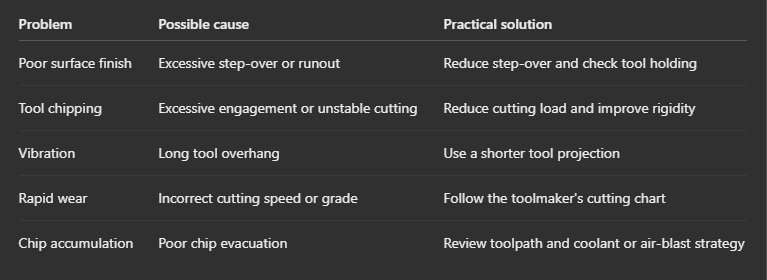
Common Machining Problems and Solutions
Why Choose the Right CNC Milling Tool?
Choosing a suitable ball nose end mill helps machining professionals achieve accurate profiles, consistent surface quality and reliable production. MakeYouEasy helps users explore CNC cutting tools and machining accessories for different manufacturing requirements. Always verify the tool dimensions, grade, coating and recommended cutting conditions before machining.
Conclusion
The R3 solid carbide 2-flute ball nose end mill is a useful cutter for 3D contouring, mould cavity finishing and machining suitable hardened materials up to 55 HRC. Its 3 mm ball radius and typical 6 mm cutting diameter make it suitable for detailed curved surfaces.
For reliable performance, select the correct tool length, coating, cutting speed, feed rate and step-over according to the manufacturer’s recommendations and actual machine conditions.
Explore CNC milling tools and accessories at MakeYouEasy.com.
FAQs
1. What is the diameter of an R3 ball nose end mill?
An R3 ball nose end mill typically has a 3 mm ball radius and a 6 mm cutting diameter.
2. What is an R3 2-flute ball nose end mill used for?
It is used for 3D contouring, mould cavity finishing, curved profiles, and detailed surface machining.
3. Can an R3 ball nose end mill machine 55 HRC steel?
Yes, if its carbide grade and coating are specified by the manufacturer for machining materials up to 55 HRC.
4. How do I calculate the feed rate for an R3 ball nose end mill?
Multiply spindle speed by the number of flutes and feed per tooth to calculate the feed rate in mm/min.
5. How does step-over affect ball nose milling surface finish?
A smaller step-over generally reduces scallop height and improves surface finish but increases machining time.
Popular Search Keywords
R3 ball nose end mill, R3 solid carbide end mill, 6mm ball nose end mill, 2 flute ball nose cutter, 55 HRC ball nose end mill, R3 end mill cutting parameters, ball nose end mill feed and speed, carbide ball nose cutter, CNC 3D contour milling, mould finishing end mill
