Product Engineering Company vs Software Development Company: Which One Does Your Business Actually N
Author : Alignminds Technologies | Published On : 28 Jul 2026
If you’re evaluating technology partners, you’ve probably noticed that almost every company claims to offer both product engineering services and software development services. On the surface, the two can appear almost identical. Both build applications, write code, and deliver software.
However, the difference lies in how they approach product creation, ownership, and long-term business outcomes.
Choosing between a product engineering company and a traditional software development company isn’t simply about selecting a vendor—it can determine how quickly your product reaches the market, how well it scales, and whether it continues delivering value long after launch.
Making the wrong choice can result in costly redesigns, technical debt, and products that fail to evolve with customer needs. Making the right one gives you a technology partner that aligns engineering decisions with business goals.
In this guide, we’ll explain the key differences between product engineering and software development, when each approach makes sense, and how to determine which partner is the best fit for your business.
What is a Product Engineering Company?
A product engineering company helps businesses design, build, launch, improve, and scale digital products throughout their entire lifecycle.
Unlike traditional development vendors that focus on implementing predefined requirements, product engineering teams take ownership of the product itself. They work alongside stakeholders to validate ideas, refine requirements, improve user experience, optimize architecture, and continuously enhance the product after launch.
Typical product engineering services include:
➜Product discovery and strategy
➜UI/UX design
➜Software architecture
➜Custom software development
➜Cloud-native engineering
➜AI integration
➜Quality engineering
➜DevOps and CI/CD
➜Product modernization
➜Continuous product enhancement
Rather than treating launch as the finish line, product engineering companies view it as the beginning of continuous product evolution.
What is a Software Development Company?
A software development company focuses primarily on building software according to predefined business requirements. The engagement is usually project-based. Clients define the scope, features, timeline, and expected deliverables, while the development team executes the agreed plan.
This model works well when requirements are stable and unlikely to change.
Common software development services include:
•Web application development
•Mobile app development
•Enterprise software development
•API development
•System integrations
•Maintenance and support
The primary objective is delivering software that meets the agreed specifications, timeline, and budget.
Product Engineering vs Software Development: The Core Difference
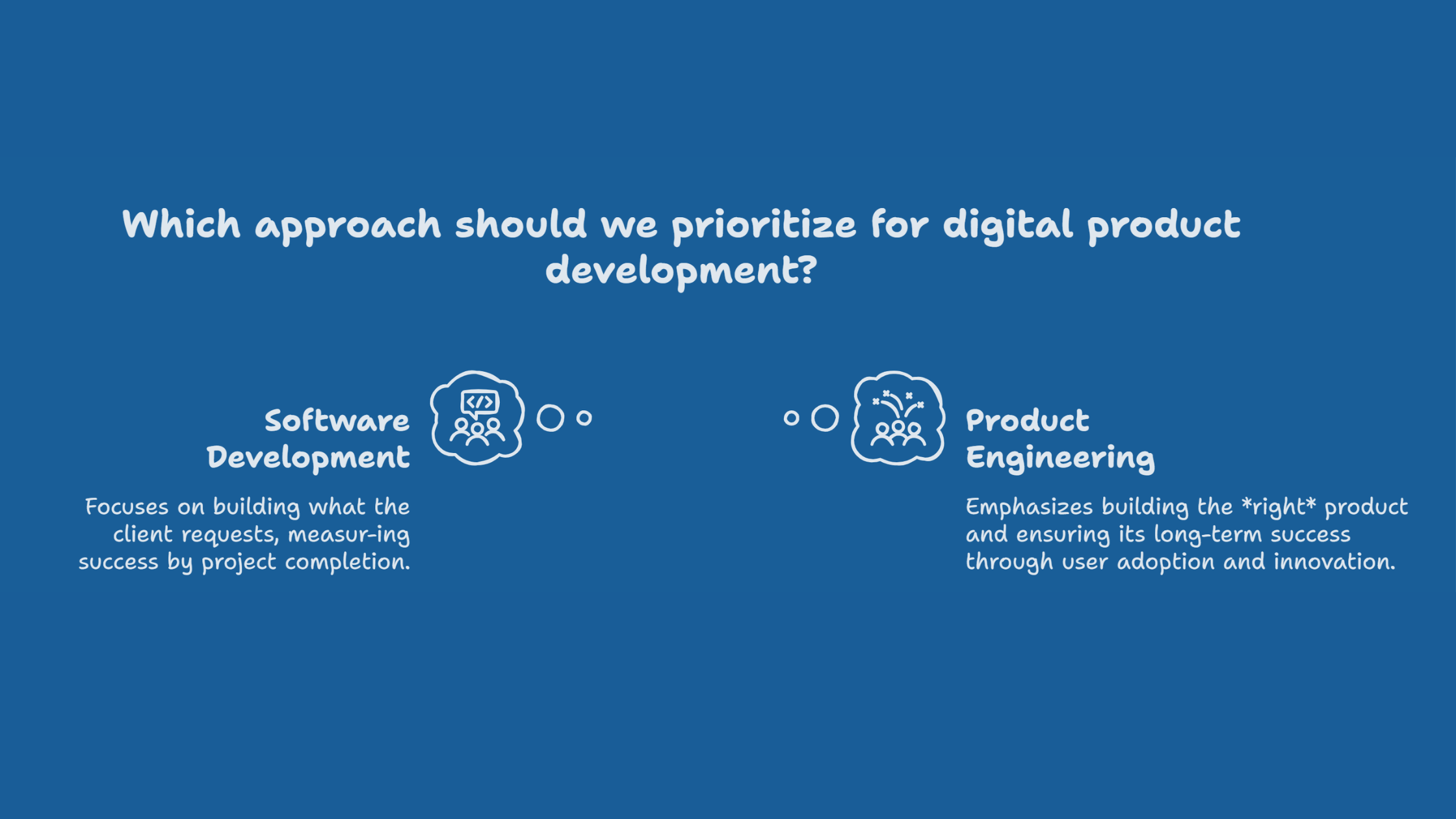
The biggest difference isn’t coding capability—it’s ownership.
A software development company asks:
“What would you like us to build?”
A product engineering company asks:
“Is this the right product to build, and how can we make it more successful?”
This shift changes everything.
Product engineering teams actively question assumptions, recommend better technical approaches, validate user needs, improve workflows, and make architectural decisions that support long-term scalability.
Instead of measuring success by project completion alone, they focus on metrics such as:
•User adoption
•Customer retention
•Product performance
•Scalability
•Business impact
•Continuous innovation
As Harvard Business Review notes, organizations moving from project-based delivery to outcome-focused product teams increasingly measure success through customer adoption and long-term product value rather than simply shipping software.
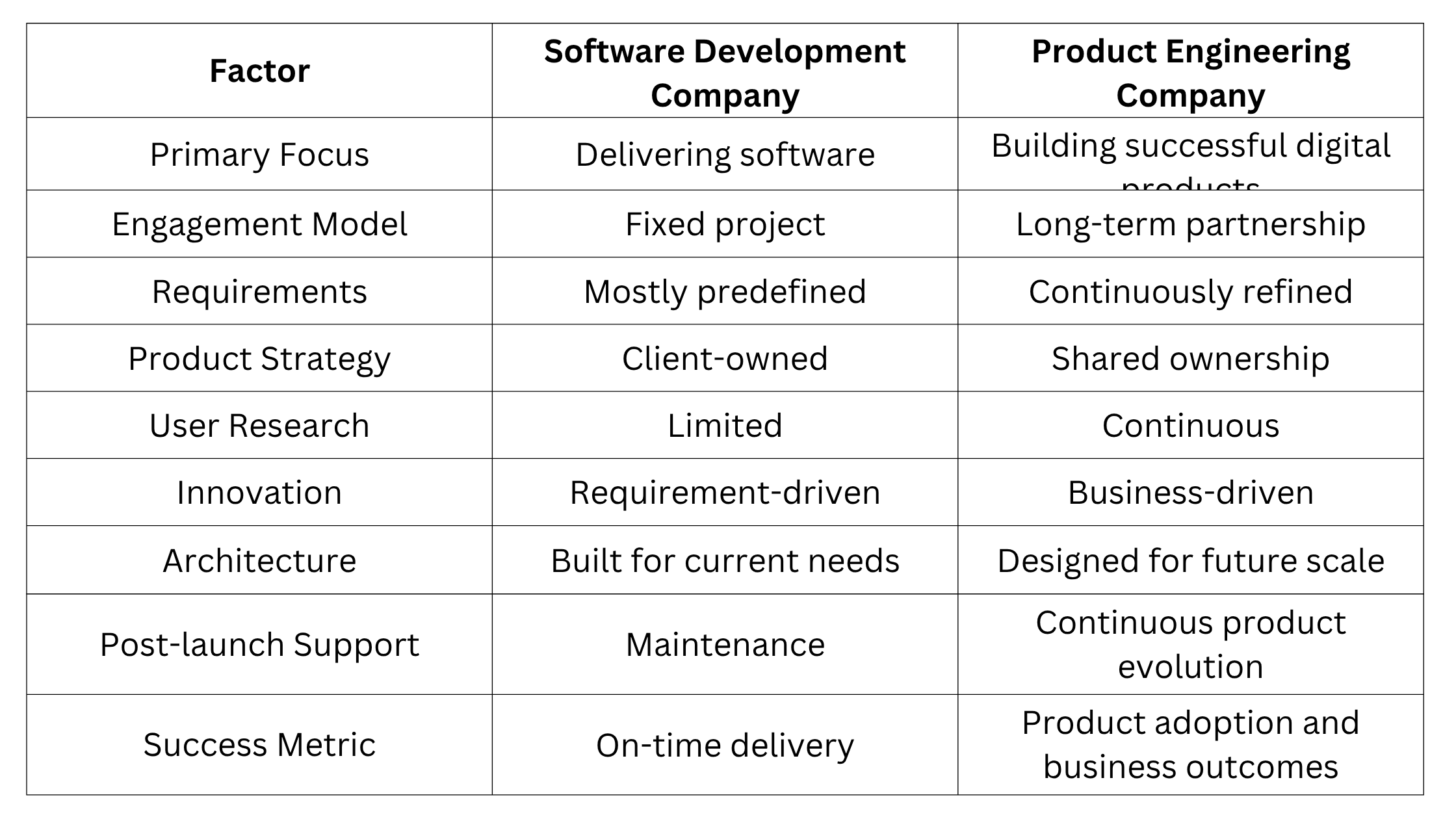
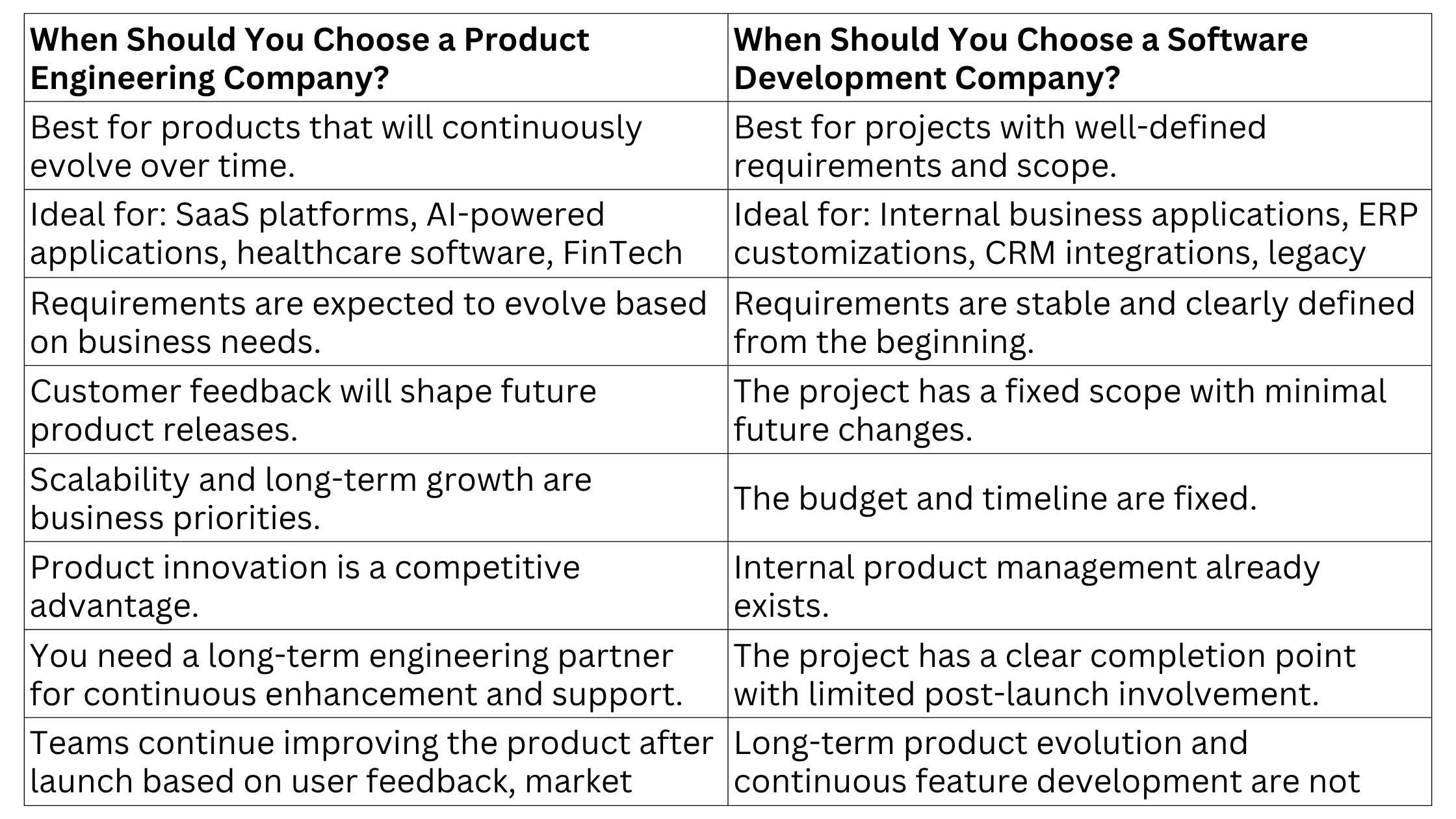
Product Engineering Company vs Software Development Company: Key Differences
How AI is Changing Product Engineering
Artificial intelligence has dramatically accelerated software development. AI coding assistants can now generate boilerplate code, automate testing, and reduce development time.
However, this shift has made product thinking more valuable than coding speed.
As routine development becomes increasingly automated, businesses gain the greatest advantage from partners who understand customer needs, product strategy, scalability, and long-term architecture.
This is one reason why many organizations are moving toward end-to-end product engineering services instead of purely execution-focused development teams.
The real competitive advantage is no longer writing code faster—it’s building the right product.
How to Choose the Right Technology Partner
Before selecting a technology partner, ask these questions:
•Do they challenge assumptions or simply execute requirements?
•Can they support the entire software product lifecycle?
•Have they built products similar to yours?
•Do they provide product strategy alongside engineering?
•Will they continue improving the product after launch?
•Can they scale engineering teams as your business grows?
The answers will reveal whether you’re speaking with a software development vendor or a true product engineering partner.
Frequently Asked Questions
1.Is product engineering the same as software development?
No. Software development focuses on building applications based on predefined requirements, while product engineering covers the complete product lifecycle—from idea validation and architecture to continuous improvement after launch.
2.Which is better for startups?
Startups often benefit more from product engineering because requirements change rapidly as founders validate ideas, gather customer feedback, and iterate toward product-market fit.
3.Is product engineering more expensive?
Initial costs may be higher, but product engineering often reduces long-term expenses by minimizing rework, improving scalability, and ensuring products evolve with business needs.
4.Can a software development company become a product engineering partner?
Some organizations offer both services. The key difference is whether they take ownership of product outcomes, contribute strategic guidance, and remain involved throughout the product lifecycle rather than simply delivering code.
Conclusion
While the terms are often used interchangeably, product engineering and software development represent two distinct approaches to building software.
If your project has fixed requirements and a clearly defined scope, a software development company can provide efficient execution. But if you’re creating a digital product that must evolve with users, adapt to market demands, and scale over time, partnering with a product engineering company delivers greater long-term value.
Ultimately, the right choice depends on your product vision, business objectives, and how much strategic collaboration you expect from your technology partner.
If you’re evaluating your next software initiative and aren’t sure which approach fits best, AlignMind’s product engineering experts can help you assess your goals, identify the right engagement model, and build a solution designed for long-term success.
