PE PP Plastic Squeezer Machine for More Stable Film Recycling
Author : Machine mg | Published On : 15 Aug 2026
Wet plastic film can carry a large amount of water after washing. If that material enters an extruder too soon, feeding becomes less steady, energy demand rises, and pellet quality can suffer. A PE PP Plastic Squeezer Machine removes water by mechanical pressure while compacting washed film and bags for the next recycling stage.
The machine is designed for wet PE and PP films, woven bags, raffia from jumbo bags, and some labels mixed with flakes. MG Machinery also describes a squeezing, heating, and agglomerating pelletizing function. The exact result depends on the feedstock, machine settings, and the rest of the recycling line.
Turn Wet PE and PP Film Waste Into Valuable Recycled Material
Address the moisture problem that slows plastic recycling
Washed film often holds water between layers and inside folds. When wet material enters an extruder, steam can form and feeding may become uneven. The result can include lower practical throughput, unstable pressure, and more work for later drying equipment.
Moisture also adds weight without adding useful plastic. That can raise transport and handling costs. A dewatering step removes much of this unwanted water before the material reaches extrusion.
Show why mechanical dewatering matters before pelletizing
Mechanical squeezing uses pressure, friction, and drainage openings to force water out of the plastic. It reduces the moisture load without depending only on hot air, heated surfaces, or long drying time.
Thermal drying still has a role in some lines, but it must remove less water after mechanical dewatering. The MG machine also includes heaters around the mold and barrel transit area, which support semi-plasticizing and discharge control. Mechanical dewatering and thermal drying are separate functions.
Reduce moisture while compacting flexible plastics
Loose film takes up a large volume and can bridge inside hoppers or conveyors. Squeezing compresses the material into a denser form that is easier to move and feed.
The product page lists a final moisture level below 3-5%. Treat that figure as a test target to confirm with the supplier, since moisture results change with film type, starting moisture, contamination, and operating settings.
Process PE and PP Film Through a More Efficient Recycling Line
Prepare washed film for extrusion and pelletizing
A typical line may run through sorting, shredding or crushing, washing, mechanical dewatering, optional hot-air drying, extrusion, and pelletizing. The squeezer sits after washing and before the main extrusion stage.
Its compacted discharge can move to a dryer, storage hopper, or extruder, depending on the line design. Drier, denser feedstock usually gives the extruder a more regular supply, but the actual result must be checked during testing.
Handle common flexible plastic feedstocks
Suitable materials listed by MG Machinery include LDPE film, HDPE film, PP film, PP raffia, woven bags, jumbo bags, and some plastic labels mixed with flakes. These materials can behave differently during feeding and squeezing.
Material compatibility does not mean unlimited contamination tolerance. PVC, stones, metal, heavily soiled waste, multilayer films, and unknown polymers should be discussed with the supplier before purchase.
Match the machine to the complete recycling line
Select the squeezer with the crusher, washer, dryer, extruder, and pelletizer in mind. A machine that works well alone may still create bottlenecks if the washer supplies material faster than the dewatering stage can process it.
Confirm the material type, moisture level, contamination, hourly capacity, and required pellet form. The product page states that MG Machinery can prepare line layouts and machine proposals based on material conditions and workshop space.
Understand How the PE PP Plastic Squeezer Machine Works
Feed washed plastic into the dewatering chamber
Washed material can reach the machine through a belt conveyor or screw loader. The manufacturer states that a screw loader suits material with higher moisture, while a belt conveyor is more suitable when the feed contains less water.
A steady feed helps maintain stable pressure inside the barrel. Poorly prepared film, large clumps, or sudden surges can reduce output and increase the risk of blockages.
Remove water through mechanical squeezing
A motor and reducer drive the screw inside the barrel. As wet film advances, pressure and friction compress the material, while holes in the thick barrel wall allow water to drain away.
The listed barrel and screw material is alloy 38CrMoAlA steel with surface nitriding. This treatment is intended to improve hardness and wear life. Drainage performance still depends on keeping the openings clear.
Discharge compacted material for the next stage
The machine can press material through a perforated mold. A cutter with two or four blades cuts the discharged strands into pellets or agglomerated pieces, which then move to a transition silo and cyclone silo.
PE and PP use different mold designs, according to the product page. Final moisture and pellet form depend on the polymer, feed condition, mold, rotation speed, temperature, and downstream setup.
Evaluate Construction, Performance, and Operating Requirements
Verify capacity, motor power, and moisture removal
Ask for rated capacity, installed motor power, voltage, dimensions, weight, inlet size, outlet design, and tested moisture results for your material. The available product-page text includes a technical-parameter heading but does not show the model values.
Request a written quotation with the exact machine model and electrical details. Compare practical sustained throughput with the nominal rating, since wet film density and contamination can change real production.
Inspect wear parts and high-load components
Check the screw, barrel, mold, cutter, drainage openings, bearings, seals, and reducer. Abrasive dirt can increase wear, while trapped metal or stones can damage high-load parts.
The machine uses a hard-tooth reducer for high squeezing torque, according to MG Machinery. Ask how often wear parts should be inspected and which replacements the supplier keeps in stock.
Confirm automation, safety, and maintenance access
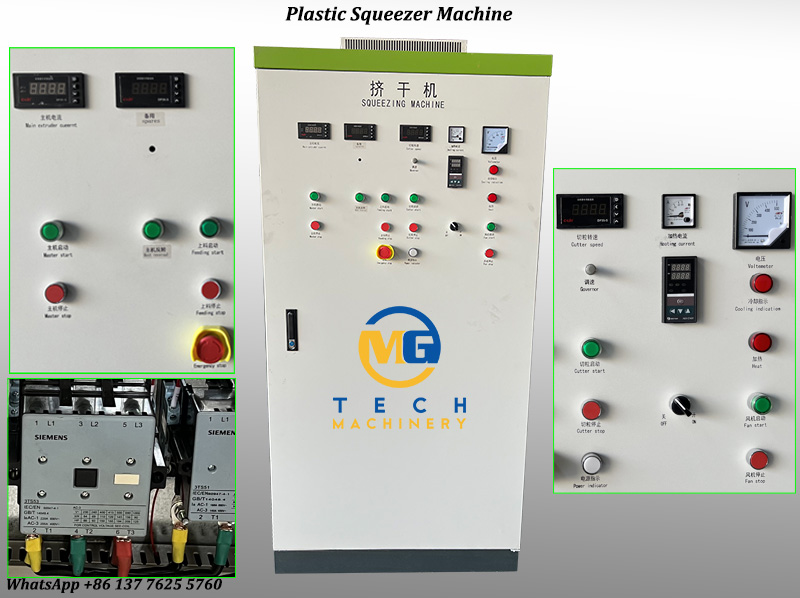
The product page lists a PLC control system, a central control cabinet, temperature controls, and inverters from brands such as Delta or ABB. It also describes water cooling for the reducer and mold head.
Confirm whether emergency stops, overload protection, guards, access doors, and alarm functions are included in your chosen model. Maintenance staff should have safe access for cleaning, drainage checks, lubrication, and lockout procedures.
Improve Recycling Results With Correct Installation and Operation
Control feed consistency before the squeezer
Remove metal, stones, glass, and excess non-plastic waste before washing and dewatering. Consistent particle size helps the screw grip the film and reduces sudden load changes.
Avoid feeding long ropes, dense bundles, or oversized pieces unless the supplier approves them. Record feed rate and motor load during commissioning to find a stable operating range.
Adjust operation to material moisture and composition
Agricultural film may carry soil, while stretch film may be light and elastic. PP woven bags and raffia can feed with different resistance than thin PE packaging film.
Test each major material category separately. Track throughput, discharge moisture, power use, pellet form, and stoppage frequency. These records provide a better basis for settings than a single trial run.
Keep drainage, screens, and discharge paths clear
Inspect water outlets, barrel holes, conveyors, silos, and discharge points on a set schedule. Blocked drainage reduces water removal and can raise pressure and motor load.
Clean the chamber according to the manual and manage wastewater so it does not return to the washed material. Keep the mold and cutter area free of buildup to maintain a steady discharge.
Choose the Right PE PP Plastic Squeezer for Your Recycling Business
Calculate the required capacity from real feedstock
Estimate hourly input from daily supply, planned operating hours, seasonal changes, moisture, and contamination. Leave room for future volume if your supply contracts may grow.
Nominal capacity does not equal sustained production. A material test can show whether the machine maintains its rate with your actual film density and washing conditions.
Request a material test before purchase
Send representative samples that include normal dirt, moisture, labels, and film mix. Ask the supplier to measure feeding behavior, dewatering results, discharge quality, power demand, and compatibility with your extruder.
A test should also confirm whether the output needs hot-air drying before extrusion. Request test records and a clear statement of the conditions used.
Compare total operating value, not only purchase price
Include electricity, wear parts, labor, cleaning, downtime, installation, spare parts, and technical support in the purchase decision. Integration work can affect the final cost as much as the machine itself.
A higher initial price may make sense if the unit produces steadier feed and reduces later drying demand. Compare the expected cost per usable kilogram, not the purchase price alone.
Build a Reliable PE and PP Plastic Recycling Workflow
Combine washing and dewatering for cleaner output
The squeezer removes water and compacts material; it does not replace sorting or washing. Pellet quality still depends on removing dirt, metals, paper, and incompatible plastics before extrusion.
Extruder filtration then helps control fine contamination. A clean washing stage and a well-adjusted dewatering stage give the pelletizer a better feedstock.
Use monitoring data to improve line performance
Track input weight, moisture before and after squeezing, throughput, motor load, downtime, rejected material, and pellet quality. Trends can reveal a blocked drain, worn screw, unstable feed, or poor washer performance.
Use the records during maintenance reviews and supplier discussions. Measured results are more useful than a capacity claim without operating conditions.
Plan for changing waste streams
Review settings when switching between agricultural film, post-consumer packaging, woven bags, and mixed PE/PP loads. Each stream may require a different feed rate, mold, temperature, or cleaning routine.
If wider material coverage is planned, confirm mold options and line flexibility before ordering. A modular layout can also make future capacity upgrades easier.
Conclusion
A PE PP Plastic Squeezer Machine adds mechanical dewatering and compaction after plastic washing. It can process wet PE and PP films, woven bags, raffia, and related flexible materials, while the MG design also supports agglomerated pelletizing through a perforated mold and cutter.The right choice depends on verified compatibility, practical capacity, moisture results, wear resistance, maintenance access, controls, safety, and full-line balance. Review the manufacturer’s specifications, send representative samples, request a performance test and quotation, and confirm the complete recycling-line configuration before ordering.
