Organic Spices vs Non-Organic Spices — What's the Real Difference?
Author : Natureland Organics | Published On : 05 Aug 2026
Spices sit at the heart of Indian cooking. They're in everything — the morning chai, the dal, the weekend biryani. We use them every single day without a second thought.
But here's the thing most people never stop to ask — where did these spices actually come from, and what was done to them before they reached your kitchen?
That question is exactly where the difference between organic spices and non-organic spices begins. And once you know what that difference looks like, it's hard to unsee it.
It Starts at the Farm
Everything about a spice — its flavour, its safety, its nutritional value — begins with how it was grown.
How Organic Spices Are Farmed
Organic spices are grown on certified farms that operate without synthetic pesticides, chemical fertilizers, herbicides, or genetically modified seeds. Farmers rely on natural composting, crop rotation, biological pest control, and traditional farming wisdom to grow healthy, chemical-free crops.
The soil is treated as a living ecosystem — because healthy soil grows healthy plants, and healthy plants produce spices with deeper flavour and stronger natural compounds.
How Non-Organic Spices Are Farmed
Conventional spice farming often involves repeated applications of synthetic pesticides and chemical fertilizers across the growing cycle. These inputs increase yield and protect crops from pests — but they leave residues.
Those residues don't fully disappear after harvest. They travel with the spice through processing, packaging, and right into your kitchen. When you add a teaspoon of non-organic chilli powder or turmeric to your food, you may be adding a trace of those chemicals along with it.
The Chemical Load Nobody Talks About
This is the part of the conversation that most spice brands quietly avoid.
The WHO and various food safety organisations have flagged pesticide residues in spices as a genuine concern. Turmeric, chilli, cumin, coriander, and pepper — some of India's most commonly used spices — have been found to carry detectable pesticide residues in conventional supply chains.
The individual dose in a single serving is small. But Indian households use spices every day, multiple times a day, across years and decades. That cumulative exposure is what matters — and it's what organic spices eliminate entirely.
Certified organic spices go through testing to verify they meet residue-free standards. That certification is your assurance — not just a marketing claim.
Flavour — And Yes, There Is a Real Difference
Ask anyone who has cooked with genuinely high-quality organic spices and they'll tell you the same thing — the flavour hits differently.
This isn't placebo. Organically grown spices develop higher concentrations of essential oils and volatile compounds — the natural chemicals responsible for aroma, depth, and flavour intensity. When a plant isn't dependent on synthetic fertilizers for growth, it develops its own natural defences and flavour compounds more fully.
The result is a spice that smells stronger when you open the jar, releases more aroma when it hits the oil, and builds more complex flavour in the finished dish.
Non-organic spices, grown for yield rather than quality, often lack that depth. They smell faint. They taste flat. You end up using more to get the same result.
What Happens After Harvest — Processing and Adulteration
The story doesn't end at the farm. What happens to spices after harvest is equally important.
Irradiation
Many conventional spices are irradiated — exposed to radiation — to extend shelf life and kill pathogens. While considered safe by regulatory standards, irradiation can reduce certain antioxidants and volatile compounds that give spices their nutritional and flavour value.
Certified organic spices cannot be irradiated under organic standards. They rely on proper drying, storage, and hygiene to maintain quality naturally.
Chemical Fumigation
Conventional spice storage often involves chemical fumigants to prevent insect infestation. These chemicals can leave residues on the spice itself. Organic spice storage uses non-chemical alternatives — heat treatment, controlled atmosphere, or physical pest exclusion methods.
Adulteration Risk
Non-organic spices have a well-documented history of adulteration — artificial colours added to chilli and turmeric, fillers mixed into coriander powder, synthetic flavour enhancers in spice blends. The 2024 global controversy around certain spice brands and ethylene oxide contamination brought this issue into sharp international focus.
Certified organic products go through stricter testing and traceability requirements — making adulteration significantly harder to hide and easier to detect.
Nutritional Value — What the Science Says
Spices aren't just flavour agents. Turmeric has curcumin. Black pepper has piperine. Coriander has antioxidants. Cinnamon supports blood sugar regulation. These compounds are why spices have been central to Ayurvedic and traditional medicine for thousands of years.
When spices are grown organically — in nutrient-rich soil without chemical shortcuts — these beneficial compounds are more concentrated. Research consistently shows that organically farmed herbs and spices carry higher levels of polyphenols, antioxidants, and essential oils than their conventionally farmed counterparts.
In other words, your organic turmeric isn't just cleaner — it's working harder for your health.
Shelf Life — Organic vs Non-Organic
Here's a common misconception worth clearing up.
Many people assume non-organic spices last longer because of the preservatives and irradiation involved. In practice, a well-stored organic spice retains its potency and flavour longer than a non-organic spice of equivalent age — because its essential oil content is higher to begin with.
What organic spices don't have is artificial shelf-life extension. They rely on proper packaging — airtight, away from light and moisture — and natural oil content to stay fresh. Buy from a reputable brand, store correctly, and your organic spices will outlast and outperform their conventional equivalents in flavour every time.
Environmental Impact — The Bigger Picture
Choosing organic spices isn't just a personal health decision. It's an environmental one.
Organic farming builds soil health over time rather than depleting it. It protects local water sources from chemical runoff. It supports biodiversity — the insects, birds, and microorganisms that make healthy farming ecosystems possible. And it protects the health of the farmers themselves, who work in direct contact with these crops every day.
When you buy organic spices, you're voting for a farming system that's better for the land, the farmer, and the food chain your family depends on.
Side-by-Side: Organic vs Non-Organic Spices
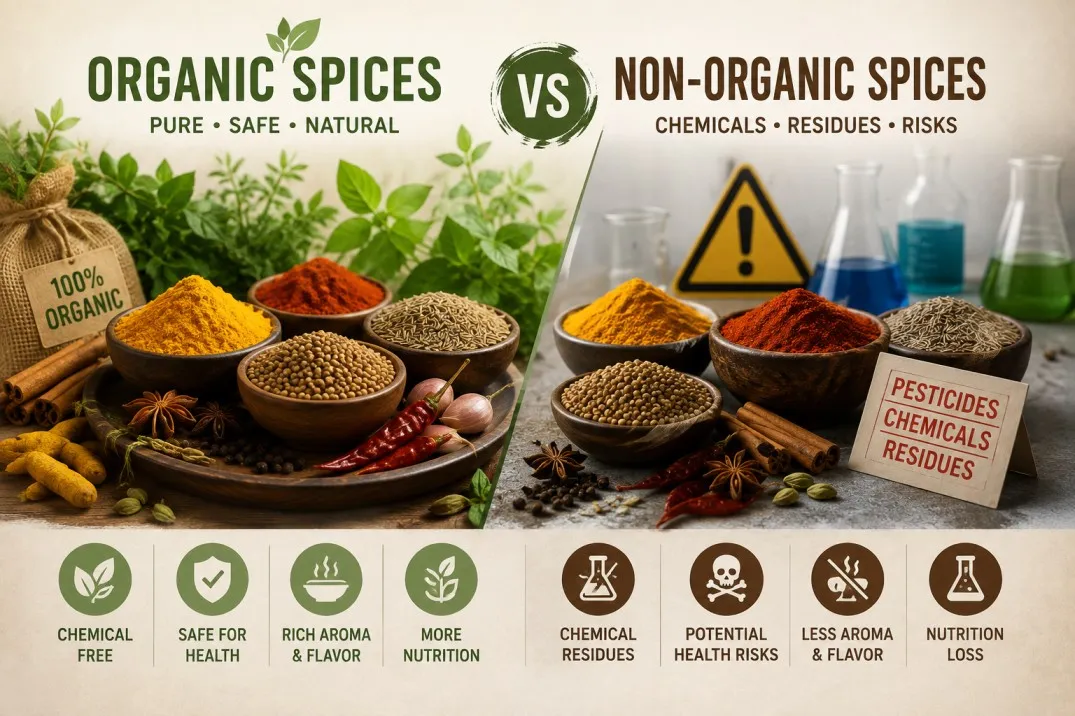
Farming method Organic spices — natural composting, crop rotation, zero synthetic chemicals. Non-organic spices — synthetic pesticides, chemical fertilizers, high-yield focused.
Chemical residues Organic spices — residue-free, verified through certification. Non-organic spices — potential pesticide and fumigant residues.
Flavour and aroma Organic spices — richer, more complex, higher essential oil content. Non-organic spices — often flat and faint, lower aromatic compounds.
Processing Organic spices — no irradiation, no chemical fumigation. Non-organic spices — commonly irradiated and chemically fumigated.
Nutritional value Organic spices — higher polyphenols, antioxidants, and active compounds. Non-organic spices — lower concentrations due to synthetic farming inputs.
Adulteration risk Organic spices — lower, due to strict certification and traceability. Non-organic spices — higher, less regulatory oversight in supply chains.
Environmental impact Organic spices — builds soil health, protects biodiversity and water. Non-organic spices — chemical runoff, soil degradation over time.
Making the Switch to Organic Spices
The good news is that switching to organic spices doesn't require changing how you cook. The recipes stay the same. The quantities stay roughly the same — sometimes even slightly less, because the flavour is stronger.
What changes is what you're bringing into your kitchen. Cleaner ingredients, more intense flavour, better nutrition, and the confidence that what you're feeding your family is genuinely free from chemical residues.
Start with the spices you use most — turmeric, cumin, coriander, chilli, garam masala. Replace them one by one as they run out. Within a few weeks, your kitchen will be completely organic — without a dramatic overhaul or a complicated transition.
Natureland Organics — Organic Spices You Can Actually Trust
If you're looking for certified organic spices that deliver on every front — flavour, purity, and genuine certification — Natureland Organics is a brand that gets it right.
Their range of organic spices is sourced from certified organic farms across India, processed without irradiation or chemical treatment, and packaged to preserve the natural essential oils that make spices worth using in the first place.
As one of India's trusted names in natural food products and organic products online, Natureland Organics brings the full range of everyday Indian spices — turmeric, cumin, coriander, black pepper, cardamom, and more — in certified organic form, delivered directly to your kitchen.
No mystery ingredients. No residues. No compromise on what goes into your food.
For anyone serious about clean cooking and honest ingredients, Natureland Organics is the straightforward answer to where you buy organic spices in India.
The Final Word
The difference between organic and non-organic spices isn't just a label. It's the entire journey from soil to shelf — the farming practices, the chemical exposure, the processing methods, the flavour compounds, and the nutritional value that either survives or gets stripped away along the way.
Spices are added to every meal, every day. If there's one place in your kitchen where going organic makes an undeniable difference — it's here.
Your food deserves real spices. Real spices start with organic farming.
