NVIDIA H100 GPU for AI, Deep Learning, and High-Performance Computing
Author : 10petabyte 10PB | Published On : 19 Oct 2026
Artificial intelligence, machine learning, and data-intensive applications are changing how businesses develop products, analyze information, and automate complex tasks. These technologies require computing infrastructure capable of processing enormous datasets and handling demanding workloads efficiently. Traditional computing resources can struggle with certain parallel-processing tasks, making specialized graphics processing units an important part of modern infrastructure.
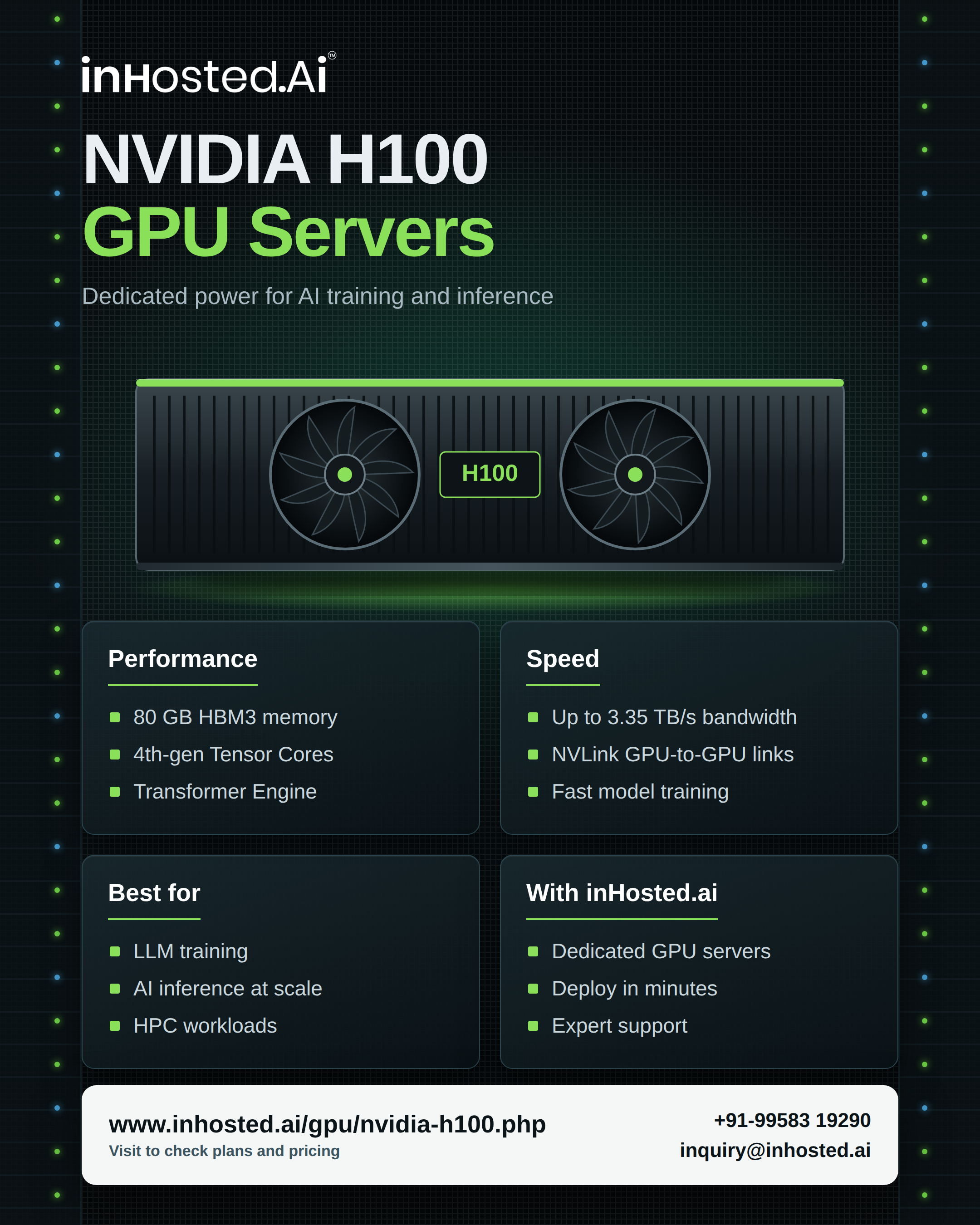
The NVIDIA H100 is designed to support demanding artificial intelligence and high-performance computing workloads. Built on NVIDIA's Hopper architecture, it provides specialized capabilities for AI training, inference, scientific computing, and other applications that benefit from accelerated processing.
For organizations exploring GPU infrastructure, understanding the H100's capabilities can help them choose resources that align with their technical requirements, budgets, and development goals.
What Is the NVIDIA H100 GPU?
The NVIDIA H100 is a data-center GPU developed for accelerated computing. Unlike a conventional CPU, which is optimized for a wide variety of general-purpose tasks, a GPU can execute many operations in parallel. This makes GPU computing particularly valuable for workloads involving matrix calculations, neural networks, simulations, and large-scale data processing.
The H100 incorporates Tensor Cores and other specialized technologies that support demanding AI and high-performance computing applications. These capabilities can help organizations process complex workloads more efficiently when their software is designed to take advantage of GPU acceleration.
Common applications include:
- Training large AI and machine learning models.
- Running deep learning experiments.
- Supporting generative AI applications.
- Processing large datasets.
- Performing scientific simulations.
- Developing advanced computer vision systems.
- Accelerating selected engineering and research workloads.
The actual performance depends on the GPU configuration, software framework, model architecture, workload, and overall system environment.
Why the NVIDIA H100 Matters for Artificial Intelligence
AI models often require substantial computing resources during both training and inference. Training involves processing data repeatedly to adjust model parameters, while inference uses a trained model to generate predictions or responses.
The H100 is designed to accelerate these demanding operations through specialized computing capabilities. Its Tensor Core technology supports the mathematical operations used extensively in deep learning, helping compatible workloads make more effective use of GPU resources.
For organizations developing large language models, recommendation systems, computer vision applications, and other AI solutions, this type of acceleration can be an important part of their infrastructure strategy.
However, a faster GPU alone does not guarantee faster results. Performance also depends on data preparation, memory requirements, model size, software optimization, and the way the workload is distributed across available resources.
Key Benefits of NVIDIA H100 Computing
1. Accelerated AI Training
Training advanced machine learning models involves repeated calculations across large datasets. GPU acceleration can reduce processing time for compatible workloads, allowing developers to experiment with models and evaluate different approaches more efficiently.
The benefits vary according to model design, batch size, precision settings, and the software stack being used.
2. Support for Generative AI
Generative AI systems can produce text, images, code, and other forms of content. Developing and operating these systems can require significant computing resources, particularly when working with large models.
The H100 provides capabilities intended to support demanding AI workloads, making it relevant for teams building generative AI products and services.
3. High-Performance Computing
GPU acceleration is useful beyond AI. Scientific research, numerical simulations, computational engineering, and other technical applications can benefit from parallel processing when the relevant software supports it.
Organizations can evaluate H100 infrastructure for workloads where GPU acceleration offers a measurable advantage over their existing computing environment.
4. Flexible Infrastructure Options
Businesses may access GPU computing through dedicated infrastructure, cloud-based environments, or other deployment models. The right option depends on utilization, security requirements, expected workload duration, and operational resources.
Cloud GPU infrastructure can be useful for teams that need access to specialized hardware without independently purchasing and maintaining an entire GPU server environment.
5. Support for Data-Intensive Workloads
Modern AI projects rely on data pipelines that prepare, transfer, and process information before it reaches a model. GPU performance must therefore be considered alongside storage throughput, system memory, networking, and CPU capacity.
A balanced infrastructure design helps reduce bottlenecks and ensures that the GPU can be used effectively.
NVIDIA H100 for Cloud GPU Infrastructure
Cloud GPU services provide access to specialized computing resources through a service arrangement rather than requiring every organization to own the physical hardware.
For development teams, this can simplify the process of testing AI workloads, deploying compatible applications, and scaling infrastructure according to project requirements. It can also provide flexibility when computing demand changes over time.
When evaluating an H100 cloud environment, consider the following factors:
- GPU availability: Confirm the specific GPU model and configuration offered.
- Memory requirements: Check whether available GPU memory meets the needs of your model and dataset.
- Storage performance: Ensure that datasets and checkpoints can be accessed efficiently.
- Networking: Evaluate network capacity for distributed training and data transfers.
- Software compatibility: Check support for your frameworks, libraries, drivers, and container environment.
- Security: Review access controls, data handling practices, and isolation options.
- Pricing: Understand billing units, minimum commitments, storage charges, and any additional service costs.
- Technical support: Determine what assistance is available for deployment and troubleshooting.
A detailed evaluation helps organizations identify whether an H100 environment is appropriate for their workloads rather than choosing infrastructure based on hardware specifications alone.
Who Can Benefit from NVIDIA H100 GPU Resources?
Several types of organizations may consider H100 infrastructure.
AI developers can evaluate it for training, fine-tuning, and deploying compatible machine learning models.
Research teams may use GPU acceleration for scientific computing, simulations, and computational experiments.
Technology companies can assess H100 resources when developing AI-powered products or processing demanding workloads.
Data science teams may benefit when their analytical models and processing pipelines are designed for GPU execution.
Enterprises exploring generative AI can investigate GPU infrastructure as part of a broader architecture that includes data governance, application security, monitoring, and deployment processes.
Not every project requires an H100. Smaller models, lighter inference workloads, and conventional applications may operate effectively on less powerful or less expensive resources. Selecting infrastructure according to actual workload requirements helps avoid unnecessary costs.
Best Practices for Using NVIDIA H100 Infrastructure
Getting useful results from GPU computing requires more than selecting suitable hardware.
First, benchmark the workload using representative data. This helps establish whether GPU acceleration improves performance compared with the existing environment.
Second, optimize the software stack. Compatible libraries, efficient data loading, appropriate numerical precision, and well-configured batch sizes can influence overall performance.
Third, monitor GPU utilization, memory consumption, temperature, and application throughput. These measurements can reveal whether the GPU is being used effectively or waiting for data from another component.
Fourth, consider the complete infrastructure. CPU performance, memory capacity, storage speed, and networking can affect how efficiently an AI application operates.
Finally, measure the cost of completing a workload, not just the hourly infrastructure rate. A more expensive GPU may still be suitable when it reduces processing time enough to improve overall project economics. This should be established through testing rather than assumed in advance.
Explore NVIDIA H100 GPU Solutions with InHosted.ai
Organizations looking for specialized GPU infrastructure can explore available configurations and compare them with their technical requirements. Before selecting a service, confirm the exact GPU model, memory capacity, availability, supported software, and pricing.
InHosted.ai provides a starting point for exploring GPU-related infrastructure options and understanding which resources may suit AI development and high-performance computing projects.
The most appropriate solution will depend on the workload, performance objectives, expected usage, and deployment requirements.
Frequently Asked Questions
What is the NVIDIA H100 used for?
The NVIDIA H100 is a data-center GPU designed for accelerated computing. Common use cases include AI model training, deep learning, generative AI, scientific computing, and other workloads that benefit from parallel processing.
Is the NVIDIA H100 suitable for generative AI?
It is designed to support demanding AI workloads, including applications involving generative AI. Actual performance depends on the model, software optimization, memory requirements, and deployment configuration.
Can businesses use the NVIDIA H100 through cloud infrastructure?
Yes, where providers offer compatible H100 resources. Businesses should verify GPU availability, configuration, software support, security features, and pricing before choosing a service.
Does every AI project need an NVIDIA H100?
No. The appropriate GPU depends on the model size, workload complexity, performance objectives, and budget. Smaller or less demanding projects may work well with alternative computing resources.
What should I check before choosing an H100 GPU service?
Review the GPU configuration, available memory, storage performance, network capacity, software compatibility, security measures, billing structure, and technical support. Benchmarking a representative workload can help validate the decision.
Conclusion
The NVIDIA H100 is an important option for organizations exploring accelerated AI and high-performance computing. Its specialized architecture and Tensor Core capabilities are designed to support demanding workloads, including deep learning, generative AI, and scientific applications.
To make the most of this technology, businesses should evaluate their workload requirements, optimize their software, and consider the entire computing environment rather than focusing on GPU specifications alone.
With careful planning and benchmarking, the right GPU infrastructure can help development teams build, test, and operate demanding applications more effectively.
