NVIDIA GPU Pricing: Compare GPU Options, Performance, and Costs
Author : 10petabyte 10PB | Published On : 18 Nov 2026
Graphics processing units have become essential components of modern computing infrastructure. Businesses, researchers, developers, and creative professionals use GPUs to accelerate artificial intelligence, machine learning, scientific calculations, rendering, and data-intensive applications.
As demand for accelerated computing increases, understanding nvidia gpu pricing becomes important for organizations planning their technology investments. Different GPU models offer different capabilities, memory configurations, and performance characteristics. The overall cost also depends on whether the hardware is purchased, rented, or accessed through a cloud computing service.
Choosing the right GPU involves more than finding the lowest advertised price. Users should evaluate the requirements of their applications, the amount of memory needed, software compatibility, and the total cost of completing their workloads.
This guide explains the main factors affecting NVIDIA GPU costs and offers practical considerations for selecting suitable GPU resources.
What Are NVIDIA GPUs Used For?
NVIDIA GPUs are widely used for applications that benefit from parallel processing. They can perform many calculations simultaneously, making them suitable for workloads that require substantial computational power.
Artificial Intelligence and Machine Learning
AI development often involves training models on large datasets and performing complex mathematical operations. GPUs can accelerate compatible workloads and help developers experiment with different models and configurations.
Organizations working with generative AI, computer vision, natural language processing, and predictive analytics may require GPU resources depending on their model size and performance goals.
Deep Learning
Deep learning models use neural networks to identify patterns in data. Training these models can require substantial computational resources, especially when datasets and model architectures become more complex.
The appropriate GPU depends on factors such as memory capacity, processing requirements, model size, and training duration.
Professional Graphics and Rendering
Designers, architects, engineers, and digital artists use GPUs for rendering, visualization, simulation, and other graphics-intensive applications.
Professional graphics cards and data center GPUs serve different purposes, so users should compare the specifications and software compatibility relevant to their particular applications.
Scientific Computing
Scientific research can involve complex simulations, numerical calculations, and large-scale data processing. GPU acceleration can improve performance for applications specifically designed to take advantage of parallel computing.
Researchers should evaluate their software requirements before selecting a GPU configuration.
What Factors Affect NVIDIA GPU Pricing?
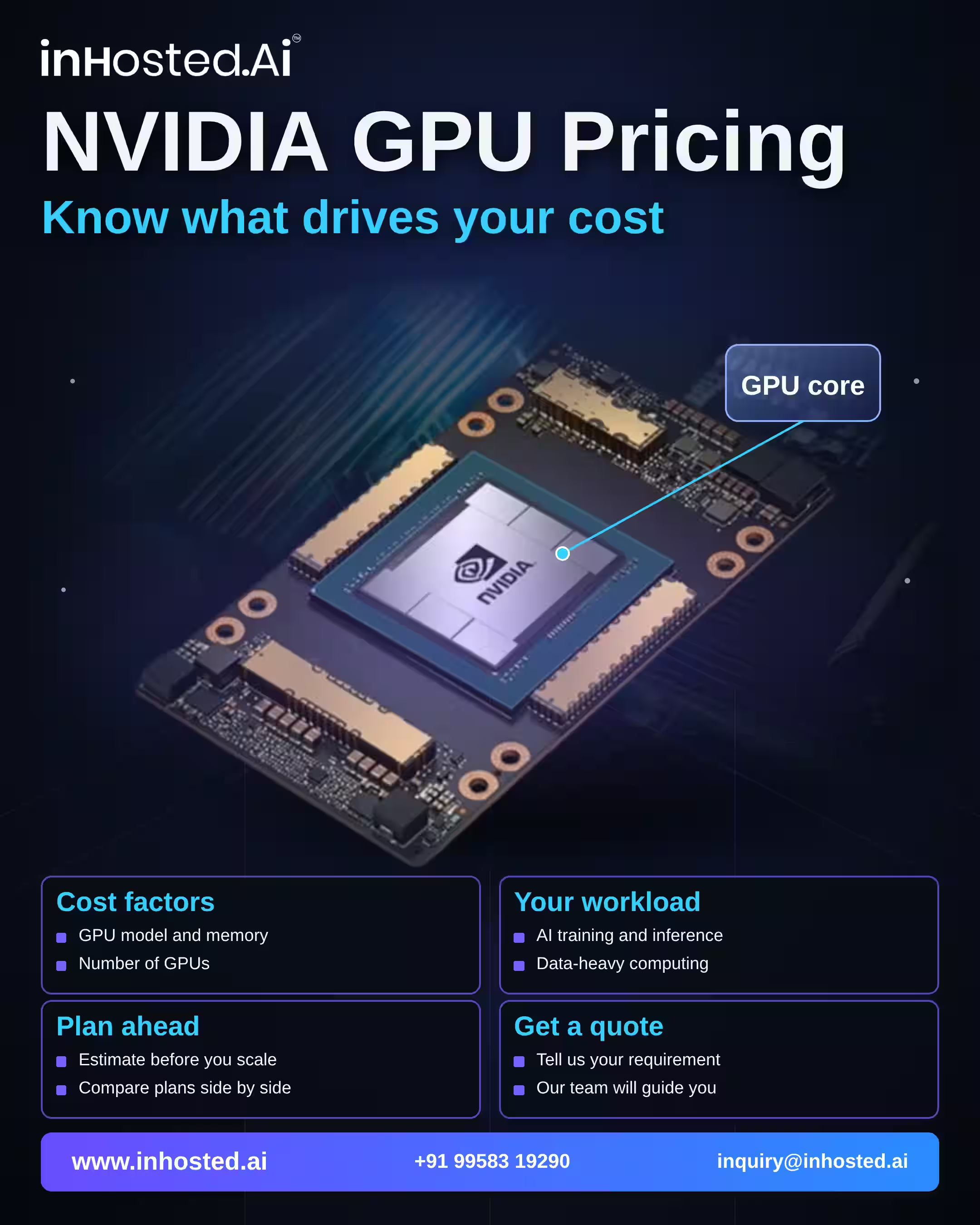
Several factors influence the price of NVIDIA GPU hardware and the cost of accessing GPU computing resources.
1. GPU Model and Architecture
Different GPU models are designed for different applications. Entry-level options, professional graphics cards, and data center GPUs have different performance characteristics and intended uses.
For example, the NVIDIA A100 is a data center GPU based on the Ampere architecture, while the H100 belongs to the Hopper generation. The RTX 6000 Ada is a professional GPU designed for graphics-intensive and compatible computing workloads.
These products should not be compared solely by their names or generation. Users should examine memory capacity, software support, performance, and workload suitability.
2. GPU Memory Capacity
GPU memory determines how much data and how many model parameters can be accommodated directly on the device.
Large AI models, complex rendering projects, and substantial datasets may require more GPU memory. Other applications may perform well with a smaller configuration.
Selecting a GPU with insufficient memory can limit the workloads that can run efficiently. However, purchasing more memory than the application requires may increase costs without providing meaningful benefits.
3. Hardware Configuration
The total cost of a computing system includes more than the GPU.
A complete GPU server may include processors, system RAM, storage, networking, power supplies, and cooling components. These supporting resources can influence both the purchase price and ongoing operating expenses.
When comparing quotations, make sure the specifications are equivalent. The price of an individual GPU should not be directly compared with that of a complete server or hosted computing instance.
4. Availability and Demand
GPU availability can vary by model, location, provider, and configuration. Market demand and hardware supply may also influence the prices offered by different vendors.
For this reason, older estimates may not reflect current market conditions. Always verify current pricing and availability before making a purchasing or rental decision.
5. Purchase Versus Rental
Buying a GPU requires an upfront investment. Depending on the deployment, additional expenses may include maintenance, electricity, cooling, and hardware replacement.
Renting GPU resources can offer an alternative for users who need accelerated computing for a limited period or have changing workloads.
The most economical option depends on usage duration, utilization, operational requirements, and the total cost over the expected service period.
Cloud GPU Computing Versus Buying Hardware
Organizations generally consider two broad approaches when accessing GPU computing: purchasing their own hardware or using hosted GPU resources.
Purchasing GPU Hardware
Buying hardware can be suitable for organizations with continuous workloads, predictable demand, and the infrastructure needed to maintain dedicated systems.
Ownership provides direct control over the hardware and its configuration. However, organizations must consider installation, maintenance, power consumption, cooling, and future upgrade requirements.
The initial purchase price is only one part of the total cost of ownership.
Renting GPU Resources
GPU rental services can provide access to computing resources without requiring users to purchase physical hardware.
This approach may suit startups, researchers, developers, and businesses that need GPU resources for experiments, short-term projects, or workloads with fluctuating demand.
Before renting, review the billing model, available GPU configurations, memory capacity, supporting resources, and service terms.
Which Option Is Better?
There is no single option that suits every organization.
Purchasing may be worth evaluating when GPU utilization is consistently high and the organization can manage the hardware efficiently. Renting may be more convenient when workloads are temporary or demand changes frequently.
Comparing the complete cost of each approach helps businesses make more informed decisions.
How to Choose the Right NVIDIA GPU
Selecting the right GPU begins with understanding the workload.
Identify your application: Determine whether you need GPU resources for AI training, inference, rendering, scientific computing, or another task.
Check memory requirements: Review the amount of GPU memory needed by your models, datasets, or applications.
Verify software compatibility: Confirm support for the required drivers, libraries, frameworks, and software versions.
Evaluate supporting hardware: Consider CPU performance, system RAM, storage, and networking requirements.
Estimate workload duration: Determine how long the GPU will be needed and whether the workload runs occasionally or continuously.
Compare performance: Where possible, benchmark your application on representative hardware before committing to a configuration.
Plan for future needs: Consider whether your workload may grow and whether you will need additional computing capacity later.
This process helps prevent overspending on unnecessary specifications or choosing hardware that cannot handle the intended application.
How to Estimate GPU Computing Costs
Understanding the billing structure is essential when evaluating GPU rental options.
For an hourly service, a basic calculation is:
Estimated GPU cost = Hourly rate × Hours used
For example, if a hypothetical GPU instance costs ₹150 per hour and is used for 40 hours, the estimated instance charge would be ₹6,000 before taxes and additional services.
This is an illustrative calculation, not a current NVIDIA GPU price quotation.
The final expense may also include storage, data transfer, supporting CPU resources, and other provider-specific charges. Users should check whether billing continues when an instance remains active but is not performing useful work.
It is also important to consider how quickly a GPU completes the task. A lower hourly rate may not produce a lower overall cost if the workload takes considerably longer to finish.
Testing the application before selecting a long-term configuration can provide a more reliable cost estimate.
Common Mistakes When Comparing GPU Prices
Businesses can avoid several common mistakes when evaluating GPU costs.
Focusing only on the initial price: Supporting infrastructure and operating expenses can significantly affect the overall investment.
Ignoring memory requirements: Insufficient GPU memory can prevent certain workloads from running efficiently.
Comparing different configurations: GPU-only prices, complete server prices, and cloud instance rates may cover different resources.
Overlooking software compatibility: A GPU must support the application's technical requirements to deliver useful results.
Ignoring usage duration: Rental costs depend on how long resources are used and how billing is calculated.
Choosing without testing: Benchmarks can help verify whether the selected GPU offers appropriate performance for the actual workload.
Considering these factors leads to better purchasing and deployment decisions.
Where to Find NVIDIA GPU Pricing Information
When researching nvidia gpu pricing, compare current provider offerings and examine the complete specifications of each option.
Check the GPU model, memory capacity, supporting hardware, availability, and pricing structure. For cloud computing services, confirm the billing unit and identify any additional charges that may apply.
You can review GPU pricing information and available computing options through the InHosted pricing page. Compare the available services with your application's requirements before selecting a configuration.
A careful evaluation can help developers, researchers, and businesses balance performance requirements with their budgets.
Conclusion
NVIDIA GPUs support a broad range of computing workloads, including artificial intelligence, machine learning, professional graphics, rendering, and scientific computing. However, different applications require different hardware configurations.
When comparing nvidia gpu pricing, evaluate the GPU model, memory capacity, software compatibility, supporting infrastructure, and expected usage. Consider both the initial investment and the cost of completing your workload.
Purchasing and renting each offer advantages under different circumstances. By comparing equivalent configurations and testing representative workloads, organizations can select GPU resources that suit their technical requirements and financial plans.
Frequently Asked Questions
1. What affects NVIDIA GPU pricing?
Pricing depends on the GPU model, architecture, memory capacity, availability, hardware configuration, and whether the GPU is purchased or rented.
2. Is renting a GPU cheaper than buying one?
Renting may be more economical for short-term or variable workloads, while purchasing may suit organizations with consistently high utilization. The best choice depends on the total cost and expected usage.
3. Which NVIDIA GPU is suitable for AI workloads?
The right GPU depends on model size, memory requirements, performance expectations, and software compatibility. Users should compare suitable data center and professional GPU configurations before choosing.
4. Why is GPU memory important?
GPU memory stores data and model parameters required during computation. Applications with large models or complex datasets may need higher memory capacity.
5. How can I calculate GPU rental expenses?
Multiply the hourly rate by the number of hours used, then account for taxes and any additional charges for storage, networking, or supporting resources.
6. Where can I check NVIDIA GPU pricing?
Review current pricing information from GPU hardware vendors and computing providers. Confirm the exact configuration, availability, billing terms, and included resources before committing.
