Navigating Agricultural Labor Crunch Through Collaborative Robotics
Author : Alex Turner | Published On : 19 Aug 2026
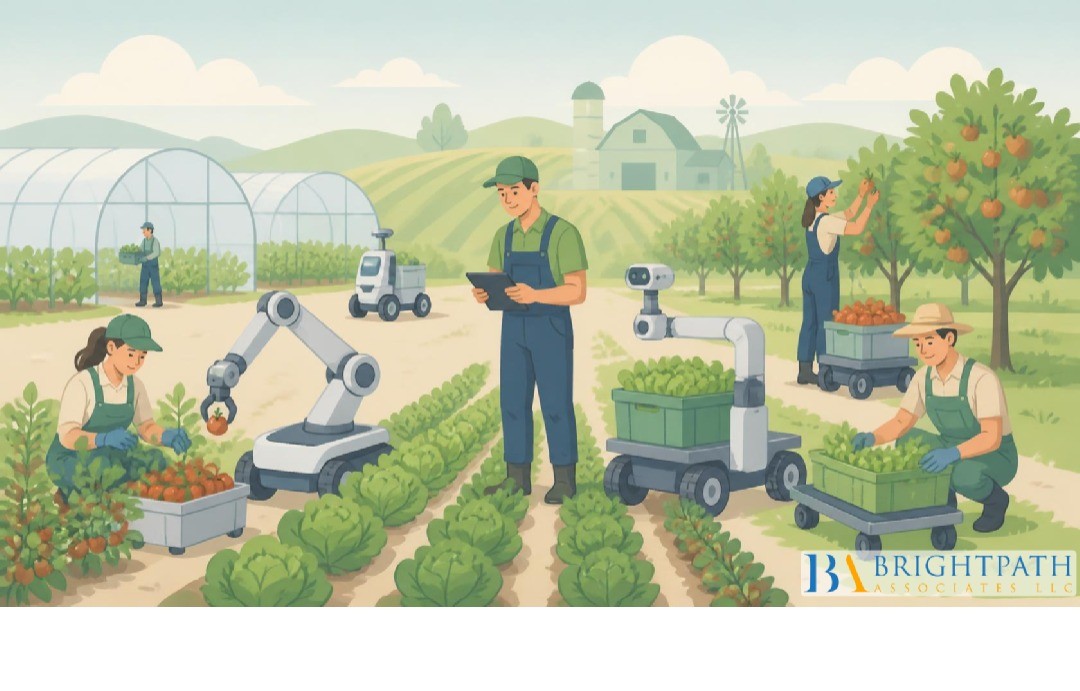
Agriculture has always depended on people. From planting and harvesting to sorting, packaging, equipment operation, and quality control, skilled workers remain essential to food production. Yet farming businesses across the United States are confronting a difficult reality: finding and retaining enough workers to support modern agricultural operations is becoming increasingly challenging.
For small and mid-sized agricultural enterprises, the labor shortage can be particularly disruptive. These businesses often operate with lean teams, limited financial resources, and narrow margins. When experienced employees are unavailable, owners and executives may find themselves balancing higher labor costs against production targets, quality requirements, and increasingly demanding customer expectations.
One technology is beginning to offer a practical part of the answer: collaborative robotics.
Rather than replacing entire agricultural workforces, collaborative robots can work alongside employees and take responsibility for repetitive, physically demanding, or highly consistent tasks. For organizations across the Farming Industry, this approach can provide a pathway toward greater productivity while allowing human workers to focus on activities requiring judgment, experience, and problem-solving.
The Agricultural Labor Challenge Is More Than a Hiring Problem
When agricultural companies experience labor shortages, the instinctive response is often to increase recruitment efforts. Hiring remains important, but recruitment alone may not solve the underlying operational challenge.
If a farm relies heavily on repetitive manual processes, simply hiring more people may provide only temporary relief. Employee turnover can create additional training costs, while physically demanding work can contribute to fatigue and retention problems.
This is why agricultural leaders are increasingly considering technology as part of their workforce strategy. The objective is not necessarily to reduce headcount. Instead, it is to increase the output and effectiveness of the people already working within the organization.
What Makes Collaborative Robotics Different?
Traditional industrial robots are often designed to operate in controlled environments, separated from human workers by safety barriers. Collaborative robots, commonly known as cobots, are designed to operate in environments where humans and machines can work in closer proximity under appropriate safety controls.
This distinction can be valuable for agricultural businesses. Farms and agricultural processing facilities frequently involve changing environments and tasks that cannot be completely standardized. A collaborative robot may be used for a specific repetitive activity while an employee performs the more variable portions of the workflow.
Where Cobots Can Create Value in Agriculture
Agricultural operations contain numerous tasks that are repetitive enough to benefit from automation. Depending on the operation, collaborative robots can support activities such as sorting, packing, palletizing, material handling, inspection, and repetitive processing tasks.
Consider a produce operation where workers repeatedly move containers from one location to another. A cobot could potentially handle a portion of the repetitive movement while employees concentrate on quality assessment, exception handling, and other tasks requiring human judgment.
This changes the role of the worker. Instead of spending an entire shift performing physically repetitive work, employees can supervise automated processes and focus on higher-value activities.
Automation Can Help Address the Productivity Gap
The value of collaborative robotics is not simply measured by the number of workers a company can replace. A more useful question is: How much more productive can the existing workforce become?
A single employee working with an appropriately configured robotic system may be able to accomplish more than an employee working entirely manually. This can become especially important during seasonal demand peaks.
Agricultural businesses often experience significant variations in workload. Hiring temporary labor at precisely the right time can be difficult, while excessive staffing during slower periods can create unnecessary costs. Automation can provide additional operational capacity that remains available across different demand cycles.
Building a More Resilient Agricultural Workforce
The future of farming will not be defined by humans versus machines. It will increasingly involve humans working with machines. The most successful agricultural businesses may be those that use robotics to eliminate repetitive bottlenecks while preserving human expertise for tasks requiring judgment, creativity, relationship management, and problem-solving.
BrightPath Associates' Navigating Agricultural Labor Crunch Through Collaborative Robotics explores how collaborative robotics can help agricultural businesses respond to workforce challenges while improving operational resilience.
Conclusion: Turning Labor Pressure Into an Innovation Opportunity
The agricultural labor crunch presents a serious challenge, but it also creates an opportunity to rethink how work gets done. Collaborative robotics can help small and mid-sized agricultural businesses increase productivity, reduce repetitive workloads, improve process consistency, and make better use of skilled employees.
The key is to approach automation strategically. Companies should identify the right processes, evaluate the economics, train their workforce, measure performance, and build leadership capabilities that support long-term technology adoption.
