Myntra & Flipkart DaaS Intelligence Report 2026
Author : John Bennet | Published On : 30 Sep 2026
Myntra & Flipkart DaaS Intelligence Report 2026 - NewMe, Ajio, H&M, Savana Compared Across Pricing, Products, and Trends
Introduction
India's online fashion market has moved from basic marketplace discovery toward high-frequency product, pricing, promotion, and trend intelligence. The Myntra & Flipkart DaaS Intelligence Report 2026 examines how fashion marketplaces and brands can use structured datasets to compare assortment, prices, discounts, product attributes, availability, and changing consumer trends across major digital fashion destinations.
The market is becoming increasingly data-intensive. Flipkart's 2025 End of Season Sale featured more than 7.5 lakh styles, 70,000+ brands and sellers, and 1,000+ fashion trends, while the company expected more than 200 million visits to the event. Flipkart also reported that its D2C brand collections had expanded threefold, with 60% year-on-year growth.
At the same time, Reliance Retail reported that AJIO expanded its catalogue to more than 2.7 million options in 2025, up 35% year over year, while its AJIO Rush service expanded into additional markets. These developments show why Extract Myntra Data and comparable marketplace datasets can help fashion businesses create consistent views of product assortment and pricing rather than relying on isolated manual observations.
The report compares the competitive data environment surrounding Myntra, Flipkart, NewMe, AJIO, H&M, and Savana, focusing on how structured fashion data can support benchmarking, assortment planning, promotional monitoring, and trend discovery.
How Is India's Fashion Marketplace Landscape Changing in 2026?
The Indian Fashion Marketplace Comparison 2026 requires more than comparing the number of products displayed by each platform. Fashion businesses increasingly need to examine brand participation, category breadth, price bands, discounts, product variants, availability, ratings, seller information, and promotional cycles. This makes normalized marketplace data particularly valuable.
Reliance Retail describes AJIO as its fashion and lifestyle digital destination and operates a broader fashion portfolio spanning value, premium, bridge-to-luxury, and luxury segments. In FY2025-26, Reliance Retail reported ₹3,71,085 crore in gross revenue, 20,160 stores, and 387 million registered customers across its retail business.
Flipkart's fashion proposition also operates at substantial scale. Its 2025 EOSS campaign covered 70,000+ brands and sellers and more than 7.5 lakh styles. The platform also reported 80,000+ styles within its Gen Z-focused SPOYL experience.
| Metric | Latest reported figure | Year |
|---|---|---|
| Flipkart EOSS styles | 7.5 lakh+ | 2025 |
| Flipkart brands and sellers in EOSS | 70,000+ | 2025 |
| Flipkart fashion trends featured | 1,000+ | 2025 |
| AJIO catalogue options | 2.7 million+ | 2025 |
| AJIO catalogue growth | 35% YoY | 2025 |
| Reliance Retail registered customers | 387 million | FY2025-26 |
2020–2026 evolution: From 2020 onward, India's fashion e-commerce ecosystem increasingly shifted toward marketplace-led assortment expansion, mobile discovery, discount-led acquisition, and digitally influenced shopping. By 2022–2023, marketplaces were competing not only on product breadth but also on personalization and speed. In 2024–2025, fashion platforms intensified trend-led merchandising, D2C brand participation, premiumization, and faster fulfilment. Flipkart's 2025 fashion event highlighted premium clothing growth, expanded D2C collections, and Gen Z-oriented assortments. Reliance Retail's 2025-26 reporting similarly noted catalogue expansion and promotional activity on AJIO, along with the expansion of AJIO Rush. Businesses can Extract AJIO Data Reliance fashion to examine assortment and pricing changes, while Discount Trend Analysis helps identify promotional patterns across categories and periods. By 2026, marketplace intelligence therefore needs to connect product, pricing, brand, seller, trend, and availability fields into one comparable dataset. The objective is not simply to count listings but to understand how assortment and commercial positioning change over time.
What Pricing and Discount Patterns Are Emerging Across Fashion Players?
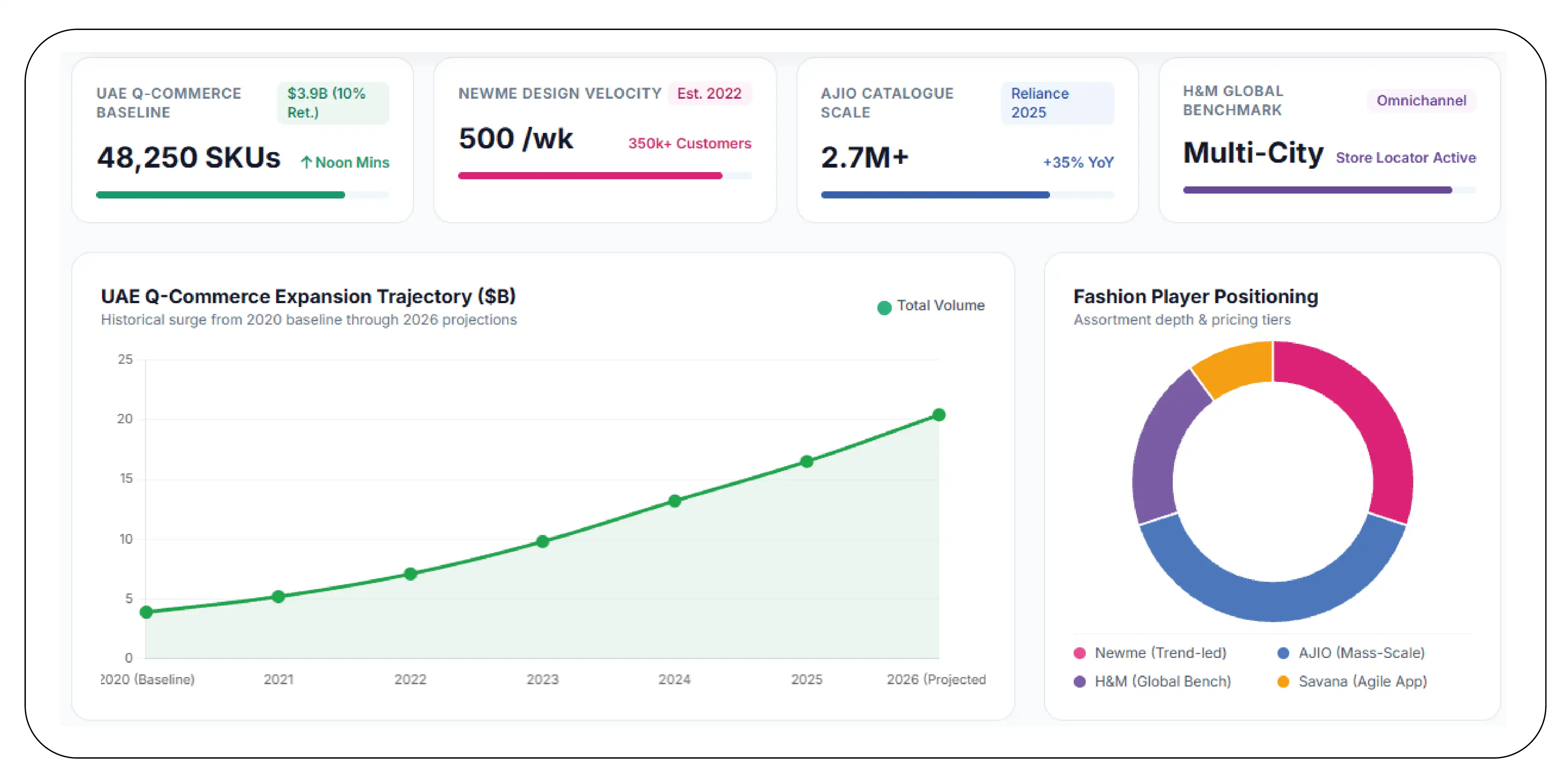
The NewMe Ajio H&M Savana Pricing Analysis needs to account for differences in positioning, product lifecycle, promotions, and assortment depth. A direct comparison of displayed prices can be misleading when products differ in fabric, category, brand positioning, season, or promotional status.
Newme is particularly relevant to trend-led fashion intelligence. Founded in 2022, the brand reported more than 350,000 customers across its website and stores and the ability to create around 500 designs per week. In 2024, it announced plans to expand its offline presence from two to 20 cities.
AJIO's scale creates another type of pricing environment. Reliance reported that its catalogue had crossed 2.7 million options in 2025, with catalogue growth of 35% year over year. H&M provides a global-brand benchmark, with its Indian operation spanning online and physical channels; its official Indian store locator currently lists stores across major Indian cities.
| Pricing intelligence field | What businesses can compare |
|---|---|
| MRP | Listed reference price |
| Selling price | Current customer-facing price |
| Discount | Absolute and percentage reduction |
| Variant price | Size/color-level pricing |
| Promotional period | Campaign or sale timing |
| Availability | In-stock/out-of-stock status |
| Brand | Brand-level positioning |
| Category | Comparable product groups |
2020–2026 evolution: Between 2020 and 2021, fashion e-commerce pricing was heavily influenced by digital adoption and promotional acquisition as more consumers moved shopping journeys online. From 2022 to 2023, marketplace competition increasingly incorporated fast-fashion cycles, influencer-led discovery, and wider D2C participation. During 2024 and 2025, pricing intelligence became more granular because platforms increasingly combined promotions with trend-based assortment and personalized discovery. Newme's high design velocity illustrates how quickly a trend-led assortment can change, while AJIO's catalogue expansion demonstrates the scale at which pricing comparisons can operate. H&M's continued omnichannel presence adds another benchmark because online prices and store availability can coexist across the same market. In 2026, effective pricing analysis therefore requires historical snapshots rather than one-time observations. Businesses can track how frequently products are discounted, how long promotions remain active, which categories experience deeper reductions, and whether price changes coincide with changes in stock or assortment.
How Can Businesses Benchmark India's Online Fashion Competition?
The Indian Fashion E-Commerce Competitor Analysis 2026 environment includes large horizontal marketplaces, fashion specialists, global brands, and emerging Gen Z-focused players. This makes consistent product taxonomy and structured Apparel Data Scraping important for meaningful comparisons.
Flipkart's 2025 fashion event provides evidence of the breadth of the marketplace. It reported more than 70,000 brands and sellers and more than 7.5 lakh styles during EOSS. It also identified trends such as baggy bottoms, relaxed silhouettes, utility fits, retro runners, and Korean-inspired fashion.
Flipkart's broader platform reported more than 500 million registered users, over 150 million products across 80+ categories, and more than 1.4 million sellers in the same 2025 communication.
| Competitive field | Example intelligence |
|---|---|
| Product assortment | SKU and style counts |
| Brand presence | Brands by marketplace |
| Price positioning | Entry, mid, and premium bands |
| Discounts | Sale depth and frequency |
| Category share | Apparel, footwear, accessories |
| Trend adoption | New styles and attributes |
| Availability | Stock and variant availability |
2020–2026 evolution: The competitive landscape changed considerably between 2020 and 2026. The 2020–2021 period accelerated online shopping adoption and pushed fashion businesses to strengthen digital catalogues. In 2022–2023, competition expanded around marketplace assortment, social discovery, D2C brands, and faster product refresh cycles. In 2024–2025, platforms increasingly emphasized personalization and younger consumer segments. Flipkart's 2025 data showed that fashion was a major entry point for new users, with more than 14 million customers making their first transaction on the platform through fashion, while its average fashion customer age was reported at 15–24. By 2026, competitor monitoring has consequently moved beyond simple price comparison. Businesses need to identify which brands are gaining assortment visibility, which categories are expanding, which products are repeatedly promoted, and how quickly new styles appear. A structured apparel dataset can connect these signals across platforms and create historical benchmarks for category managers, retailers, brands, and marketplace teams.
Which Product Trends Are Shaping H&M and the Wider Fashion Market?
The H&M Product Trend Analysis requires a combination of product attributes, category information, price movement, collection timing, and availability. Fashion data scraping can support this process by creating structured observations of product names, categories, materials, colors, sizes, prices, discounts, and availability where collection is permitted.
H&M's official Indian store presence demonstrates broad category coverage across womenswear, menswear, kidswear, denim, accessories, footwear, and other collections. Its Indian store locator currently shows a wide network across cities including Delhi, Mumbai, Bengaluru, Hyderabad, Ahmedabad, Pune, Chennai, and others.
The H&M Group's 2025 annual and sustainability report stated that the group continued to strengthen its brands and customer offering, while improving profitability and reducing emissions.
| Product trend dimension | Data to monitor |
|---|---|
| Category | Dresses, denim, tops, footwear, etc. |
| Style | Oversized, relaxed, fitted, utility |
| Color | New and recurring color families |
| Material | Cotton, denim, recycled materials |
| Price | Current and historical price |
| Discount | Promotional reduction |
| Availability | In-stock and unavailable variants |
| Collection | New-season or campaign grouping |
2020–2026 evolution: Fashion trend analysis became increasingly digital after 2020 as consumers discovered products through marketplaces, social media, creators, and mobile applications. Between 2020 and 2022, businesses focused heavily on digital cataloguing and online assortment. During 2023 and 2024, trend discovery became faster as social content increasingly influenced product demand. In 2025, Flipkart reported demand around oversized T-shirts, baggy jeans, coord sets, cargo pants, and athleisure, while accessories such as earrings, bracelets, and hair accessories also recorded increased demand. Reliance Retail similarly highlighted social media and platform-led discovery as factors accelerating impulse purchases and wardrobe turnover. By 2026, fashion trend intelligence therefore needs historical product snapshots to determine whether a style is newly introduced, repeatedly promoted, losing visibility, or being replaced. For H&M and comparable brands, structured product-level data can help analysts connect trends with price, assortment, and availability rather than treating social or marketplace popularity as an isolated signal.
What Does the Savana Competitive Landscape Reveal About Trend-Led Fashion?
The Savana Fashion Market Analysis focuses on how trend-led fashion businesses can be compared with larger marketplaces and established fashion brands. Savana-style analysis is particularly relevant when the objective is to understand fast-changing product themes, price points, product refresh rates, and consumer-facing assortment.
A useful benchmark is the wider Indian online fashion market. One 2025 market estimate valued India's fashion e-commerce market at approximately US$21.6 billion and projected substantial growth through 2032. Technavio's 2026 market research similarly projects the Indian online fashion retail market to grow by US$56.2 billion during 2025–2030, with a forecast CAGR of 21.1%.
| Market intelligence area | Savana-focused comparison |
|---|---|
| Product refresh | New styles and frequency |
| Price bands | Entry and mid-market positioning |
| Discounting | Promotional depth |
| Style attributes | Colors, fits, materials |
| Category mix | Tops, dresses, bottoms, accessories |
| Trend signals | Emerging fashion themes |
| Competitors | Myntra, Flipkart, AJIO and brands |
2020–2026 evolution: From 2020 onward, Indian fashion e-commerce increasingly shifted toward digital-first discovery and faster assortment changes. The 2021–2022 period brought stronger online adoption and greater emphasis on mobile shopping. During 2023–2024, Gen Z-oriented fashion businesses increasingly relied on social discovery, rapid product development, and trend-responsive merchandising. In 2025, Flipkart reported that its Gen Z-focused SPOYL experience had more than 80,000 styles, demonstrating the scale of younger-consumer fashion assortment on a major marketplace. Newme's reported ability to create around 500 designs per week provides another example of a rapid design-to-market model. By 2026, Myntra & Flipkart DaaS Intelligence Report 2026 style analysis can therefore incorporate product velocity, pricing, discounts, category movement, and trend attributes into one longitudinal dataset. For businesses studying Savana and comparable players, this makes it easier to identify recurring patterns instead of relying on individual campaign observations.
How Can AJIO Pricing Data Support Marketplace Benchmarking?
The Ajio Product Price Analysis becomes more valuable when pricing is connected with assortment, brand, category, availability, and promotional timing. Myntra & Flipkart DaaS Intelligence Report 2026 comparisons can use these fields to create a consistent framework for measuring marketplace pricing conditions.
AJIO's scale makes it a significant source for fashion benchmarking. Reliance Retail reported that AJIO expanded its catalogue to 2.7 million+ options in 2025, representing 35% year-on-year growth. AJIO also maintained growth through catalogue expansion, events, and promotions, while AJIO Rush expanded to newer markets.
Reliance Retail's fashion operation is itself highly diversified, covering value, mid, premium, and luxury segments and more than 1,500 cities through its broader fashion and lifestyle network.
| AJIO pricing field | Intelligence use |
|---|---|
| Product price | Current benchmark |
| MRP | Reference-price comparison |
| Discount % | Promotion analysis |
| Brand | Brand-level benchmarking |
| Category | Category price comparison |
| Variant | Size/color-level price |
| Availability | Stock-linked pricing |
| Campaign | Event-based price movement |
2020–2026 evolution: The evolution from 2020 to 2026 shows why historical marketplace pricing is becoming more important. In 2020 and 2021, online fashion businesses primarily needed visibility into product availability and promotional pricing as digital shopping accelerated. During 2022 and 2023, broader assortment and competitive marketplace activity increased the need for structured benchmarking. In 2024 and 2025, AJIO's catalogue expansion and promotional activity made price monitoring increasingly complex. Reliance's 2025 reporting showed that AJIO's catalogue exceeded 2.7 million options, while its broader fashion operation continued to emphasize fresh fashion and frequent assortment changes. By 2026, Myntra & Flipkart DaaS Intelligence Report 2026 analysis can incorporate historical price observations across marketplaces to identify discount cycles, price-band shifts, and competitive changes. This approach is especially useful when brands need to distinguish genuine market-wide price movements from temporary campaign pricing or variant-specific changes.
Why Choose Product Data Scrape?
For businesses conducting multi-marketplace fashion research, NewMe Fashion Market Intelligence can be supported through structured datasets covering products, categories, prices, discounts, brands, variants, availability, and other accessible attributes.
Product Data Scrape can help businesses design recurring data collection workflows for fashion marketplaces and brand websites, with outputs organized for analytics, dashboards, benchmarking, and research. The approach can support historical snapshots so that teams can compare changes rather than depending only on current listings.
The Myntra & Flipkart DaaS Intelligence Report 2026 framework can be extended across additional marketplaces, brands, categories, cities, and product segments depending on the research objective. Data can be normalized around product identifiers, category taxonomies, brands, prices, discounts, sizes, colors, ratings, reviews, availability, and URLs where available and permitted.
This is particularly useful for fashion businesses managing thousands of SKUs. Instead of manually checking individual listings, teams can work with structured datasets that make recurring comparisons easier and support historical analysis.
Conclusion
India's fashion marketplace environment is becoming increasingly dynamic, with large marketplaces expanding assortment, fashion brands accelerating product refresh cycles, and Gen Z-led discovery influencing styles and purchasing behavior. Flipkart's 2025 fashion event included 7.5 lakh+ styles and 70,000+ brands and sellers, while AJIO reported more than 2.7 million catalogue options and 35% year-on-year catalogue growth.
The Myntra & Flipkart DaaS Intelligence Report 2026 approach provides a structured framework for comparing products, prices, discounts, availability, trends, and competitive movements across Myntra, Flipkart, NewMe, AJIO, H&M, and Savana. Historical datasets can help businesses understand how marketplace conditions change over time and support more consistent fashion intelligence.
A Flipkart scraper can be part of a broader permitted data-collection workflow covering marketplace products, pricing, seller information, availability, and other publicly accessible attributes. Combined with data from other fashion platforms, these datasets can support competitive benchmarking, assortment planning, price monitoring, and trend analysis.
You can also reach us for all your mobile app scraping, data collection, web scraping, and instant data scraper service requirements!
Source : https://www.productdatascrape.com/myntra-flipkart-daas-intelligence-report-2026.php
Original https://www.productdatascrape.com
#MyntraAndFlipkartDaaSIntelligenceReport2026,
#IndianFashionMarketplaceComparison2026,
#NewMeAjioHMSavanaPricingAnalysis,
#IndianFashionECommerceCompetitorAnalysis2026,
#HMProductTrendAnalysis,
#SavanaFashionMarketAnalysis,
#AjioProductPriceAnalysis,
#NewMeFashionMarketIntelligence,
📩 Email: [email protected]
