Modular Processing Plants: Reducing Time-to-Market for Junior Miners
Author : Shawn Fisher | Published On : 13 Aug 2026
For junior mining companies, discovering a commercially viable mineral deposit is only the beginning. The real challenge often begins after exploration: how can a company move from a promising resource to an operating project without allowing lengthy construction schedules, capital constraints, and complex infrastructure requirements to delay development?
This question is becoming increasingly important across the Mining and Metals Industry. Junior miners frequently operate with smaller budgets and limited internal resources compared with major mining companies, making speed, flexibility, and capital discipline particularly important. Modular processing plants are emerging as one approach that can help smaller operators shorten development timelines while creating greater flexibility as projects evolve.
Why Time-to-Market Matters for Junior Mining Companies
Mining projects can take years to move from exploration to commercial production. Feasibility studies, permitting, engineering, financing, infrastructure development, equipment procurement, construction, commissioning, and workforce recruitment all need to align before revenue can begin.
For a junior mining company, every additional month before production can create financial pressure. Capital remains tied up while the organization continues to spend money on development, staffing, consulting, permitting, and other activities. Delays can also affect investor confidence and create uncertainty around project economics.
This makes project-development speed a strategic consideration rather than simply an engineering objective. Modular processing can help address part of this challenge by allowing processing infrastructure to be designed, manufactured, transported, assembled, and commissioned in a more structured manner than conventional site-built facilities.
What Makes Modular Processing Different?
Traditional processing plants are often constructed extensively on-site. This approach can involve significant civil works, equipment installation, fabrication, electrical integration, and commissioning activities at the mine location.
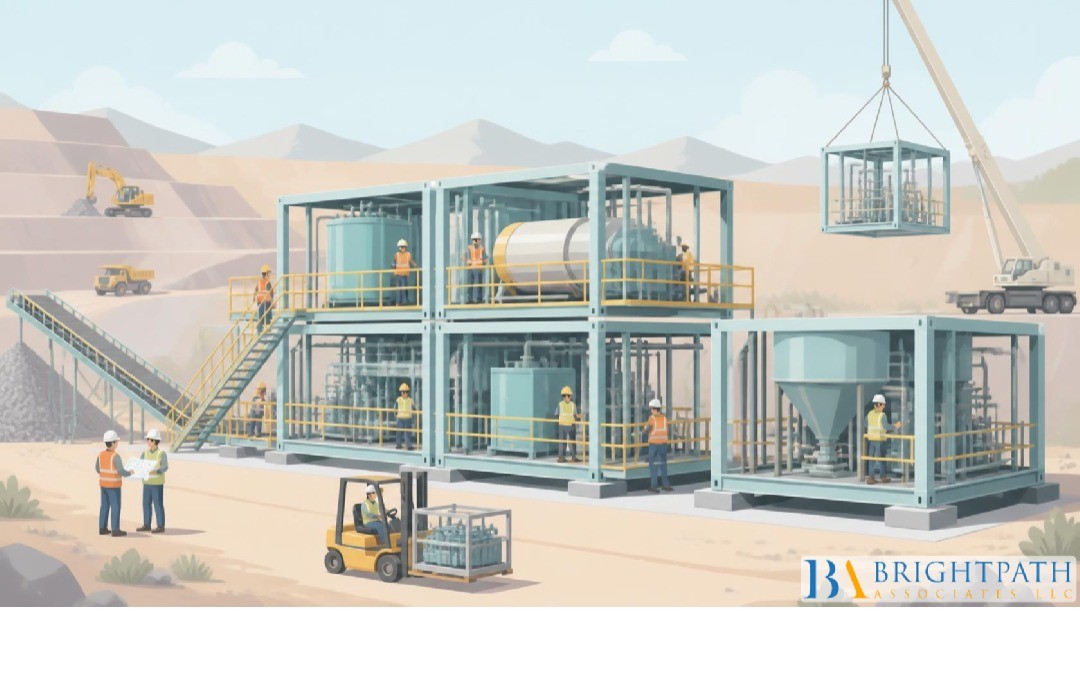
A modular approach shifts a greater portion of the work into controlled manufacturing or fabrication environments. Processing components can be designed as standardized or semi-customized modules before being transported to the project site.
The concept is particularly attractive for projects where speed and scalability are important. Instead of treating the processing facility as one enormous construction project, the plant can be viewed as a collection of interconnected systems that can be assembled according to the project's requirements.
Reducing Construction Uncertainty
One advantage of modularization is the potential to move more fabrication activity away from the mine site. Controlled manufacturing environments can provide greater consistency in fabrication, quality control, scheduling, and equipment integration.
Remote mining locations often present logistical difficulties. Weather, limited skilled labor availability, transportation challenges, and inadequate local infrastructure can complicate conventional construction.
By completing more work before modules reach the mine site, companies may be able to reduce the amount of specialized fabrication required in remote locations. For junior miners, this can be especially valuable because project delays can have a disproportionate impact on smaller balance sheets.
Modular Plants Can Support Phased Development
Mining projects rarely develop perfectly according to the original plan. Resource estimates can change, commodity prices fluctuate, metallurgical characteristics may evolve, and financing conditions can shift. A large permanent processing facility designed around initial assumptions may become difficult to adapt if the project's circumstances change.
Modular systems can provide greater flexibility for phased development. A junior miner may initially deploy a processing capacity appropriate for a smaller production target and later add capacity as the resource base, financing, or market conditions justify expansion. This approach can help align capital expenditure more closely with project development.
Engineering Must Begin With the Orebody
A modular processing plant cannot simply be selected from a catalog without considering the characteristics of the resource. Mineralogy, ore hardness, particle size, moisture, recovery requirements, throughput targets, contaminants, and desired concentrate specifications all influence processing design.
Metallurgical testing therefore remains critical. A modular plant needs to be designed around actual processing requirements rather than the assumption that standardized equipment will work for every deposit. The most successful modular projects are likely to combine standardized engineering principles with sufficient customization to accommodate the specific characteristics of the ore.
Modularization Requires Strong Project Leadership
The benefits of modular processing cannot be realized without effective project management. Engineering decisions, procurement schedules, fabrication, transportation, construction, commissioning, permitting, and workforce planning must remain coordinated.
This places significant responsibility on project executives and technical leaders. Junior miners may need experienced professionals who can operate across organizational boundaries and manage complex development programs with limited resources. Leaders must be comfortable balancing technical requirements with financial constraints and changing project conditions.
The original BrightPath article, Modular Processing Plants for Junior Miners, explores how modular approaches can help smaller mining companies think differently about project development, capital deployment, and the journey toward production.
Future of Faster Mining Project Development
For junior miners, speed-to-production can influence financing, investor confidence, revenue generation, and long-term competitiveness. Modular processing plants offer one potential pathway for improving development flexibility while reducing some of the complexities associated with conventional construction.
The real opportunity, however, is broader than modular equipment. Successful implementation requires metallurgical expertise, disciplined engineering, effective logistics, automation capabilities, project leadership, and specialized talent working together.
As mining projects become more technologically sophisticated and capital discipline becomes increasingly important, junior miners will need to rethink how they design and execute processing infrastructure. Modularization can provide flexibility, but its greatest value emerges when it is integrated into a broader project-development strategy.
