Missing Teeth? Understanding Your Dental Implant Options, Treatment Steps and Recovery
Author : Dr. ONKAR JABADE | Published On : 12 Aug 2026
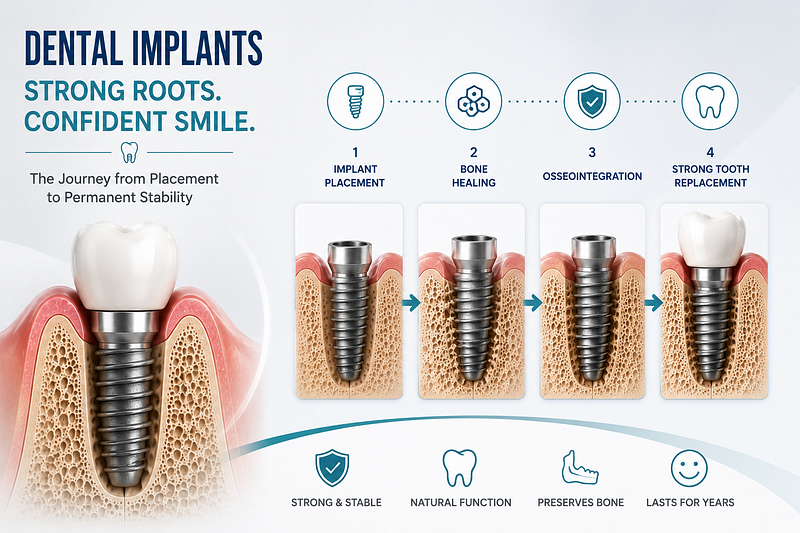
A missing tooth can affect everyday activities in ways that are easy to overlook. Eating may become uncomfortable, neighbouring teeth can be affected, and many people become less confident about smiling.
Dental implants are one option used to replace missing teeth with a fixed restoration. But before deciding on treatment, it is useful to understand what the procedure involves, how long healing can take, and what factors your dentist needs to evaluate.
For patients searching for dental implant treatment in Pune, the treatment journey generally begins with assessment and planning rather than surgery.
At Jabade Dental, Pune, Dr. Onkar Jabade has placed thousands of dental implants and provides implant treatment according to the individual needs of each patient.
How Does a Dental Implant Replace a Missing Tooth?
A natural tooth has two main visible and supporting components: the crown and the root.
When a tooth is lost, a dental implant can be used to replace the root portion. The implant is generally made from titanium and is placed within the jawbone.
After placement, the surrounding bone gradually integrates with the implant through a process called osseointegration.
Once healing is adequate, the implant can support an abutment and a dental crown or another type of restoration.
This approach provides a fixed foundation for replacing the missing tooth.
Step 1: Finding Out Whether an Implant Is Suitable
Not every missing tooth requires exactly the same treatment.
Your dentist first needs to understand your oral and general health.
During the consultation, the dentist may evaluate:
- The location and number of missing teeth
- Remaining teeth
- Gum condition
- Jawbone volume
- Bite and tooth alignment
- Previous dental treatment
- Medical history
- Current medications
- Lifestyle factors such as smoking
If problems such as active gum disease or infection are identified, they may need to be managed before implant treatment proceeds.
Step 2: Examining the Jawbone
The implant needs adequate support from the jawbone.
Dental X-rays can provide useful information, while three-dimensional imaging such as CBCT may be recommended for more detailed assessment.
Imaging can help the dentist understand:
- Bone height
- Bone width
- Bone density and anatomy
- Nerve position
- Sinus location
- Relationship with neighbouring teeth
This information is particularly useful when planning implants in areas with limited bone.
Step 3: Designing a Personalised Treatment Plan
After the examination, your dentist can determine how the treatment should be approached.
The plan may include:
- The number of implants
- Implant position
- Implant dimensions
- Type of restoration
- Tooth extraction
- Bone grafting
- Healing requirements
- Temporary replacement options
A single missing tooth may require a very different plan from a patient who has lost several teeth or needs full-mouth rehabilitation.
Step 4: Preparing the Treatment Area
Before implant placement, the treatment site needs to be suitable for surgery.
If the tooth is still present but cannot be restored, extraction may be required.
In selected situations, an implant may be placed immediately after extraction. However, this depends on factors such as the condition of the socket, available bone, surrounding tissues, and presence of infection.
If immediate placement is not appropriate, the dentist may recommend healing before implant surgery.
Step 5: Improving Bone Support When Necessary
Bone loss can occur after a tooth has been missing for a long time. Periodontal disease, trauma, or previous dental problems can also contribute to reduced bone volume.
When there is not enough bone to provide appropriate implant support, bone grafting may be recommended.
Bone grafting is not automatically required for every patient.
Your dentist can determine whether additional bone preparation is necessary after clinical examination and imaging.
Step 6: Placing the Implant
Once the treatment area is ready, the implant is positioned in the jawbone according to the planned location.
Local anaesthesia is generally used during implant surgery to keep the area numb.
The length of the appointment varies according to:
- Number of implants
- Implant location
- Bone condition
- Surgical complexity
- Additional procedures
After the implant has been placed, the next stage is healing.
Step 7: Allowing the Implant to Integrate
The implant cannot immediately be treated as a fully healed natural tooth.
The jawbone needs time to establish a stable biological connection with the implant surface.
This process is called osseointegration.
The duration can differ depending on:
- Bone quality
- Implant location
- General health
- Oral hygiene
- Smoking
- Medical conditions
- Bone grafting or other procedures
Several months may be required in many treatment situations.
Your dentist will assess the healing process before proceeding with the permanent restoration.
Step 8: Connecting the Restoration
After sufficient healing, the implant can be prepared to receive the final restoration.
An abutment may be attached to the implant. It acts as the connector between the implant and the crown.
The final crown is then designed according to the patient’s mouth, bite, tooth colour, shape, and surrounding teeth.
The goal is to create a restoration that is functional and blends naturally with the existing smile.
Can You Get a Temporary Tooth During Healing?
In appropriate cases, a temporary tooth or provisional restoration may be provided while the implant is healing.
However, this is not the same for every patient.
Factors such as implant stability, location, bite forces, and the type of treatment can determine whether a temporary restoration is suitable.
Your dentist will discuss the available option for your particular case.
What Does Dental Implant Recovery Feel Like?
The experience after implant surgery varies from patient to patient.
Because local anaesthesia is generally used during the procedure, the treatment area remains numb while the implant is placed.
Afterward, some temporary soreness, swelling, or tenderness can occur.
The extent of discomfort depends on the complexity of treatment and individual healing.
Your dental team can provide instructions regarding:
- Oral hygiene
- Diet
- Medication
- Physical activity
- Follow-up visits
- Protection of the surgical site
Following these instructions can help support recovery.
How Long Before the Final Tooth Is Ready?
The complete implant journey is usually longer than the surgical placement itself.
Healing and osseointegration are important parts of the process, and these biological stages take time.
A straightforward case may follow a different timeline from one involving:
- Bone grafting
- Tooth extraction
- Multiple implants
- Gum treatment
- Full-mouth rehabilitation
For this reason, treatment duration should be estimated after an individual examination rather than assuming one fixed timeline for every patient.
What Can Influence Implant Treatment Outcomes?
Several factors can affect the progress and long-term maintenance of dental implants.
Gum Health
Healthy supporting tissues are important. Existing gum disease may need appropriate treatment before implant placement.
Bone Condition
Adequate bone volume provides the foundation for implant placement. Bone grafting may sometimes be considered where required.
Oral Hygiene
Regular cleaning helps maintain the gums and tissues surrounding the implant.
General Health
Some medical conditions can affect healing. Patients should provide their dentist with an accurate medical history.
Smoking
Smoking can interfere with healing and may negatively affect implant-related outcomes.
Professional Planning
Correct assessment, implant positioning, surgical technique, and restoration planning all contribute to the treatment process.
Why Choose an Experienced Implantologist?
Dental implant treatment combines surgical and restorative procedures. Each case also has its own anatomical challenges.
An experienced implantologist can evaluate factors such as:
- Bone availability
- Implant position
- Gum condition
- Bite
- Number of missing teeth
- Restoration requirements
- Need for additional procedures
Dr. Onkar Jabade of Jabade Dental, Pune, has placed thousands of dental implants and has experience with different implant treatment requirements, including cases involving multiple missing teeth and full-mouth rehabilitation.
Dental Implant Options Based on Tooth Loss
The type of implant treatment depends on how many teeth are missing and the condition of the mouth.
Single-Tooth Replacement
A single implant can be used to support a crown when one tooth is missing.
Multiple Tooth Replacement
Several implants may be planned to support multiple replacement teeth.
Full-Mouth Dental Implants
Patients with extensive tooth loss may be assessed for implant-supported full-mouth rehabilitation.
All-on-4 Dental Implants
For selected patients requiring full-arch rehabilitation, an All-on-4 approach may be considered.
The most suitable option should be determined after evaluating bone, gums, anatomy, bite, and overall dental health.
Looking After Your Implant After Treatment
An implant still requires regular maintenance after the crown has been fitted.
Patients should maintain:
- Regular brushing
- Cleaning between teeth
- Good gum health
- Professional dental check-ups
- Recommended hygiene appointments
- Appropriate care of the crown
Avoiding habits that place excessive force on the restoration can also help protect it.
Although the implant itself cannot develop tooth decay, the tissues around it can still be affected by plaque and inflammation.
How Long Can Dental Implants Remain Functional?
Dental implants are intended to provide long-term tooth replacement.
Their longevity can be influenced by oral hygiene, gum health, smoking, general health, bite forces, implant position, and regular professional maintenance.
The implant may remain functional for many years, while the visible crown can experience normal wear and may eventually need repair or replacement.
Implant Dentistry at Jabade Dental, Pune
Jabade Dental provides dental implant treatment following individual assessment and treatment planning.
Dr. Onkar Jabade has placed thousands of dental implants and provides treatment options that may include:
- Dental implants
- Dental implant surgery
- Single-tooth implants
- Multiple dental implants
- Full-mouth dental implants
- All-on-4 dental implants
- Bone grafting for dental implants
The treatment recommended for each patient depends on their clinical findings and individual requirements.
Conclusion
Replacing a missing tooth with a dental implant involves several carefully considered stages.
The process can begin with a dental examination and imaging, followed by treatment planning, preparation of the site, implant placement, osseointegration, abutment placement, and final crown restoration.
Understanding these steps can help you prepare for a dental consultation and ask informed questions about your treatment.
If you are considering dental implants in Pune, a personalised assessment with an experienced implantologist can help you understand your available options, expected healing period, and long-term maintenance requirements.
Jabade Dental — Dr. Onkar Jabade
Law College Road, Pune
Dental Implants Pune | All-on-4 Dental Implants | Full Mouth Dental Implants
🌐 Website: https://jabadedentalpune.in/
📞 Phone: 9226525757
📍 Google Business Profile:
https://share.google/lnmEkfNkvyqknDYAu
https://share.google/xDmKgfyqK7ypnseRq
#DentalImplant #DentalImplants #DentalImplantSurgery #DentalImplantCost #DentalImplantNearMe #DentalImplantPune #DentalImplantSpecialist #FullMouthDentalImplants #AllOn4 #SameDayDentalImplants #ToothReplacement #Pune
