Military Vehicle Mount Antenna: HF, VHF and UHF Options
Author : Gurleen Nayar | Published On : 29 Oct 2026
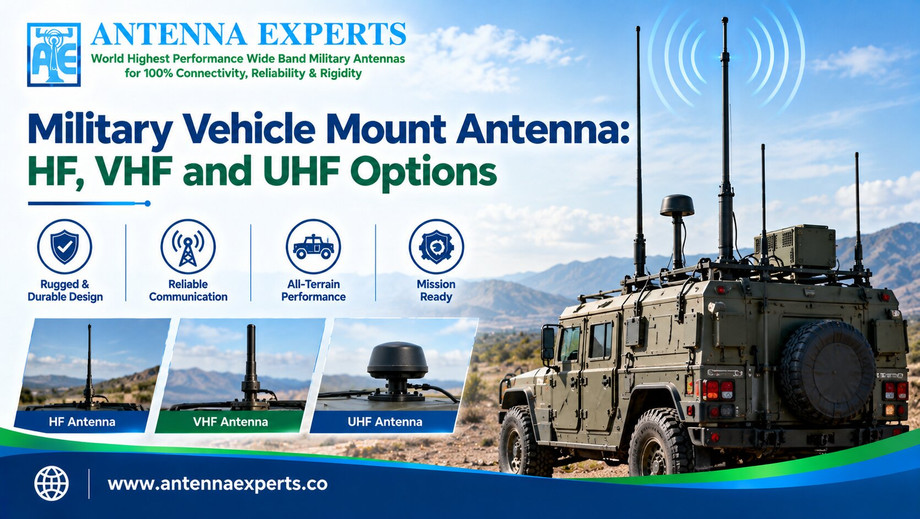
A military vehicle mount antenna is a radio antenna mounted to a combat, command or support vehicle that enables the crew to communicate either stationaryly or while in transit. It connects the radio of the vehicle to the outside world, and the distance and clarity of the transmission is a function of its design.
HF, VHF and UHF antennas work at different parts of the radio spectrum. HF is commonly used when longer range communication is required, while VHF and UHF are often selected for line of sight communication. The final choice depends on the radio system, required range, terrain, antenna size and vehicle installation.
In this article we take a look at the differences between the bands, the mounting of a Military Vehicle Mount Antenna and what to look for before you purchase one, using four models from Antenna Experts as examples.
What Is a Military Vehicle Mount Antenna?
All command posts, signal vehicles and supply columns are radio equipped and each needs a suitable antenna. A military vehicle antenna has to survive vibration, dust, rain, heat and rough ground while still operating on the right frequencies. A Tactical Antenna is also chosen with the vehicle profile in mind to clear branches and leave room for other roof equipment.
How Do HF, VHF and UHF Vehicle Antennas Differ?
HF or high frequency is from about 3 to 30 MHz. These signals can bounce off the upper atmosphere and allow communication over hundreds of kilometres without relay stations. Because HF wavelengths are longer, HF vehicular whip antenna are generally larger than antennas designed for VHF or UHF frequencies.
VHF ranges from about 30 to 300 MHz and mostly travels in line of sight. Hills and buildings can block it but it provides clear voice and data between vehicles within range. UHF, beginning at around 300 MHz. is also line of sight but uses shorter antennas which are easier to fit on a vehicle.
HF is generally selected when longer range communication is needed, while VHF and UHF antennas are commonly used for shorter range vehicle to vehicle or local communication. A broadband antenna can be useful when one vehicle needs to support multiple radio frequencies.
Which Vehicle Antenna Mounting Options Are Used?
Many models use a NATO 4 hole mount antenna, the antenna base being fixed to the vehicle by means of a fixed bolt layout. Before installation, check if the mounting pattern matches the vehicle bracket.
Military vehicles experience constant vibration and movement, especially over rough terrain. Some models use a spring base to help absorb shock and vibration during vehicle movement. Not every model includes a spring base, so check the product datasheet before selecting one.
The hardware is as important as the placement. A Vehicle Mount Antenna located near other roof equipment or large metal structures may not perform the same as a clear surface. When a radome is used, a UV resistant ABS radome protects the internal parts from sunlight and weather.
Which HF, VHF and UHF Antennas Fit Different Applications?
HFV-155 is a 5 m HF whip for 1.6–30 MHz. The HFV-155 is designed to work with an automatic antenna tuner for HF whips, which helps match the antenna to the radio across its operating range. The tuner is not included with the antenna and must be purchased separately.
The BVM-230 also covers HF, from 2 to 30 MHz, and requires no ground plane.
The BVM-118-400 covers bands of 118-400 MHz, spanning the upper VHF and part of UHF and is a Broadband Vehicle Antenna when one mount must serve several radios. The AVM-450 is narrower and covers 330 to 512 MHz with a gain of 3 dBi.
What Should Buyers Consider When Selecting a Tactical Vehicle Antenna?
- Frequency range: match the radio's band and not just the band family.
- Mounting arrangement: confirm the NATO hole pattern fits the vehicle bracket.
- Vehicle integration: check roof space, nearby equipment and cable runs.
- Antenna length: a 5 m whip changes clearance and travel profile.
- Tuner requirements: find out whether a tuner is needed and supplied.
- Operating environment: consider vibration, sun, dust and rain.
- Communication role: long-range HF, local VHF or UHF, or a mix.
Why Choose Antenna Experts?
Antenna Experts is an Indian Defense and Antenna Manufacturer, working with military and tactical antenna systems from HF to microwave frequencies. Its work includes custom antenna design, R&D, testing & OEM requirements. This range is useful for buyers looking for a defense antenna manufacturer in India when a standard model doesn’t quite fit the vehicle or radio. For those comparing the best antenna manufacturer in India, specifications can be discussed directly too.
Conclusion
The first thing you need to consider when choosing a vehicle antenna is what role it will play in communication. Select the band for the radio. Inspect the mounting pattern and shock absorption. Check length, tuner needs and environment. Following these checks in order helps you select an antenna that suits both the vehicle and its communication requirements.
Author Bio
Gurleen Nayar is a writer specializing in military vehicle mount, tactical and communication antenna systems, with experience in technical content and defence industry communications.
