Micro-Modular Fabrication: Scaling Operations without Massive Capex
Author : Shawn Fisher | Published On : 11 Aug 2026
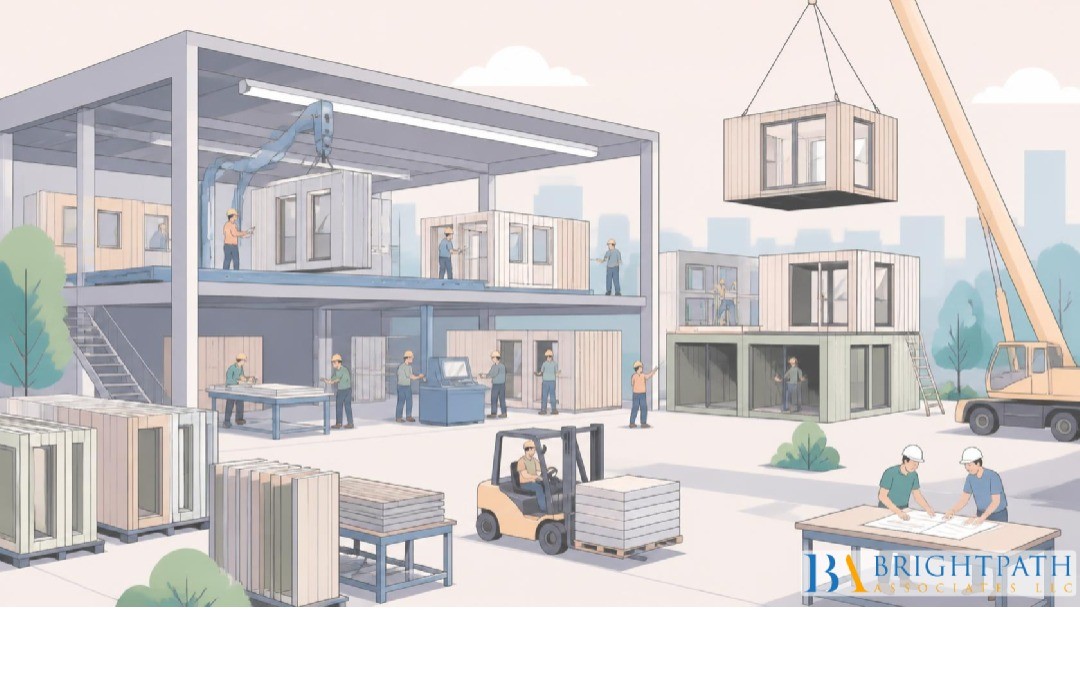
For many building materials manufacturers, growth has traditionally meant making a large capital investment. Companies forecast future demand, build or expand a major facility, purchase substantial equipment, and commit significant financial resources before the market has fully revealed what it will need. This approach can work when demand is highly predictable, but it can also expose small and mid-sized manufacturers to considerable financial and operational risk. Micro-modular fabrication offers a different path: instead of scaling through one massive investment, companies can expand production capacity through smaller, standardized, repeatable manufacturing units.
The basic idea is straightforward. A production system is divided into functional modules or manufacturing cells that can be deployed, replicated, and improved independently. Rather than constructing a facility designed around a distant five- or ten-year demand forecast, a company can establish an initial production cell, measure actual market performance, and add additional capacity when demand justifies the investment. This changes expansion from a major event into a more controlled and continuous process.
For companies operating in the Building Materials Industry, this approach can be particularly valuable. Construction markets can vary significantly by region, project type, interest rates, infrastructure spending, and local development activity. A manufacturer that commits too early to a large facility may find itself carrying excess capacity if demand changes. Micro-modular fabrication provides greater flexibility by allowing capacity to follow actual market signals.
The financial advantage is not limited to the initial capital expenditure. Large industrial projects consume significant amounts of management attention, require lengthy commissioning periods, and depend on assumptions about labor availability, logistics, energy prices, raw-material costs, and future customer demand. If any of those assumptions change, the economics of the investment can deteriorate. Smaller modules reduce the size of each individual bet and allow organizations to learn before committing additional resources.
This flexibility can also make geographic expansion more practical. Building materials often have relatively high transportation costs because many products are bulky or heavy compared with their selling price. A distributed network of smaller manufacturing facilities can potentially bring production closer to major demand centers. Instead of serving every customer from one distant plant, manufacturers can place selected capacity near regional construction markets. Shorter transportation distances may improve delivery reliability while reducing exposure to freight volatility.
Micro-modular production also creates opportunities to improve inventory management. Traditional manufacturing networks may maintain substantial inventory buffers because production and transportation systems cannot respond quickly to unexpected demand. If additional capacity can be introduced in smaller increments, businesses may be able to match production more closely with regional requirements. This can reduce the need to overproduce simply to protect against future uncertainty.
Another benefit is operational learning. A standardized manufacturing module can be designed with consistent processes, instrumentation, quality controls, and performance measurements. When a company builds a second or third module, it does not have to start from zero. Lessons learned from the first installation can be incorporated into the next one. Over time, the organization develops a repeatable operating model rather than accumulating isolated knowledge at individual facilities.
Micro-modular fabrication can also support innovation without placing the entire production network at risk. A company may want to experiment with a new material, recycled feedstock, product configuration, or manufacturing technique. Implementing that change across a massive continuous production line can be expensive and disruptive. A dedicated module can provide a controlled environment for testing and validation before the innovation is expanded more broadly.
Sustainability is another area where modularity can create strategic opportunities. A smaller, standardized production unit can be designed from the beginning around energy efficiency, waste reduction, water management, and material optimization. Companies can build sustainability requirements directly into the design instead of trying to retrofit them into an aging facility.
The same principle applies to circular materials. Building materials manufacturers are increasingly exploring recycled aggregates, recovered materials, alternative binders, reclaimed wood, and other circular inputs. These materials can sometimes introduce greater variability into production. A dedicated manufacturing module can be configured around specific feedstock characteristics and process parameters, allowing companies to experiment with circular inputs while protecting the consistency of established product lines.
However, distributed manufacturing introduces a new challenge: compliance. A single large facility may operate under one primary set of permits and regulatory relationships. Multiple smaller facilities can create a more complicated compliance environment involving local zoning, environmental requirements, workplace safety regulations, building codes, and product certification standards.
The solution is to treat compliance as part of the modular design rather than something addressed after installation. Companies can develop standardized documentation, safety procedures, environmental controls, equipment specifications, and quality systems that can be reused across deployments. The objective is to make a new module resemble a controlled replication rather than an entirely new industrial project.
Quality management becomes equally important. If customers purchase the same building material from two different production locations, they expect equivalent performance. Distributed manufacturing therefore requires strong traceability, calibration practices, operator training, process controls, and data management. Digital systems can help establish a common quality framework across locations.
The workforce challenge should not be underestimated. Micro-modular fabrication does not eliminate complexity; it distributes it. Instead of concentrating technical and operational expertise at one large facility, companies need capable leaders across multiple sites. Frontline managers must understand production, quality, safety, maintenance, workforce development, and local supplier relationships.
For small and mid-sized building materials companies, this creates an important strategic consideration. The transition to modular manufacturing should not be viewed simply as an equipment project. It is an operating-model transformation. The organization needs leaders who can establish repeatable processes, manage distributed teams, interpret operational data, and maintain consistency while allowing individual sites enough flexibility to respond to local conditions.
The original analysis, Micro-Modular Fabrication Without Massive Capex, explores these dynamics in greater detail, including the relationship between modular manufacturing, supply-chain resilience, sustainable construction, regulatory requirements, and talent strategy. Ultimately, micro-modular fabrication offers building materials manufacturers a way to rethink the relationship between growth and capital investment. Instead of making one enormous commitment based on uncertain future demand, companies can create capacity progressively, measure results, improve processes, and expand when market conditions justify the next investment.
The approach will not be appropriate for every product or operation. Some manufacturing processes benefit from significant economies of scale, and certain products may require large centralized facilities. But where standardized production cells are technically feasible, micro-modular fabrication can provide an attractive balance between scalability, flexibility, and financial discipline.
