Meesho Data Scraping API for Scalable Marketplace Analytics
Author : iweb0303 iweb0303 | Published On : 24 Nov 2026
Introduction
The rapid growth of social commerce and marketplace retail has created a huge demand for structured ecommerce intelligence. Sellers, brands, retailers, analysts, and marketplace strategists need accurate information about products, prices, sellers, ratings, availability, and category trends to make faster decisions. A Meesho Data Scraping API can help businesses collect and organize this information at scale for competitive analysis, pricing intelligence, catalog monitoring, and marketplace research.
A Meesho seller data extraction API enables businesses to capture seller-level information such as seller names, product counts, ratings, product categories, pricing patterns, and availability. Similarly, Meesho product data scraping can provide structured information about product titles, descriptions, images, specifications, ratings, reviews, discounts, and other marketplace attributes.
As Meesho continues expanding its marketplace ecosystem, accessing frequently updated ecommerce data can help organizations understand changing customer preferences and competitive movements. Instead of manually checking thousands of product pages, businesses can use automated extraction workflows to collect marketplace information in structured formats such as JSON, CSV, Excel, or database-ready records.
Why Meesho Marketplace Data Matters?
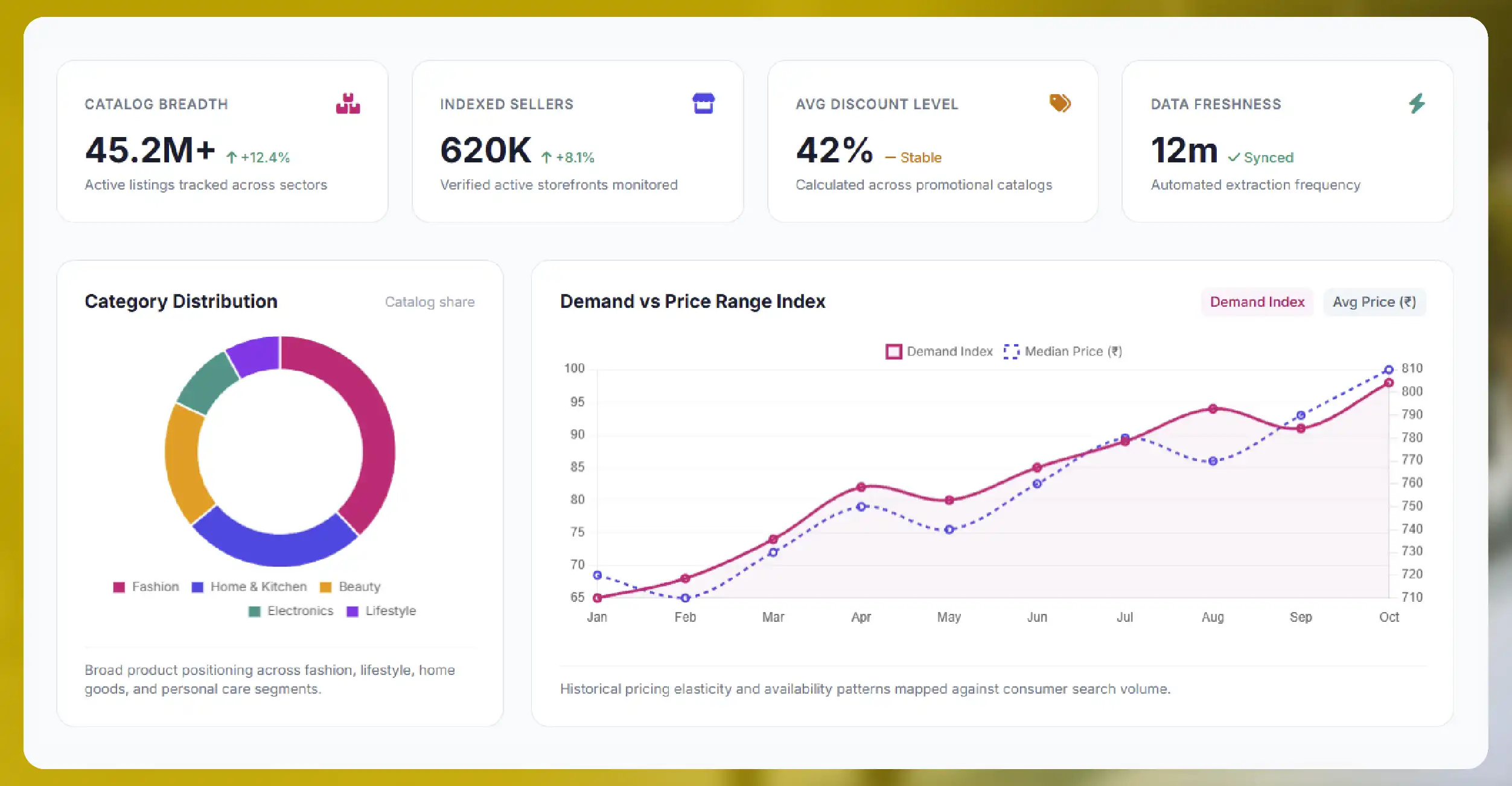
Meesho offers a broad selection of products across fashion, beauty, home and kitchen, electronics, accessories, personal care, lifestyle, and other categories. This breadth makes marketplace data valuable for businesses looking to understand product positioning and consumer demand.
For example, a retailer entering a new category can analyze competing products, price ranges, seller activity, ratings, and discount levels. A brand can monitor similar products and identify opportunities for catalog optimization. An analyst can study historical pricing and availability patterns to understand marketplace dynamics.
Automated data collection makes this process considerably more scalable. Instead of collecting information manually, businesses can establish scheduled extraction processes that continuously refresh datasets.
What Data Can Be Collected?
A well-designed marketplace extraction system can collect multiple data fields depending on business requirements.
| Data Category | Example Information |
|---|---|
| Product Information | Product title, description, category, specifications |
| Pricing | Current price, original price, discount, price changes |
| Seller Information | Seller name, rating, location, product availability |
| Inventory | Stock status, availability, variants |
| Reviews | Review count, rating, review trends |
| Product Images | Image URLs and gallery information |
| Marketplace Signals | Ranking, visibility, popularity indicators |
| Category Data | Subcategory, attributes, product classifications |
These datasets can then be standardized, deduplicated, enriched, and delivered through APIs or downloadable files.
Pricing Intelligence for Competitive Decisions
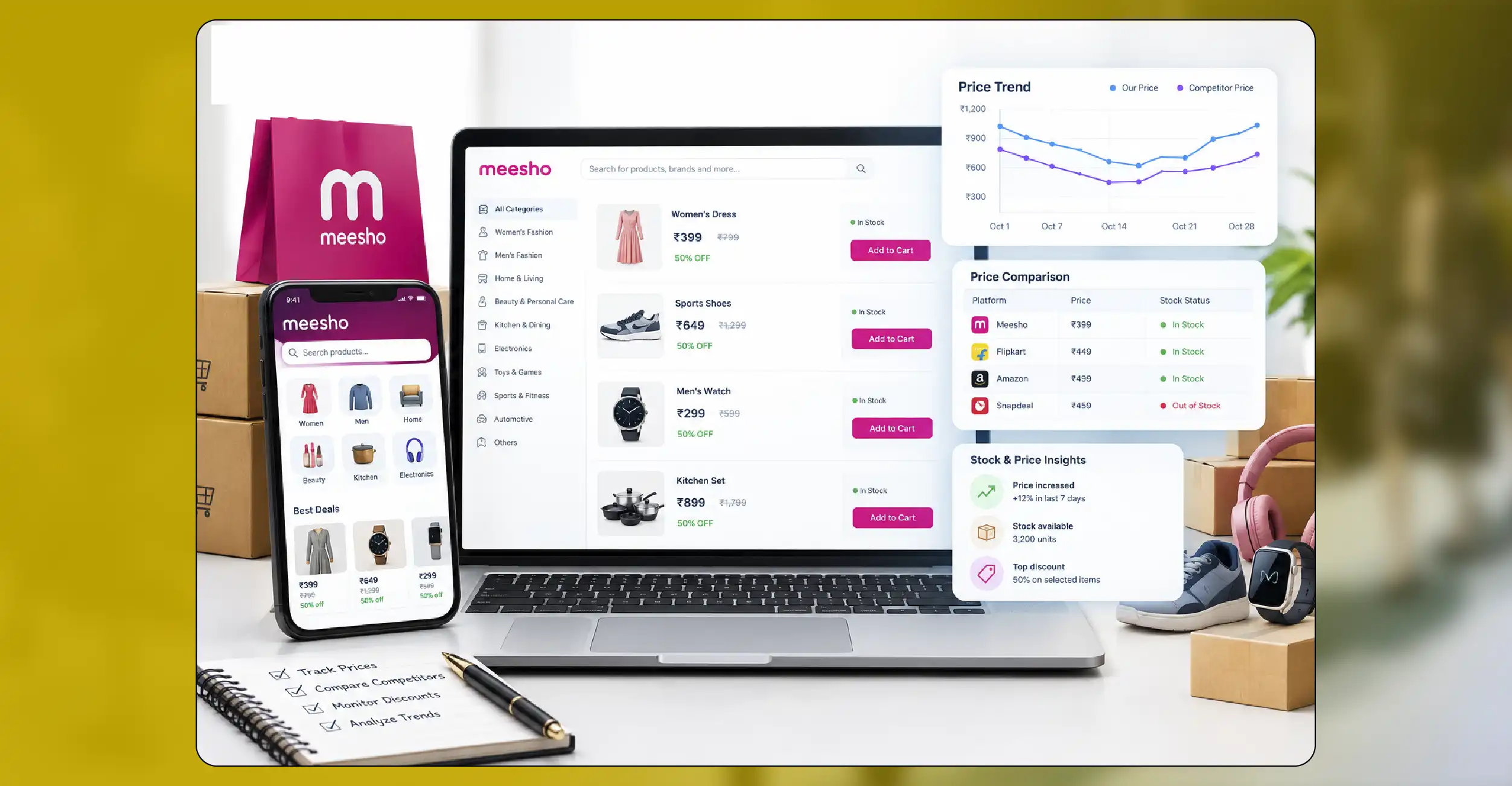
Price is one of the most important variables in ecommerce. Marketplace sellers constantly adjust pricing based on competition, demand, promotions, inventory, and market conditions.
A strategy to Extract Meesho price data API can support automated collection of product pricing information. Businesses can use this information to compare prices across competing products, identify discount patterns, monitor price changes, and develop pricing strategies.
For example, suppose a retailer tracks 10,000 products across multiple categories. Manual monitoring could require significant time and resources. Automated extraction can collect pricing information periodically and place it into a centralized dataset where analysts can compare products and identify meaningful changes.
A structured Meesho pricing and inventory data API can further connect price information with stock availability. This makes it possible to determine whether price changes coincide with inventory movements, product launches, promotions, or changes in competitive activity.
Seller Intelligence and Marketplace Research
Seller data provides another important layer of marketplace intelligence. Understanding which sellers are active in specific categories can help businesses evaluate competition and identify potential opportunities.
A Meesho ecommerce data extraction API can collect seller-level information alongside product information. Businesses can analyze the number of sellers operating within a category, their product assortment, pricing strategies, ratings, and catalog depth.
This information can support seller benchmarking and marketplace research. For example, a company may identify sellers with extensive catalogs in a particular category and analyze their product assortment to understand which products receive stronger visibility or customer engagement.
Seller intelligence can also help marketplace consultants and researchers identify market concentration, emerging competitors, and rapidly expanding catalogs.
Product Catalog Monitoring at Scale
Large ecommerce catalogs change constantly. New products can appear, existing products can disappear, prices can change, inventory can fluctuate, and product information can be updated.
A reliable extraction solution can help businesses maintain refreshed product datasets without repeatedly collecting information manually.
Businesses can monitor:
- New product listings
- Product availability
- Price changes
- Discount changes
- Seller changes
- Rating movements
- Review volumes
- Product category changes
- Variant availability
- Catalog expansion
This creates a continuously updated marketplace intelligence layer that can support dashboards, analytics systems, research reports, and business applications.
Marketplace Analytics and Business Intelligence
Data becomes significantly more valuable when it can be transformed into actionable insights. A Meesho API for marketplace analytics can provide structured information to analytics platforms, allowing businesses to build dashboards and automated reporting systems.
For instance, an analytics dashboard could display:
- Average category prices
- Top-selling product segments
- Seller distribution
- Discount ranges
- Product availability
- Rating distributions
- Price movement
- New product launches
- Category-level competition
Organizations can combine marketplace datasets with internal sales information, customer research, advertising data, or other ecommerce sources to develop a broader market intelligence framework.
Applications Across Ecommerce Businesses
Meesho marketplace data can support multiple business use cases.
Competitive Price Monitoring
Retailers and brands can compare their prices with competing marketplace products and identify areas where pricing may require adjustment.
Product Research
Entrepreneurs can analyze categories, product attributes, pricing levels, ratings, and seller activity before introducing new products.
Catalog Intelligence
Brands can track competing catalogs and understand how product assortments evolve over time.
Market Trend Analysis
Researchers can identify emerging product categories, changing price ranges, and shifts in seller participation.
Inventory Monitoring
Businesses can track availability signals to understand product supply conditions and identify frequently unavailable products.
Seller Benchmarking
Marketplace sellers can compare catalog size, ratings, pricing, and product positioning against competing sellers.
Building a Scalable Data Pipeline
A successful marketplace data project requires more than simply collecting web pages. The data pipeline should include extraction, validation, normalization, storage, monitoring, and delivery.
A typical workflow can include:
- Discovery: Identify product categories, sellers, search results, and relevant product pages.
- Extraction: Collect product, seller, pricing, inventory, rating, and review information.
- Normalization: Standardize fields, currencies, categories, product names, and seller information.
- Validation: Check records for missing, duplicate, or inconsistent values.
- Storage: Deliver information to databases, cloud storage, data warehouses, or business intelligence systems.
- Refresh: Schedule recurring collection based on the required data frequency.
This approach helps businesses transform raw marketplace information into reliable datasets that can be used for strategic decision-making.
Benefits of Automated Marketplace Data Collection
Automation can reduce repetitive manual research while improving the consistency of data collection. Instead of asking analysts to repeatedly inspect individual listings, organizations can establish structured extraction processes.
The resulting datasets can support faster competitor research, more frequent price monitoring, broader catalog analysis, and scalable marketplace intelligence.
For companies operating across multiple categories, automation also makes it easier to expand coverage. A workflow initially designed for one product category can potentially be extended to additional categories, sellers, or markets according to business requirements.
How iWeb Data Scraping Can Help You?
1. Scalable Product Intelligence
iWeb Data Scraping can collect structured product information across large marketplace catalogs, helping businesses monitor titles, categories, prices, ratings, sellers, specifications, and availability efficiently at scale.
2. Competitive Price Monitoring
Businesses can track marketplace pricing changes through automated datasets, enabling analysts to compare competitors, identify discount movements, evaluate pricing patterns, and respond quickly to market changes.
3. Seller and Catalog Analysis
iWeb can help organize seller-level information and product catalogs into structured datasets, supporting competitor benchmarking, assortment analysis, seller discovery, and category-level marketplace intelligence.
4. Customized Data Delivery
Collected marketplace information can be structured according to business requirements and delivered through APIs, CSV, JSON, Excel, or database-ready formats for seamless integration with analytics platforms.
5. Continuous Marketplace Monitoring
Scheduled data collection can help businesses maintain refreshed marketplace datasets, allowing them to identify product launches, price changes, inventory movements, seller activity, and evolving competitive trends.
Conclusion
Marketplace intelligence is becoming increasingly important as ecommerce competition grows and product catalogs become more dynamic. Businesses need timely information about products, sellers, prices, inventory, ratings, discounts, and categories to understand market movements and make informed decisions.
A structured data extraction solution can turn extensive marketplace information into usable datasets for pricing intelligence, competitive research, seller benchmarking, product discovery, and marketplace analytics. From tracking individual products to monitoring thousands of listings, automated extraction provides the scalability required for modern ecommerce research.
Businesses looking to implement Meesho Ecommerce Scraper 2026 strategies can use structured data pipelines to monitor marketplace activity more efficiently. Similarly, Meesho.com Product Data Scraping can support organizations seeking detailed product intelligence, competitive pricing insights, seller analysis, and catalog monitoring.
With the right extraction architecture, marketplace data can become more than a collection of product records—it can become a strategic intelligence resource for ecommerce growth.
