Long Range RFID Scanner Installation Guide: What Actually Matters During Setup
Author : Jaming Wong | Published On : 05 Aug 2026
Installing a long range RFID scanner looks simple from the outside. Mount the reader, connect the antenna, turn on the software, and start reading tags.
But in real projects, especially warehouses, production lines, and asset tracking systems, installation problems usually appear after everything is connected.
A reader may work perfectly on the test bench but fail when installed between metal shelves. The reading distance may drop from 15 meters to only 3 meters. Or the system may read tags from the wrong area and create duplicate data.
From our experience working with RFID applications, the installation location and antenna adjustment often decide whether a project succeeds or not.
This guide explains the practical points that RFID distributors, system integrators, and project engineers should check before deployment.
Before Installation: Understand Your RFID Reading Area
Before fixing any equipment, the first question should not be:
“How powerful is the RFID reader?”
The better question is:
“Where exactly do we want the RFID signal to cover?”
A long range RFID scanner is designed for specific reading zones. For example:
- Warehouse entrance tracking
- Tool cabinet management
- Production line monitoring
- Vehicle access control
- Pallet identification
Each application has a different reading environment.
A warehouse gate may require a wide reading area, while a smart cabinet needs a controlled reading zone to avoid detecting nearby items.
We have seen projects where customers selected a high-power reader but ignored antenna direction. The result was not better performance, but more unwanted reads.
Step 1: Select the Right Installation Location
The installation position is usually the first factor affecting RFID performance.
For fixed long range RFID scanners, avoid installing antennas:
- Behind large metal structures
- Close to electrical interference sources
- Facing each other directly
- Near moving metal equipment
Metal can reflect RFID signals and create unpredictable reading areas.
For example, when installing RFID antennas beside warehouse racks, the signal may bounce between metal surfaces. Sometimes this increases the reading range, but sometimes it creates blind spots.
A practical approach is to install the antenna temporarily first, test the actual reading performance, then complete the final mounting.
Step 2: Install and Adjust RFID Antennas Correctly
The antenna is often more important than the reader itself.
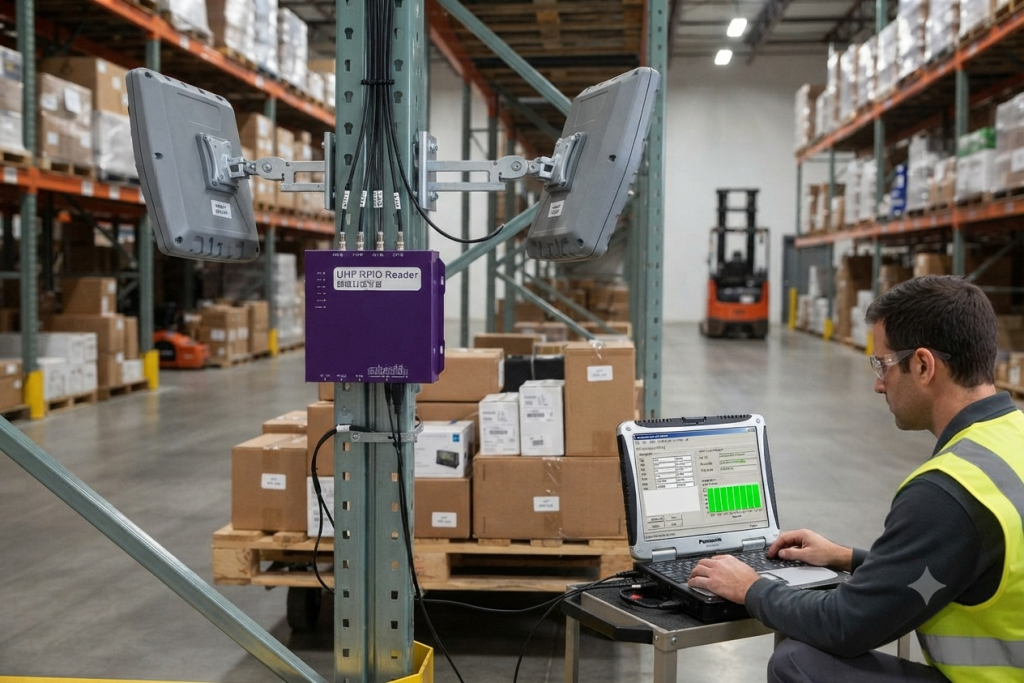
A long range RFID scanner normally includes:
- RFID reader module
- RFID antenna
- Connection cable
- Software system
The reader generates the RF signal, but the antenna decides where that energy goes.
For directional RFID antennas:
- Point the antenna toward the target reading area
- Keep the antenna angle stable
- Avoid unnecessary overlap between multiple antennas
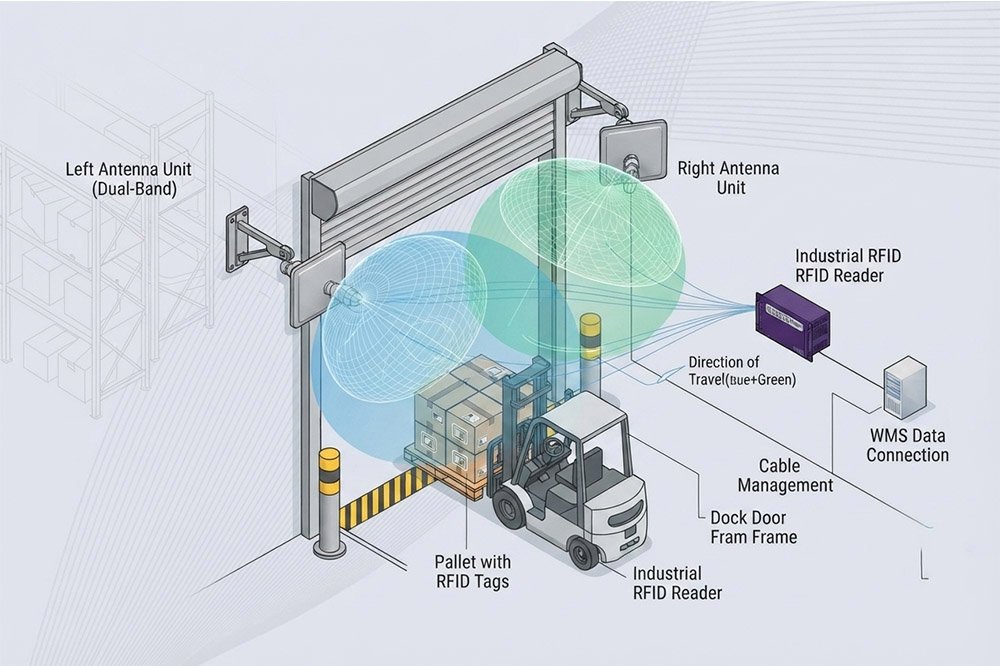
For example, in a warehouse doorway:
Wrong setup:
Two antennas facing each other directly.
Possible result:
Tags entering from outside may still be detected.
Better setup:
Place antennas at both sides of the gate and adjust their angles slightly toward the center area.
This creates a controlled reading zone.
Step 3: Pay Attention to Cable Installation
Many installation issues are caused by RFID antenna cables.
Long cable distance can reduce signal performance.
During installation:
- Keep antenna cables as short as possible
- Avoid sharp cable bending
- Keep cables away from strong electrical wires
- Use proper connectors
In industrial environments, cables are often exposed to vibration, dust, and temperature changes. A good installation should consider long-term reliability, not only initial testing.
Step 4: Configure RFID Reader Parameters
After hardware installation, software configuration becomes the next step.
Typical settings include:
Reading Power
Higher power does not always mean better performance.
Too much power may cause:
- Reading outside the target area
- More tag collision
- False identification
The best setting depends on the application.
Reading Mode
Different projects may require:
- Continuous scanning
- Trigger-based reading
- Inventory mode
- Fast moving tag detection
For example, a conveyor tracking system usually needs fast continuous reading, while an RFID tool cabinet may need accurate item identification after opening and closing.
Common Long Range RFID Scanner Installation Problems
Problem 1: RFID Reads Too Many Tags
This is one of the most common issues.
Possible causes:
- Antenna power too high
- Incorrect antenna direction
- Poor reading zone design
Solutions:
- Reduce transmit power
- Adjust antenna angle
- Use directional antennas
Problem 2: Reading Distance Is Short
Possible reasons:
- Wrong antenna selection
- Metal interference
- Poor tag placement
- Low-quality RFID tags
A long range RFID scanner cannot compensate for every installation problem.
For example, an ordinary RFID tag attached directly on a metal surface may have very poor performance unless a specially designed on-metal RFID tag is used.
Problem 3: Multiple RFID Readers Interfere With Each Other
Large projects often install many readers together.
If multiple readers operate nearby, they may affect each other.
Common solutions include:
- Reader scheduling
- Different frequency channels
- Proper antenna positioning
- Software filtering
This is especially important in warehouses with multiple RFID gates.

Installation Example: RFID Tool Management Cabinet
A smart tool cabinet is a good example of why installation design matters.
Inside the cabinet:
- RFID tags are attached to tools
- Reader antennas detect tools automatically
- Software records borrowing and returning
The challenge is not maximum distance.
The challenge is:
“How can the system only read the tools inside the cabinet?”
Usually, engineers reduce antenna power and design a controlled reading environment.
A shorter but accurate reading zone is often better than a very long range with incorrect data.
What RFID System Integrators Should Check Before Delivery
Before handing over a long range RFID system, we recommend checking:
✓ Actual reading distance
✓ Reading accuracy
✓ Wrong tag detection rate
✓ Performance with different tag positions
✓ Operation during peak working hours
✓ Communication stability with software
A successful RFID installation is not only about achieving the longest reading distance. It is about making the system predictable in daily operation.
Choosing Long Range RFID Scanner Supplier
For wholesalers and RFID solution providers, hardware quality is only one part of the project.
A reliable supplier should provide:
- Stable UHF RFID readers
- Different antenna options
- SDK/API support
- OEM customization
- Technical installation support
Many RFID projects require adjustment after installation, so working with a manufacturer who understands real applications can save significant time.
For bulk purchasing or customized RFID scanner projects, choosing an experienced long range RFID scanner supplier helps reduce installation risks and improve project success rates.
